Freshly Printed - allow 10 days lead
Couldn't load pickup availability
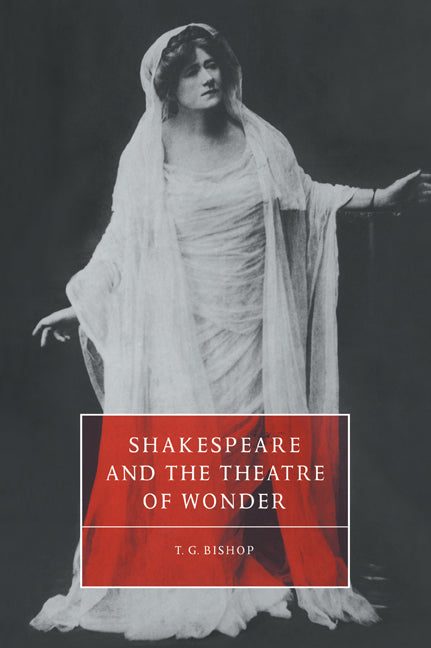
Shakespeare and the Theatre of Wonder
This study examines ways in which wonder has been used by classical and medieval playwrights, and by Shakespeare.
T. G. Bishop (Author)
9780521034920, Cambridge University Press
Paperback / softback, published 14 December 2006
240 pages
22.8 x 15.2 x 1.4 cm, 0.364 kg
"...Shakespeare and the theatre of wonder is an enlightening work, coupling impressive insight into the plays it analyzes with an infectious appreciation for the rich chemistry of those dynamic still points in which nothing but everything is happening." Thomas Moisan, Shakespeare Quarterly
Playwrights throughout history have used the emotion of wonder to explore the relation between feeling and knowing in the theatre. In Shakespeare and the Theatre of Wonder, T. G. Bishop argues that wonder provides a turbulent space, rich at once in emotion and self-consciousness, where the nature and value of knowing is brought into question. Bishop compares the treatment of wonder in classical philosophy and drama, and goes on to examine English cycle-plays, charting wonder's ambivalent relation to dogma and sacrament in the medieval religious theatre. Through extended readings of three of Shakespeare's plays - The Comedy of Errors, Pericles and The Winter's Tale - Bishop argues that Shakespeare uses wonder as a key component of his dialectic between affirmation and critique. Wonder is shown as vital to the characteristic self-consciousness of Shakespeare's plays as acts of narrative enquiry and renovation.
Acknowledgments
List of abbreviations
Introduction
1. Theory of wonder
theatre of wonder
2. Vision and vocation in the theatre of God
3. Compounding 'Errors'
4. Pericles
or, the past as fate and miracle
5. The Winter's Tale
or, filling up the graves
Conclusion
Notes
Bibliography
Index.
Subject Areas: Shakespeare studies & criticism [DSGS]