Freshly Printed - allow 10 days lead
Couldn't load pickup availability
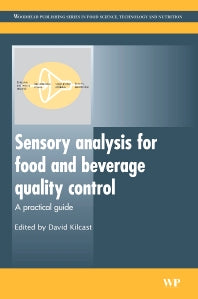
Sensory Analysis for Food and Beverage Quality Control
A Practical Guide
David Kilcast (Edited by)
9780081014677, Elsevier Science
Paperback, published 19 August 2016
400 pages
23.4 x 15.6 x 2.5 cm, 0.56 kg
"In my opinion this book fills a serious hole in commercial sensory literature. This is a comprehensive text on a crucial topic. I will certainly be using it in my courses." --Dr Hal MacFie, Hal MacFie Training Services, UK "The book more than lives up to its subtitle, in that it provides practioners in the food industry with the necessary background to establish and maintain a sensory quality control system." --Lebensmitteltechnik "I found this document to cetainly be one of the best, if not the best to date." --Food and Beverage Reporter
Producing products of reliable quality is vitally important to the food and beverage industry. In particular, companies often fail to ensure that the sensory quality of their products remains consistent, leading to the sale of goods which fail to meet the desired specifications or are rejected by the consumer. This book is a practical guide for all those tasked with using sensory analysis for quality control (QC) of food and beverages. Chapters in part one cover the key aspects to consider when designing a sensory QC program. The second part of the book focuses on methods for sensory QC and statistical data analysis. Establishing product sensory specifications and combining instrumental and sensory methods are also covered. The final part of the book reviews the use of sensory QC programs in the food and beverage industry. Chapters on sensory QC for taint prevention and the application of sensory techniques for shelf-life assessment are followed by contributions reviewing sensory QC programs for different products, including ready meals, wine and fish. A chapter on sensory QC of products such as textiles, cosmetics and cars completes the volume. Sensory analysis for food and beverage quality control is an essential reference for anyone setting up or operating a sensory QC program, or researching sensory QC.
Part 1 Designing a sensory quality control program 1. Designing a sensory quality control program 2. Selection and management of staff for sensory quality control 3. Proficiency testing of sensory panels Part 2 Methods for sensory quality control and analysis of results 4. Sensory methods for quality control 5. Establishing product sensory specifications 6. Combining instrumental and sensory methods in food quality control 7. Statistical approaches to sensory quality control Part 3 Sensory quality control in practice 8. Using sensory techniques for shelf-life assessment 9. Sensory quality control for taint prevention 10. Sensory quality definition of food ingredients 11. Sensory quality control in the chilled and frozen ready meal, soup and sauce sectors 12. Sensory quality control in the wine industry 13. Sensory quality control of distilled beverages 14. Sensory quality control of fresh produce 15. Sensory quality management of fish 16. Sensory quality control in food service 17. Sensory quality control of consumer goods other than food
Subject Areas: Food & beverage technology [TDCT]