Freshly Printed - allow 7 days lead
Couldn't load pickup availability
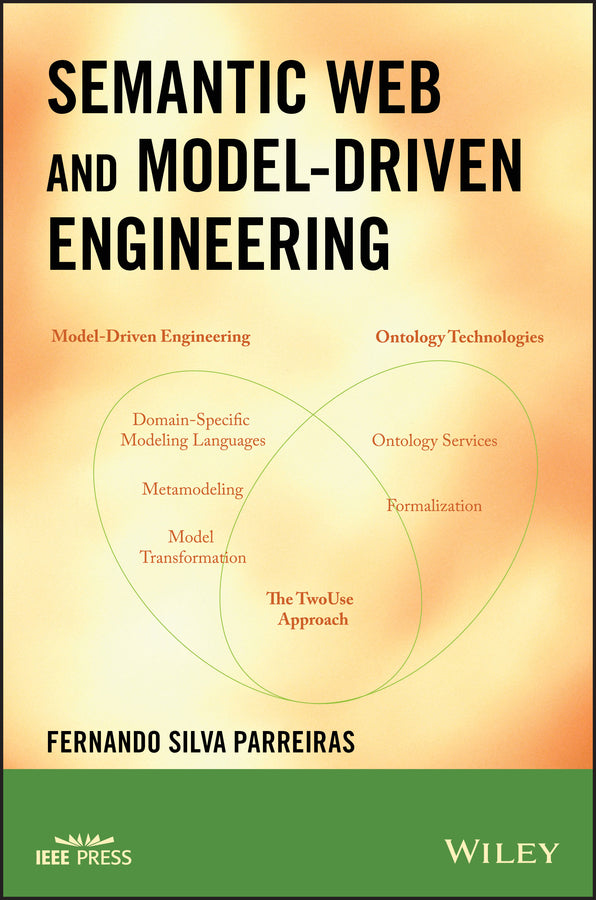
Semantic Web and Model-Driven Engineering
Fernando S. Parreiras (Author)
9781118004173, Wiley
Paperback / softback, published 15 June 2012
272 pages, Drawings: 50 B&W, 0 Color
23.4 x 15.5 x 2.3 cm, 0.454 kg
The next enterprise computing era will rely on the synergy between both technologies: semantic web and model-driven software development (MDSD). The semantic web organizes system knowledge in conceptual domains according to its meaning. It addresses various enterprise computing needs by identifying, abstracting and rationalizing commonalities, and checking for inconsistencies across system specifications. On the other side, model-driven software development is closing the gap among business requirements, designs and executables by using domain-specific languages with custom-built syntax and semantics. It focuses on using modeling languages as programming languages. Among many areas of application, we highlight the area of configuration management. Consider the example of a telecommunication company, where managing the multiple configurations of network devices (routers, hubs, modems, etc.) is crucial. Enterprise systems identify and document the functional and physical characteristics of network devices, and control changes to those characteristics. Applying the integration of semantic web and model-driven software development allows for (1) explicitly specifying configurations of network devices with tailor-made languages, (2) for checking the consistency of these specifications (3) for defining a vocabulary to share device specifications across enterprise systems. By managing configurations with consistent and explicit concepts, we reduce cost and risk, and enhance agility in response to new requirements in the telecommunication area. This book examines the synergy between semantic web and model-driven software development. It brings together advances from disciplines like ontologies, description logics, domain-specific modeling, model transformation and ontology engineering to take enterprise computing to the next level.
List of Figures xv List of Tables xix Foreword xxi Preface xxiii Acronyms xxvii Part I Fundamentals 1 Introduction 3 1.1 Motivation 3 1.2 Research Questions 5 2 Model-Driven Engineering Foundations 9 2.1 Introduction 9 2.2 Model-Driven Engineering Structure 9 2.2.1 Models 11 2.2.2 Metamodels 11 2.2.3 Modeling Languages 13 2.2.4 Model Transformations 17 2.2.5 Query Languages 17 2.3 Technical Spaces 19 2.4 Conclusion 20 3 Ontology Foundations 21 3.1 Introduction 21 3.2 Ontology 22 3.2.1 Ontology Modeling 22 3.3 The Ontology Web Language 24 3.3.1 OWL 2 Syntax 24 3.3.2 OWL 2 Semantics 27 3.3.3 World Assumption and Name Assumption 27 3.4 Ontology Services 31 3.4.1 Reasoning Services 31 3.4.2 Querying 31 3.5 Ontology Engineering Services 33 3.5.1 Explanation 33 3.5.2 Ontology Matching 34 3.6 Rules 34 3.7 Metamodels for Ontology Technologies 35 3.7.1 OWL Metamodels 35 3.7.2 SPARQL Metamodel 40 3.8 Ontological Technical Spaces 41 3.9 Conclusion 43 4 Marrying Ontology and Model-Driven Engineering 44 4.1 Introduction 44 4.2 Similarities between OWL Modeling and UML Class-Based Modeling 45 4.3 Commonalities and Variations 46 4.3.1 Language 47 4.3.2 Formalism 49 4.3.3 Data Model 49 4.3.4 Reasoning 50 4.3.5 Querying 51 4.3.6 Rules 51 4.3.7 Transformation 52 4.3.8 Mediation 52 4.3.9 Modeling Level 53 4.4 The State of the Art of Integrated Approaches 54 4.4.1 Model Validation 54 4.4.2 Model Enrichment 56 4.4.3 Ontology Modeling 58 4.5 Existing Work on Classifying Integrated Approaches 58 4.6 Conclusion 59 Conclusion of Part I Part II The TwoUse Approach 5 The TwoUse Conceptual Architecture 65 5.1 Introduction 65 5.2 Requirements for Integrating Ontology Technologies and Model-Driven Engineering 66 5.2.1 Usage of Ontology Services in MDE 66 5.2.2 Usage of MDE Techniques in OWL Ontology Engineering 67 5.3 Addressing the Requirements with the TwoUse Approach 68 5.4 Metamodeling Architecture 70 5.4.1 The TwoUse Metamodel 70 5.5 Syntax 72 5.5.1 UML Profile for OWL 72 5.5.2 Pure UML Class Diagrams 75 5.5.3 Textual Notation 75 5.6 Conclusion 77 6 Query Languages for Integrated Models 78 6.1 Introduction 78 6.2 Combining Existing Approaches 78 6.3 Querying Ontologies Using OWL Syntax: SPARQLAS 80 6.3.1 SPARQLAS Concrete Syntax 80 6.3.2 SPARQLAS Metamodel 81 6.3.3 Transformation from SPARQLAS to SPARQL 81 6.4 Querying Integrated Models: SPARQLAS4TwoUse 82 6.5 Conclusion 84 7 The TwoUse Toolkit 86 7.1 Introduction 86 7.2 Use Case Descriptions 87 7.3 A Generic Architecture for MDE and Ontology Engineering 87 7.3.1 Core Services 88 7.3.2 Engineering Services 89 7.3.3 Front-End 90 7.4 Instantiating the Generic Model-Driven Architecture: The TwoUse Toolkit 90 7.5 Conclusion 93 Conclusion of Part II Part III Applications in Model-Driven Engineering 8 Improving Software Design Patterns with Owl 99 8.1 Introduction 99 8.2 Case Study 100 8.2.1 Applying the Strategy Pattern 100 8.2.2 Extending to the Abstract Factory 101 8.2.3 Drawbacks 103 8.3 Application of the TwoUse Approach 104 8.3.1 OWL for Conceptual Modeling 104 8.3.2 TwoUse for Software Design Patterns: The Selector Pattern 105 8.4 Validation 109 8.4.1 Participants and Collaborations 109 8.4.2 Applicability 110 8.4.3 Drawbacks 110 8.4.4 Advantages 110 8.5 Related Work 111 8.6 Conclusion 111 9 Modeling Ontology-Based Information Systems 112 9.1 Introduction 112 9.2 Case Study 113 9.2.1 UML Class-Based Software Development 113 9.2.2 Ontology-Based Software Development 116 9.3 Application of the TwoUse Approach 117 9.3.1 Concrete Syntax 118 9.3.2 Abstract Syntax 119 9.3.3 Querying 121 9.4 Validation 121 9.4.1 Limitations 123 9.5 Conclusion 123 10 Enabling Linked Data Capabilities to MOF Compliant Models 124 10.1 Introduction 124 10.2 Case Study 125 10.2.1 Requirements 127 10.3 Application of the TwoUse Approach 128 10.3.1 Model Extension 128 10.3.2 Model Transformation 130 10.3.3 Matching 131 10.3.4 Querying with SPARQLAS 131 10.4 Validation 132 10.4.1 Limitations 134 10.5 Related Work 134 10.6 Conclusion 135 Conclusion of Part III Part IV Applications in the Semantic Web 11 Model-Driven Specification of Ontology Translations 141 11.1 Introduction 141 11.2 Case Study 142 11.3 Application of the TwoUse Approach 145 11.3.1 Concrete Syntax 145 11.3.2 Metamodels 146 11.3.3 Model Libraries 148 11.3.4 Semantics 148 11.3.5 Ontology Translation Process 148 11.3.6 Implementation 149 11.4 Examples 150 11.5 Analysis 153 11.6 Related Work 154 11.7 Conclusion 155 12 Automatic Generation of OntologyAPIs156 12.1 Introduction 156 12.2 Case Study 158 12.3 Application of the TwoUse Approach 161 12.3.1 Key Domain Concepts 161 12.3.2 agogo Concrete Syntax by Example 163 12.3.3 Implementation 166 12.4 Analysis 167 12.5 Related Work 169 12.6 Conclusion 170 13 Using Templates in Owl Ontologies 171 13.1 Introduction 171 13.2 Case Study 172 13.3 Application of the TwoUse Approach 174 13.3.1 Extending the OWL Metamodel with Templates 174 13.3.2 Semantics of Templates 177 13.3.3 Notations for Templates in OWL 179 13.3.4 Query Templates 180 13.4 Analysis 181 13.4.1 Limitations 182 13.5 Related Work 182 13.6 Conclusion 183 Conclusion of Part IV 14 Conclusion 187 14.1 Contributions 187 14.2 Outlook 189 14.2.1 Ongoing Research 189 Appendix A 191 A.1 EBNF Defi nition of the Concrete Textual Syntax for TwoUse 191 A.2 EBNF Grammar of SPARQLAS Functional Syntax 192 A.3 EBNF Grammar of SPARQLAS Manchester Syntax 197 A.4 SPARQLAS Metamodel 202 A.5 Ecore to OWL: Translation Rules 204 Appendix B206 B.1 Use Cases 206 B.1.1 Design Integrated Models 206 B.1.2 Design Integrated UML Class Diagram 206 B.1.3 Design Integrated Ecore Model 207 B.1.4 Specify SPARQLAS4TwoUse Query Operations 207 B.1.5 Transform to OWL 207 B.1.6 Compute Alignments 208 B.1.7 Browse 208 B.1.8 Explain Axioms 209 B.1.9 Query UML Class-Based Models 209 B.1.10 Query OWL Ontologies 209 B.1.11 Design Ontology Engineering Services 209 B.1.12 Design Ontology API 210 B.1.13 Design Ontology Translation 210 B.1.14 Design Ontology Template 210 B.1.15 Generate Service 211 B.2 Connecting Use Cases with Requirements 211 References 212 Index 226
Subject Areas: Electronics & communications engineering [TJ]