Freshly Printed - allow 10 days lead
Couldn't load pickup availability
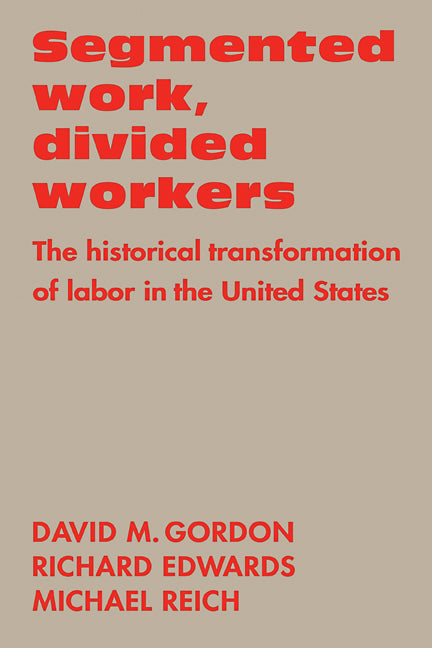
Segmented Work, Divided Workers
The historical transformation of labor in the United States
Segmented Work, Divided Workers presents a restatement and expansion of the theory of labor segmentation by three of its founding scholars.
David M. Gordon (Author), Richard Edwards (Author), Michael Reich (Author)
9780521289214, Cambridge University Press
Paperback / softback, published 31 May 1982
304 pages
22.9 x 15.2 x 2.5 cm, 0.65 kg
Segmented Work, Divided Workers presents a restatement and expansion of the theory of labor segmentation by three of its founding scholars. The authors argue that divisions with the US working class are rooted in a segmentation of jobs since World War II. They explain the origins of job segmentation through a careful and systematic historical analysis of changes in the labor process and the structure of labor markets since the early 1800s. this analysis builds, in turn, upon hypotheses about successive stages in the history of capitalist development. Segmented Work, Divided Workers integrates this economics analysis with a careful historial appreciation of the complexity of working-class experience in the United States.
Preface
1. The historical transformation of labor: an overview
2. Long swings and stages of capitalism
3. Initial proletarianization: 1820s to 1890s
4. the homogenization of labor: 1870s to World War II
5. The segmentation of labor: 1920s to the present
6. A recapitulation
Notes
Bibliography
Index.
Subject Areas: History of the Americas [HBJK]