Special Order - allow 2+ weeks lead
Couldn't load pickup availability
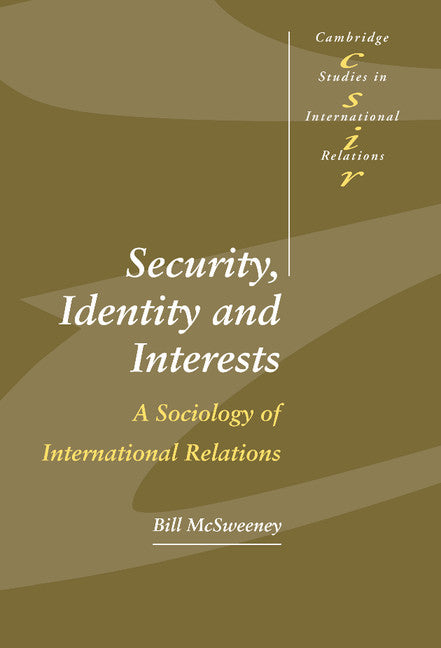
Security, Identity and Interests
A Sociology of International Relations
Addresses the central problem of international relations - security - and constructs a novel framework for its analysis.
Bill McSweeney (Author)
9780521661775, Cambridge University Press
Hardback, published 4 November 1999
256 pages
23.7 x 15.8 x 2.1 cm, 0.535 kg
Bill McSweeney addresses the central problem of international relations - security - and constructs a novel framework for its analysis. He argues for the unity of the interpersonal, societal and international levels of human behaviour and outlines a concept of security which more adequately reflects the complexity and ambiguity of the topic. This book introduces an alternative way of theorizing the international order, within which the idea of security takes on a broader range of meaning, inviting a more critical and interpretative approach to understanding the concept and formulating security policy. The recent shift to sociology in international relations theory has not as yet realized its critical potential for the study of security. Drawing on contemporary trends in social theory, Dr McSweeney argues that human agency and moral choice are inherent features of the construction of the social and thus international order, and hence of our conception of security and security policy.
Acknowledgements
Introduction
1. The meaning of security
Part I. Objectivist Approaches to International Security: 2. Early stages of development
3. Broadening the concept of security
4. Identity versus the state
Part II. Theorizing Security: the Turn to Sociology: 5. A conceptual discussion
6. The social constructionist approach
7. The limits of identity theory
8. Agency and structure in social theory
9. Seeing a different world: a reflexive sociology of security
Part III. Practising Security: 10. Doing security by stealth
11. Conclusion: security and moral choice
Bibliography
Index.
Subject Areas: International relations [JPS]