Freshly Printed - allow 7 days lead
Couldn't load pickup availability
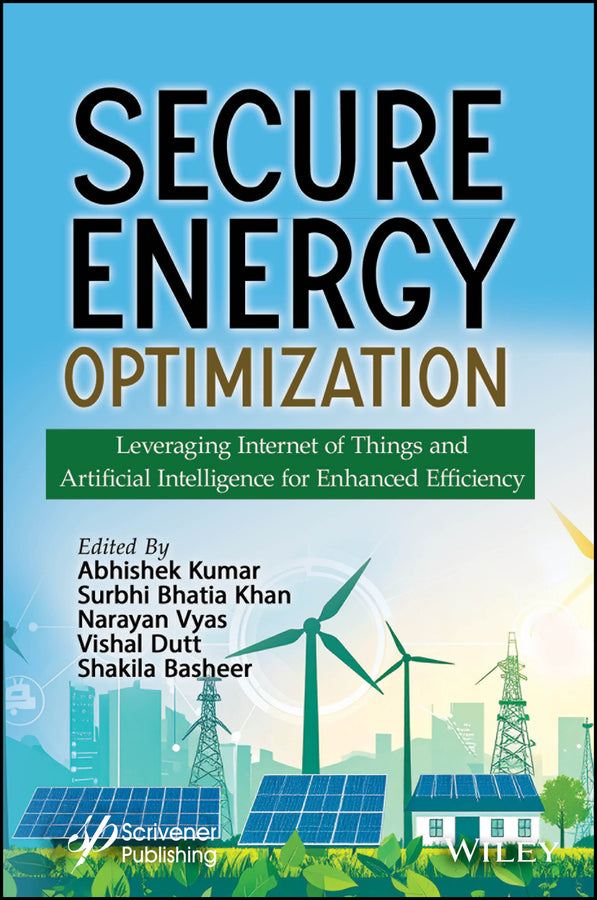
Secure Energy Optimization
Leveraging Internet of Things and Artificial Intelligence for Enhanced Efficiency
Abhishek Kumar (Edited by), Surbhi Bhatia Khan (Edited by), Narayan Vyas (Edited by), Vishal Dutt (Edited by), Shakila Basheer (Edited by)
9781394271818, Wiley
Hardback, published 19 August 2025
496 pages
22.9 x 15.2 x 3 cm, 0.907 kg
Secure Energy Optimization: Leveraging Internet of Things and Artificial Intelligence for Enhanced Efficiency is essential for anyone looking to navigate the transformative landscape of energy management, as it expertly combines the principles of IoT and AI with real-world case studies to provide actionable insights for achieving sustainable and efficient energy optimization. Energy is rapidly changing, with an emphasis on sustainable and efficient energy use. In this context, the combination of Internet of Things (IoT) and Artificial Intelligence (AI) technologies has emerged as a potent technique for optimising energy use, improving efficiency, and enhancing overall energy security. Secure Energy Optimization: Leveraging Internet of Things and Artificial Intelligence for Enhanced Efficiency provides a comprehensive review of how IoT and AI can be used to accomplish safe energy optimisation. Readers will gain an understanding of the underlying principles of IoT and AI, as well as their applications in energy efficiency and the problems and hazards related to their adoption. They will investigate the successful integration of IoT and AI technologies in energy management systems, smart grids, and renewable energy sources using real-world case studies and examples. By bringing together theoretical notions, cutting-edge research, and practical examples, this book bridges the gap between theory and implementation.
Preface xxi 1 Exploring the IoT and AI Technologies in Energy-Efficient Sustainable Agriculture 1 1.1 Introduction to the Internet of Things and Artificial Intelligence 2 1.2 Essentials of IoT and AI Applications in Agriculture 5 1.2.1 IoT Applications in Agriculture 5 1.2.1.1 Monitor and Sense 5 1.2.1.2 IoT-Enabled Precision Agriculture 5 1.2.1.3 Monitor Livestock 5 1.2.1.4 Managing the Supply Chain 5 1.2.2 AI Applications in Agriculture 6 1.2.2.1 Soil Management 6 1.2.2.2 Weed Management 6 1.3 Robotics in Agriculture 8 1.3.1 Automation of Agricultural Processes 8 1.3.2 Precision Farming 9 1.3.3 Livestock Management 9 1.3.4 Benefits of Robotics in Agriculture 9 1.3.5 Challenges and Future Prospects 10 1.4 Smart Farming 10 1.5 Technologies Used in AI and IoT for Smart Farming 11 1.5.1 Global Positioning System (GPS) 12 1.5.2 Sensor Technologies 13 1.5.2.1 Environmental Sensors 14 1.6 Energy-Efficient Sustainable Agriculture 14 1.7 Applications in Agriculture 16 1.7.1 Precision Farming 16 1.7.2 Sensors in Farming 17 1.7.3 Soil Mapping and Plant Monitoring 18 1.7.4 Climate Conditions 19 1.7.5 Crop Monitoring and Disease Detection 20 1.7.6 Smart Irrigation and Water Management 21 1.7.7 Environmental Impact and Sustainability 22 1.7.8 Data-Driven Decision-Making 22 1.8 Advantages of IoT and AI in Agriculture 23 1.9 The Future of IoT And AI in Agriculture 24 1.10 Conclusion 25 References 25 2 A Comprehensive Review of Machine Learning Techniques for Smart Grid Optimization 29 2.1 Introduction 30 2.2 Smart Grid Fundamentals 31 2.2.1 Overview of Smart Grid Technology 31 2.2.2 Key Components and Architecture 31 2.2.3 Challenges in Smart Grid Optimization 32 2.2.4 Role of Machine Learning in Smart Grids 34 2.3 Machine Learning Techniques for Smart Grid Optimization 34 2.3.1 Supervised Learning Approaches 34 2.3.2 Unsupervised Learning Techniques 35 2.3.3 Reinforcement Learning for Dynamic Optimization 35 2.3.4 Deep Learning Applications 36 2.3.5 Hybrid Models and Ensemble Methods 36 2.4 Applications of Machine Learning in Smart Grids 37 2.4.1 Load Forecasting 37 2.4.2 Renewable Energy Integration 38 2.4.3 Predictive Maintenance 39 2.4.4 Energy Management 40 2.4.5 Energy Market Optimization 41 2.5 Advanced Topics in Machine Learning for Smart Grids 43 2.5.1 Explainable AI (XAI) in Smart Grids 43 2.5.1.1 Importance of Explainability 43 2.5.1.2 Techniques for Explainability 44 2.5.2 Transfer Learning for Smart Grid Applications 45 2.5.3 Integration of IoT and Edge Computing 46 2.5.3.1 IoT Devices in Smart Grids 46 2.5.3.2 Edge Computing for Real-Time Analytics 47 2.5.4 Blockchain Technology for Smart Grids 48 2.5.5 AI-Driven Cybersecurity in Smart Grids 49 2.6 Discussion, Future Directions, and Emerging Trends 50 2.6.1 Discussion 50 2.6.2 Future Research Directions and Emerging Trends 51 2.6.3 Practical Implementation Strategies 53 2.7 Conclusion 54 References 55 3 Innovations in Machine Learning for Energy Efficiency: Bridging Predictive Analytics and Real-World Applications 61 3.1 Introduction 62 3.1.1 Climate and Economic Drivers 63 3.2 Paradigm Shift Toward Decarbonization 65 3.3 Advanced Data-Driven Approaches to Energy Management 66 3.3.1 Big Data Analytics and Energy Management 66 3.3.2 Feature Engineering for Enhanced Predictive Models 67 3.3.3 Spatial-Temporal Analysis for Demand Forecasting 67 3.3.4 Integration of Machine Learning for Dynamic Optimization 67 3.3.5 Hybrid Approaches Combining Data-Driven Techniques 68 3.4 Machine Learning Algorithms for Predictive and Prescriptive Energy Analytics 69 3.4.1 Predictive Analytics: Anticipating Energy Demand and Trends 69 3.4.2 Prescriptive Analytics: Optimizing Energy Management Decisions 70 3.4.3 Hybrid Models for Enhanced Decision-Making 71 3.4.4 Advanced Neural Networks 73 3.5 Optimization Strategies Using Machine Learning 74 3.5.1 Energy Management in Smart Grids with Multi-Agent Systems 75 3.5.2 Optimization Algorithms for Renewable Energy Integration 75 3.5.3 Multi-Objective Optimization in Energy Systems 76 3.6 Cognitive Energy Management Systems 77 3.6.1 Autonomous Energy Management with AI and IoT Integration 77 3.6.2 Self-Learning Systems for Adaptive Energy Efficiency 78 3.6.3 Human-AI Collaboration in Energy Decision Making 78 3.7 Advanced Case Studies and Applications 79 3.7.1 AI-Driven Microgrids for Autonomous Energy Communities 79 3.7.2 AI-Powered Predictive Maintenance in Energy Infrastructure 79 3.7.3 Dynamic Energy Pricing with Machine Learning 80 3.7.4 AI-Driven Smart Building Systems 81 3.7.5 AI in Energy-Intensive Industries 81 3.8 Challenges and Future Directions in ML-Driven Energy Efficiency 83 3.8.1 Ethical and Social Implications of AI in Energy 83 3.8.2 Scalability of ML Models in Large-Scale Energy Systems 83 3.8.3 Future-Proofing Energy Systems with Quantum Machine Learning 84 3.8.4 Cybersecurity Challenges in AI-Driven Energy Systems 84 3.8.5 Regulatory and Compliance Issues 85 3.9 Conclusion 85 References 86 4 Understanding Energy Security Elements and Challenges 93 4.1 Introduction 93 4.1.1 Important Elements of Energy Security 95 4.1.2 Challenges 97 4.2 Literature Survey 101 4.3 Methodology 104 4.4 Results 106 4.5 Conclusion and Future Scope 107 References 108 5 Energy Storage and Optimization Techniques 111 5.1 Introduction 112 5.1.1 Overview of Energy Storage 112 5.1.2 Importance of Optimization in Energy Systems 112 5.1.3 Integration of IoT and AI in Energy Optimization 115 5.2 Fundamentals of Energy Storage 117 5.2.1 Types of Energy Storage Systems 117 5.2.2 Storage Capacity and Characteristics 118 5.3 Rules for Optimization 119 5.3.1 The Basics of Improving Energy Systems 120 5.3.2 Role of IoT in Real-Time Monitoring 121 5.3.3 AI Algorithms for Energy Optimization 122 5.3.3.1 Machine Learning Models 124 5.3.3.2 Deep Learning Approaches 125 5.4 Security Challenges in Energy Optimization 126 5.4.1 Cybersecurity Risks in IoT-Enabled Systems 126 5.4.2 AI-Powered Protecting Energy Optimization Algorithms 127 5.5 New Ideas and Trends for the Future 128 5.5.1 Improvements in Technologies for Storing Energy 128 5.5.2 Emerging Trends in AI for Energy Optimization 129 5.5.3 Sustainable Practices in the Energy Sector 130 5.6 Conclusion 130 References 131 6 IoT-Enabled Energy Storage Systems: Challenges and Solutions 135 6.1 Introduction 136 6.1.1 Overview of Energy Storage Systems (ESS) 136 6.1.2 Role of IoT in Energy Storage 138 6.2 Literature Survey 139 6.2.1 IoT in Monitoring and Diagnostics of Energy Storage Systems 140 6.2.2 Optimization of Energy Storage Operations through IoT 140 6.2.3 Cybersecurity Challenges in IoT-Enabled Energy Storage Systems 141 6.2.4 Case Studies and Real-World Applications of IoT in Energy Storage 142 6.3 Challenges in Energy Storage Systems 143 6.3.1 Integration with Renewable Energy Sources 143 6.3.2 Scalability and Efficiency 146 6.3.3 Security and Privacy Concerns 146 6.4 IoT-Enabled Solutions for Energy Storage Systems 147 6.4.1 Advanced Monitoring and Control 147 6.4.2 Optimization Algorithms 150 6.4.3 Energy Management Systems (EMS) 151 6.4.4 Security Enhancements 152 6.5 Case Studies on Real-Time Applications 153 6.6 Future Trends and Developments 158 6.6.1 Next-Generation IoT Technologies 158 6.6.2 Sustainable and Green Energy Storage Solutions 160 6.7 Conclusion 161 References 161 7 Dynamic Pricing and Energy Optimization Strategies 165 7.1 Introduction 166 7.1.1 Fundamentals of Dynamic Pricing 168 7.1.1.1 Understanding Dynamic Pricing Models 168 7.1.2 Economic Principles Behind Dynamic Pricing 171 7.1.2.1 Demand Response Mechanisms 171 7.1.2.2 Price Elasticity of Demand in Energy Markets 172 7.1.2.3 Technological Enablers for Dynamic Pricing 174 7.1.2.4 Smart Meters and Sensors 175 7.1.2.5 IoT-Enabled Energy Consumption Monitoring 176 7.1.3 Integration of IoT and AI for Dynamic Pricing 177 7.1.3.1 Case Studies of Successful Implementations 177 7.1.3.2 Synergies between IoT and AI Technologies 178 7.1.3.3 Data-Driven Energy Management 179 7.1.3.4 Automated Energy Control Systems 182 7.1.4 Challenges and Future Directions 183 7.1.4.1 Data Privacy and Security Concerns 183 7.1.4.2 Regulatory and Policy Considerations 185 7.1.4.3 Future Trends in Dynamic Pricing and Energy Optimization 186 7.1.5 Conclusion 187 7.1.5.1 Implications for the Future of Energy Management 188 7.1.5.2 Vision for a Sustainable and Efficient Energy Future 188 References 189 8 Smart Energy: Harnessing IoT and AI for Renewable Resource Integration 193 8.1 Introduction 194 8.1.1 The Role of IoT in Renewable Energy 194 8.1.2 Understanding IoT: Definition and Key Components 194 8.1.3 The Key Components of IoT in Renewable Energy Include 194 8.1.4 Enhancing Monitoring and Management of Renewable Energy Systems 195 8.1.5 Optimizing Energy Production and Distribution 196 8.2 Artificial Intelligence in Renewable Energy Management 196 8.2.1 An Overview of AI: Fundamental Ideas and Technologies 197 8.2.2 The Following are Important AI Technologies that are Related to Managing Renewable Energy 197 8.2.3 AI’s Function in Energy Generation Forecasting 198 8.2.4 Optimizing Energy Storage with AI 198 8.2.5 Examples of AI-Driven Solutions in Renewable Energy Grids 199 8.3 Smart Grids: The Backbone of IoT and AI in Renewables 200 8.3.1 Definition and Components of Smart Grids 200 8.3.2 Types of Smart Grids are as Follows 200 8.3.3 How Smart Grids Integrate with IoT and AI 201 8.3.4 The Advantages of Smart Grids for Improving Reliability and Energy Efficiency 202 8.3.5 Examples of Smart Grids in Use in the Real World 203 8.4 Data Analytics and Predictive Maintenance in Renewable Systems 204 8.4.1 Importance of Data Analytics in Renewable Energy Systems 205 8.4.2 AI Algorithms and Internet-of-Things Sensors for Predictive Maintenance 206 8.4.3 Predictive Maintenance’s Advantages 207 8.4.4 The Future of Predictive Maintenance and Data Analytics in Renewables 207 8.5 Energy Storage Solutions: Optimizing with AI and IoT 208 8.5.1 Overview of Energy Storage Technologies 208 8.5.2 Role of AI and IoT in Maximising Storage Efficiency 209 8.6 Sustainability and Environmental Impact 210 8.6.1 How AI and IoT Help Make Renewable Energy Systems More Sustainable 211 8.6.2 Integration of Distributed Energy Resources (DERs) into the Larger Energy Grid 212 8.6.3 Reducing the Carbon Footprint of Renewable Energy Operations 212 8.6.4 Balancing Technological Advancement with Environmental Stewardship 213 8.7 Future Directions and Research Opportunities 214 8.7.1 New Developments in AI, IoT, and Renewable Energy 214 8.7.2 Research Gaps and Potential Areas for Innovation 215 8.7.3 The Role of Academia, Industry, and Government in Advancing Integration 216 8.8 Conclusion and Key Points 217 8.8.1 Using IoT and AI to Optimize Renewable Energy Systems 217 8.8.2 Improving Energy Management and Grid Stability 218 8.8.3 Predictive Upkeep and Dependability of Systems 218 8.8.4 Applications in the Real World and Case Studies 218 8.8.5 Prospects for Research and Future Paths 219 8.8.6 Working Together for a Sustainable Future 219 References 220 9 Machine Learning Algorithms for Energy Efficiency Enhancement 223 9.1 Introduction 224 9.1.1 Overview of Energy Efficiency 224 9.1.2 Role of Machine Learning in Energy Efficiency 225 9.1.3 Case Studies and Real-World Applications 225 9.1.4 Objectives of the Chapter 226 9.2 Machine Learning Concepts for Energy Efficiency 227 9.2.1 Supervised Learning 227 9.2.2 Methods of Classification in Energy Efficiency 228 9.2.3 Unsupervised Learning 228 9.2.3.1 Clustering for Load Profiling and Segmentation 228 9.2.3.2 Anomaly Detection in Energy Usage 228 9.3 Reinforcement Learning 229 9.3.1 Role in Dynamic Control Systems for Energy Management 229 9.4 Neural Networks and Deep Learning 230 9.4.1 Applications in Energy Forecasting and Optimization 230 9.4.2 Designing Neural Networks for Energy-Efficient Models 230 9.5 Algorithms for Energy Efficiency Enhancement 230 9.5.1 Linear Regression 230 9.5.2 Decision Trees and Random Forests 231 9.5.3 Support Vector Machines (SVMs) 231 9.5.4 K-Means Clustering 232 9.5.5 Neural Networks and Deep Learning Models 233 9.6 Applications of Machine Learning in Energy Systems 233 9.6.1 Smart Grids 233 9.6.2 Energy Efficiency in Buildings 234 9.6.3 Renewable Energy Systems 235 9.6.4 Transportation and Electric Vehicles 235 9.7 Conclusion 236 9.8 Future Scope 236 References 237 10 Optimizing Vulnerable Energy User Support in England through Clustering Analysis 241 10.1 Introduction 241 10.2 Literature Review 243 10.2.1 Determinants of Energy Vulnerability 243 10.2.1.1 Measuring Energy Vulnerability 243 10.2.2 Past Interventions on Social Issues and Ethical Considerations 244 10.2.3 AI in the Energy Sector 245 10.3 Proposed Methodology 245 10.3.1 Data Collection 245 10.3.2 Data Preprocessing 248 10.3.3 Data Transformation 248 10.3.4 Dimensionality Reduction 249 10.3.5 Model Development and Clustering 250 10.3.6 Evaluation and Results Analysis 251 10.4 Model Development and Clustering 251 10.4.1 The Energy Vulnerability Index (EVI) 251 10.4.2 Exploratory Data Analysis (EDA) 253 10.4.3 Clustering with K-Means 260 10.4.4 Clustering with DBSCAN 263 10.4.5 Clustering with HDBSCAN 263 10.5 Result Analysis 266 10.5.1 Cluster Distribution 266 10.5.2 Feature Contribution 267 10.5.3 Spatial Visualization 269 10.5.4 Evaluation 270 10.5.5 Discussions 272 10.6 Conclusion 273 References 273 11 Real-Time Monitoring & Fault Detection in Energy Infrastructure 277 11.1 Introduction 278 11.2 Technologies and Tools for Real-Time Data Acquisition 282 11.3 Data Analytics and Machine Learning for Fault Detection 287 11.4 Case Studies of Real-Time Monitoring Systems in Energy Infrastructure 288 11.5 Integration of IoT and Smart Sensors in Energy Monitoring 291 11.6 Cybersecurity and Data Integrity in Monitoring Systems 293 11.7 Predictive Maintenance with Real-Time Surveillance 296 11.8 Challenges and Solutions in Implementing Fault Detection Systems 296 11.9 Future Trends in Real-Time Monitoring and Fault Detection 297 11.10 Conclusion and Future Research Directions 299 References 299 12 Robust Security Strategies for Smart Grid Networks: Integration of AI, Blockchain, and Resource-Efficient Techniques 303 12.1 Introduction 304 12.1.1 Background 304 12.1.2 Significance of Security in Smart Grids 304 12.1.3 Overview of Current Security Results 305 12.1.4 Gaps and Challenges in Being Security Results 305 12.1.5 Proposed Security Framework 306 12.1.6 Research Objectives 307 12.1.7 Significance of the Research 307 12.2 Literature Review 309 12.3 Methodology 311 12.3.1 Protocol Selection 312 12.3.1.1 Encryption and Decryption 312 12.3.1.2 Authentication and Authorization 313 12.3.1.3 Intrusion Detection and Prevention Systems (IDPS) 314 12.3.1.4 Secure Communication Protocols 315 12.3.2 Implementation and Integration 315 12.3.2.1 Deployment of Security Measures 315 12.3.2.2 Integration with Existing Systems 316 12.3.2.3 Training and Awareness 316 12.3.3 Evaluation and Testing 317 12.3.3.1 Security Testing 317 12.3.3.2 Performance Evaluation 317 12.3.3.3 Continuous Monitoring and Improvement 317 12.4 Results 318 12.4.1 Encryption Effectiveness 318 12.4.1.1 Encryption Performance 318 12.4.1.2 Encryption Strength 319 12.4.2 Authentication Mechanisms 319 12.4.2.1 Authentication Accuracy 319 12.4.2.2 Authentication Speed 320 12.4.3 Intrusion Detection and Prevention Systems (IDPS) 320 12.4.3.1 Detection Accuracy 320 12.4.3.2 Response Time 321 12.4.4 Overall Performance Impact 321 12.4.4.1 Network Performance 321 12.4.4.2 Resource Utilization 322 12.5 Future Work 323 12.6 Conclusion 324 References 325 13 The Power of Prediction: Revolutionizing Energy Management 327 13.1 Introduction 328 13.1.1 Energy System in Building 328 13.1.2 The Transformative Power of Predictive Analytics 328 13.1.3 IoT and AI Transforming Energy Management 329 13.2 Predictive Analytics in Energy Management 330 13.2.1 Properties and Relevance of Predictive Analytics 330 13.2.2 How Predictive Analytics is Changing Energy Management 331 13.2.3 Case Studies of Predictive Analytics Applied in the Real World 332 13.2.4 Combine IoT and AI for Predictive Energy Management 332 13.2.5 Case Studies of IoT- and AI-Based Prediction Systems 333 13.2.6 Benefits of Integrating these Technologies 334 13.3 Problems with Deploying Predictive Energy Management 335 13.3.1 Data-Related Challenges: Quality, Availability, and Security 335 13.3.2 Physical and Integration Hurdles 337 13.3.3 Regulatory and Ethical Issues 337 13.4 Case Studies and Applications 338 13.4.1 Examples in Detail of Different Sectors (i.e., Residential, Industrial, and Commercial) 338 13.4.2 Analysis of Successful Implementations and their Impact 340 13.4.3 Lessons Learned from Real-World Applications 341 13.5 Future Trends in Predictive Energy Management 341 13.5.1 Emerging Technologies and their Potential Impact 343 13.5.2 AI and IoT in Energy Management Future Directions 343 13.5.3 Predictions for the Evolution of Energy Management Over the Next Decade 345 13.6 Conclusion 346 13.6.1 Summary of the Key Insights 346 13.6.2 The Potential of Predictive Analytics to Revolutionize Energy Management 346 13.6.3 Conclusions on the Future of the Field 347 References 347 14 Predictive Analytics as a Pathway to Intelligent Demand Response and Load Management 351 14.1 Introduction 352 14.1.1 Enhance Demand Forecasting and Optimized Load Management 353 14.1.2 Improved Demand Response 353 14.1.3 Enhanced Integration of Renewable Energy 354 14.1.4 Consumer Engagement 354 14.2 Overview of Predictive Analytics 354 14.3 Demand Purpose 355 14.3.1 Forecasting Demand 355 14.3.2 Customer Segmentation and Behavior Analysis 357 14.3.3 Demand Response Strategies 359 14.4 Load Management 361 14.4.1 Forecasting and Optimization 361 14.4.2 Demand-Side Management 362 14.4.3 Capacity Planning 363 14.4.4 Load Shedding and Peak Shaving 363 14.5 Technologies and Tools: Fundamental Requirements 363 14.5.1 Machine Learning Algorithms 364 14.5.2 Big Data and Internet of Things 364 14.5.3 Software and Platform 365 14.5.4 Advanced Analytical Techniques 365 14.6 Advanced Demand Response and Load Management Strategies 366 14.6.1 Innovative Incentive Structures 367 14.6.2 Real-Time Load Management Techniques 368 14.6.3 Advanced Capacity Planning 368 14.6.4 Behavioral Demand Response Innovation 369 14.7 Challenges and Limitations 370 14.7.1 Data Quality and Availability 370 14.7.2 Model Accuracy and Complexity 370 14.7.3 Privacy and Security 371 14.8 Practical Applications of Predictive Analytics 371 14.8.1 Enhanced Grid Management 371 14.8.2 Renewable Energy Integration 372 14.8.3 Advanced Load Management 372 14.9 Emerging Patterns and New Directions 372 14.9.1 Integration of Artificial Intelligence (AI) and Machine Learning (ML) 372 14.9.2 Focus on Consumer-Centric Solutions 373 14.9.3 Factors Related to Regulation and Compliance 373 14.9.4 Future Prognostication 373 14.10 Conclusion 374 References 375 15 Data Collection and Analysis for Real-Time Secure Energy Monitoring and Optimization 381 15.1 Introduction 382 15.2 Literature Survey 384 15.2.1 Evolution of Energy Monitoring Systems 384 15.2.2 Real-Time Data Collection and Analysis 384 15.2.3 Security Challenges in Energy Monitoring Systems 385 15.2.4 Emerging Trends in Energy Monitoring and Optimization 385 15.3 Fundamentals of Real-Time Energy Monitoring 386 15.4 Data Collection Techniques for Energy Monitoring 388 15.4.1 Types of Data in Energy Systems 390 15.4.2 Data Acquisition Methods and Devices 391 15.4.3 Communication Protocols 392 15.4.4 Challenges in Real-Time Data Collection 393 15.5 Data Analysis for Energy Optimization 394 15.5.1 Introduction to Data Analysis Techniques 396 15.5.2 Real-Time Data Processing Frameworks 397 15.5.3 Predictive Maintenance and Anomaly Detection in Energy Systems 398 15.5.4 Load Forecasting and Demand-Side Management 398 15.5.5 Security Considerations in Real-Time Energy Monitoring 399 15.5.6 Overview of Security Threats in Energy Monitoring Systems 401 15.5.7 Encryption Techniques for Securing Data Transmission 401 15.5.8 Secure Data Storage and Access Control 402 15.5.9 Blockchain Technology for Secure Energy Transactions 402 15.6 Case Studies 403 15.7 Future Trends in Real-Time Secure Energy Monitoring 408 15.7.1 Emerging Technologies in Energy Monitoring 408 15.8 Conclusion 409 References 410 16 Methods for Implementing Real-Time Pricing and Improving Energy Efficiency 413 16.1 Introduction 414 16.2 Overview of Real-Time Pricing (RTP) 418 16.3 Fundamentals of Real-Time Pricing 419 16.4 Technological Requirements for Real-Time Pricing Implementation 422 16.5 Strategies for Effective Real-Time Pricing 424 16.6 Consumer Engagement and Behavioral Insights 427 16.7 Energy Efficiency Improvement Techniques 430 16.8 Energy Efficiency Improvement Techniques 432 References 434 17 Case Studies: Successful Implementations of Secure Energy Optimization Using IoT and AI 437 17.1 Introduction 438 17.1.1 Background and Context 438 17.1.2 Purpose of the Study 439 17.1.3 Challenges in Securing IoT and AI in Energy Systems 441 17.2 Literature Review 442 17.3 Methodology 443 17.4 Case Studies 445 17.4.1 Case Study 1: Optimizing Wind Turbine Maintenance Using AI 445 17.4.2 Case Study 2: Smart Grid Optimization with AI and IoT 447 17.4.3 Case Study 3: AI-Driven Energy Management in Smart Homes 448 17.4.4 Case Study 4: AI for Predictive Maintenance in Solar Power Plants 450 17.5 Analysis and Discussion 453 17.5.1 Comparison of Case Studies 453 17.5.2 Challenges and Solutions 454 17.6 Conclusion 455 References 456 About the Editors 459 Index 463
M. Muthumalathi, Ponnarasi Loganathan, P.B. Pankajavalli and A. Priya Dharshini
Gaurav Gupta, Abhishek Tomar, Saigurudatta Pamulaparthyvenkata and Anandaganesh Balakrishnan
Aditya Vardhan, Amarjeet Singh Chauhan, Mohit Yadav, Sanjay Saini and Sagar Sharma
Priya Batta
Mamta
Dankan Gowda V., Mirza Shuja, Christian Rafael Quevedo Lezama, Pullela S.V.V.S.R. Kumar and Suganthi N.
Inderjeet Singh, Muskan Sharma, Suvigya Yadav, Yash Mahajan and Koushik Sundar
Ashutosh Pagrotra
Neetu Rani, Narinder Yadav, Poonam Singh and Vanshika
Shola E. Ayeotan and Surbhi Bhatia Khan
Amit Sharma and Titu Singh Arora
Santhosh Kumar C., Nancy Lima Christy S., S. Sindhuja and Madhan. K.
Neha Bhati, Hardik Dhiman, Surendra Yadav, Rakesh Sharma, Gajendra Shrimal and Jitendra Kumar Katariya
Aditya Vardhan, Amarjeet Singh Chauhan and Sagar Sharma
Dankan Gowda V., Pullela S.V.V.S.R. Kumar, Madan Mohanrao Jagtap, Shekhar R. and Rahul Vadisetty
Amit Sharma
Saritakumar N., Sudharsan M. K., Gowthaman S., Sreeman T. S. and Harrish Sridhar
Subject Areas: Economics [KC]