Freshly Printed - allow 7 days lead
Couldn't load pickup availability
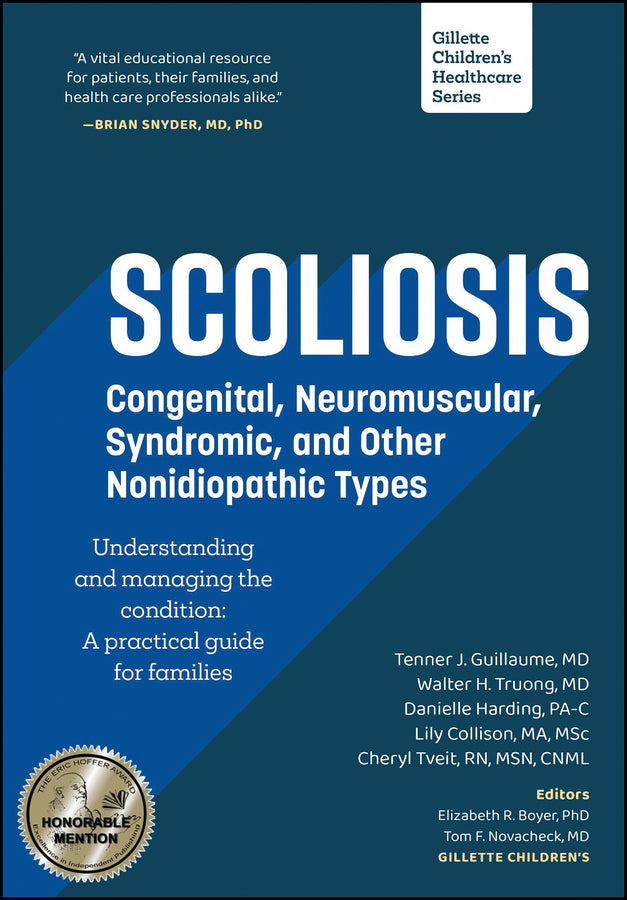
Scoliosis
Congenital, Neuromuscular, Syndromic and other Nonidiopathic Types
Tenner J. Guillaume (Author), Walter H. Truong (Author), Danielle H. Harding (Author), Lily Collison (Author), Cheryl Tveit (Author), Elizabeth R. Boyer (Edited by), Tom F. Novacheck (Edited by)
9781952181214, Wiley
Paperback / softback, published 30 September 2025
210 pages
24.1 x 16.8 x 2.3 cm, 0.68 kg
Approximately 20 percent of all scoliosis cases have a known cause. This book explains the condition and includes both the current best-practice treatments and the lived experience of families. It is a companion book to Idiopathic scoliosis, which addresses scoliosis where the cause is unknown. The writing of this scoliosis book was led by Tenner J. Guillaume, MD, Walter H. Truong, MD, and Danielle Harding, PA-C, spine specialists at Gillette Children’s, a world-renowned center of excellence for the treatment of brain, bone, and movement conditions. This book is part of the Gillette Children’s Healthcare Series, a series of books for families who are looking for clear, comprehensive information. Health care professionals, researchers, educators, students, and extended family members will also benefit from reading it. Other titles in the series include: · Craniosynostosis · Idiopathic Scoliosis · Spastic Hemiplegia—Unilateral Cerebral Palsy · Spastic Quadriplegia—Bilateral Cerebral Palsy · Spastic Diplegia—Bilateral Cerebral Palsy, second edition · Epilepsy · Spina Bifida · Osteogenesis Imperfecta
Contents Authors and editors Foreword by Dr. Tom Novacheck Introduction Chapter 1 Scoliosis 1.1 Introduction 1.2 Understanding the spine 1.3 Atypical spine curvatures 1.4 Classification of scoliosis 1.5 Diagnosis of scoliosis Key points Chapter 1 Chapter 2 Congenital scoliosis 2.1Introduction 2.2 Type of vertebral anomalies 2.3 Anomalies in other organ systems 2.4 Risk of curve progression Key points Chapter 2 Chapter 3 Neuromuscular scoliosis 3.1 Introduction 3.2 Cerebral palsy 3.3 Spinal muscular atrophy With Jamie Eskuri, MD 3.4 Spina bifida 3.5 Duchenne muscular dystrophy With Jamie Eskuri, MD 3.6 Arthrogryposis multiplex congenita With Jamie Eskuri, MD Key points Chapter 3 Chapter 4 Syndromic scoliosis With Tori Bahr, MD 4.1 Introduction 4.2 Rett Syndrome 4.3 Autism spectrum disorder 4.4 Neurofibromatosis 4.5 Down syndrome 4.6 Ehlers-Danlos syndrome 4.7 Prader-Willi syndrome 4.8 Other syndromes Key points Chapter 4 Chapter 5 Other nonidiopathic scoliosis With Teresa Schultz APRN, CNP-Pediatrics 5.1 Introduction 5.2 Syrinx 5.3 Chiari malformation type I 5.4 Tethered cord syndrome Key points Chapter 5 Chapter 6 Overview of treatment 6.1 Why treat scoliosis? 6.2 Factors affecting treatment decisions 6.3 Overview of treatment 6.4 Evidence-based medicine and shared decision-making Key points Chapter 6 Chapter 7 Nonsurgical treatment 7.1 Introduction 7.2 Observation 7.3 Bracing With Kristin Smith, CO 7.4 Casting 7.5 Physical therapy 7.6 Alternative and complementary treatments Key points Chapter 7 Chapter 8: Scoliosis surgery 8.1 Introduction 8.2 Preparing for surgery 8.3 Spinal fusion 8.4 Growth-friendly treatment 8.6 Recovery after surgery 8.6 Halo gravity traction Key points Chapter 8 Chapter 9 Special treatment considerations 9.1 Introduction 9.2 Congenital scoliosis 9.3 Neuromuscular scoliosis 9.4 Syndromic scoliosis 9.5 Other nonidiopathic scoliosis Key points Chapter 9 Chapter 10 Aging considerations with scoliosis Key points Chapter 10 Chapter 11 Further reading and research Acknowledgments Appendices (online) Appendix: Rib phase and rib vertebral angle difference Glossary References Index
Subject Areas: Other branches of medicine [MM]