Freshly Printed - allow 10 days lead
Couldn't load pickup availability
Sciences and the Self in Medieval Poetry
Alan of Lille's Anticlaudianus and John Gower's Confessio Amantis
A 1995 study of two important late medieval poems and their philosophical and psychological contexts.
James Simpson (Author)
9780521021111, Cambridge University Press
Paperback / softback, published 13 October 2005
336 pages
22.9 x 15 x 2 cm, 0.229 kg
'The originality of the juxtaposition is one measure of the provocativeness and occasional brilliance of Simpson's vigorous and ambitious new study, which offers radically novel readings of both poems at the same time that it draws them together in an intriguing exploration of the nature of the humanist poetics of the Middle Ages.' John Gower Newsletter
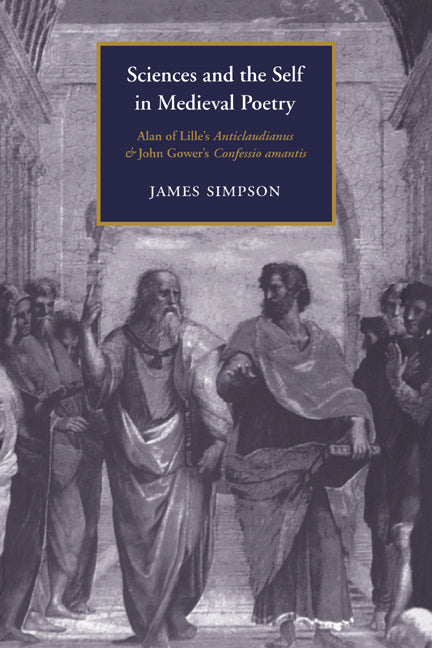
In this 1995 study James Simpson examines two great poems of the later medieval period, the Latin philosophical epic, Alan of Lille's Anticlaudianus (1181–3), and John Gower's English poem, The Confessio Amantis (1390–3). Simpson locates these works in a cultural context dominated by two kinds of literary humanism: the absolutist, whose philosophical mentor is Plato, whose literary model is Virgil and whose concept of the self is centred in the intellect, and the constitutionalist, whose classical models are Aristotle and Ovid and whose concept of the self resides in the mediatory power of the imagination. Both poems are examples of the Bildungsroman, in which the self reaches its fullness only by traversing an educational cursus in the related sciences of ethics, politics and cosmology, but as this study shows, there are very different modes of thought behind their conceptions of selfhood and education.
1. Introduction
2. The outer form of the Anticlaudianus
3. A preposterous interpretation of the Anticlaudianus
4. Alan's philosopher-king
5. Ovidian disunity in Gower's Confessio Amantis
6. Genius's psychological information in Book III
7. The primacy of politics in the Confessio Amantis
8. Poetics
9. Conclusion: varieties of humanist politics.
Subject Areas: Literary studies: poetry & poets [DSC]