Special Order - allow 2+ weeks lead
Couldn't load pickup availability
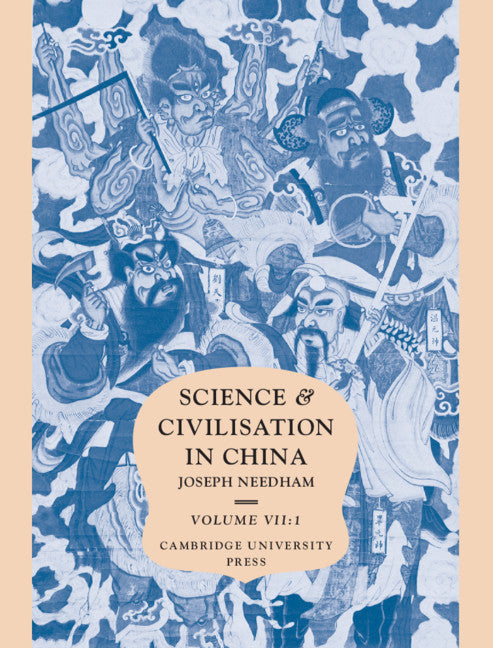
Science and Civilisation in China: Volume 7, The Social Background, Part 1, Language and Logic in Traditional China
The first systematic survey of the conceptual history of basic logical terminology in ancient China.
Joseph Needham (Author), Christoph Harbsmeier (Author), Joseph Needham (Foreword by)
9780521571432, Cambridge University Press
Hardback, published 19 February 1998
504 pages
25.4 x 19.5 x 3.6 cm, 1.36 kg
"Perhaps the greatest single act of historical synthesis and intercultural communication ever attempted by one man."
Laurence Picken, Cambridge University
Science and Civilisation in China Volume 7 Part 1 is the first book in the final volume of this unique resource. The Chinese culture is the only culture in the world which has developed systematic logical definitions and reflections on its own and on the basis of a non-Indo-European language. Christoph Harbsmeier discusses the basic features of the classical Chinese language which made it a suitable medium for science in ancient China, and he discusses in detail a wide range of abstract concepts which are crucial for the development of scientific discourse. There is special emphasis on the conceptual history of logical terminology in ancient China, and on traditional Chinese views on their own language. Finally the book provides an overview of the development of logical reflection in ancient China, first in terms of the forms of arguments that were deployed in ancient Chinese texts, and then in terms of ancient Chinese theoretical concerns with logical matters.
Foreword Joseph Needham
Preface
SECTION 49: LANGUAGE AND LOGIC IN TRADITIONAL CHINA
A: METHOD: 1. Methodological remarks
2. The history of the study of classical Chinese language and logic in the West
B: TYPOLOGY: 1. The place of Chinese among East Asian languages
2. Spoken Chinese and the semiotics of Chinese characters
3. Traditional Chinese comments on language
4. The art of definition
5. Dictionaries in traditional China
6. The art of grammar in traditional China
7. The art of literacy in traditional China
C: LOGIC: 1. Negation and the law of double negation in classical Chinese
2. Logical sentence connectives
3. Logical quantifiers
4. Lexical and grammatical categories
5. Logical and grammatical explicitness
6. Logical and grammatical complexity in classical Chinese
D: SENTENCES: 1. Punctuation and the concept of a sentence
2. The concept of meaning
3. The concept of truth
4. The concept of necessity
5. The concept of contradiction
6. The concept of a class
7. Abstraction and the concept of a property
8. The concept of subsumption
9. The concepts of knowledge and belief
E: RATIONALITY: 1. Argumentation and rationality in early China
2. Some forms of argument in ancient China
F: HUI SHIH: 1. Teng Hsi and Hui Shih
2. Kungsun Lung and the White Horse dialogue
Appendix to 2. The mass noun hypothesis and the part-whole analysis of the White Horse dialogue
3. Hsun Tzu's logic
4. Later Mohist logic
5. Chinese reactions to ancient Chinese disputation and logic
6. Logical thought in the 3rd century
G: BUDDHIST LOGIC: 1. History of Buddhist logic
2. The system of Buddhist logic
3. The argument for consciousness only
4. The translation of logic from Sanskrit to Chinese
5. Contrasts between Yin Ming and Aristotelian logic
CONCLUDING REFLECTIONS
Bibliography
Index.
Subject Areas: History of science [PDX]