Freshly Printed - allow 10 days lead
Couldn't load pickup availability
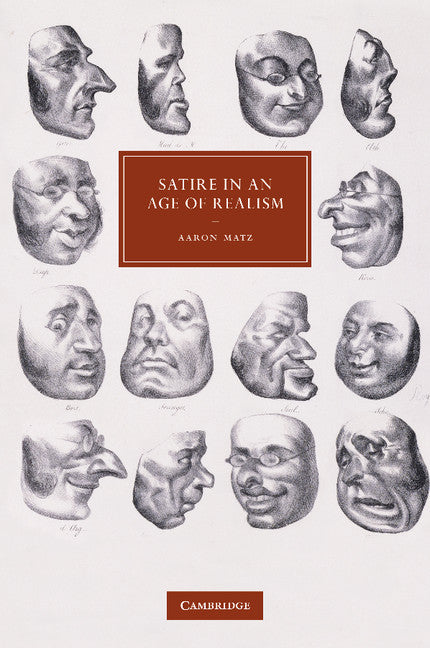
Satire in an Age of Realism
Explores how realism in the nineteenth century became so extreme in its portrayal of human experience that it blurred into satire.
Aaron Matz (Author)
9781107691230, Cambridge University Press
Paperback / softback, published 21 November 2013
240 pages
22.9 x 15.2 x 1.3 cm, 0.33 kg
"In brief, Matz's readings of individual authors offer both pleasures and insights, and his overall arguments do not fail to engage (and sometimes provoke) the reader. Though he limits his argument to British fiction, his range of literary reference--especially to French literature-- is relatively broad, and his book makes a substantive contribution to the study of satire, a much neglected form. Finally, this book showcases a formidable critical talent at work, and we will look forward to seeing more of it in years to come."
-NBOL 19
As nineteenth-century realism became more and more intrepid in its pursuit of describing and depicting everyday life, it blurred irrevocably into the caustic and severe mode of literature better named satire. Realism's task of portraying the human became indistinguishable from satire's directive to castigate the human. Introducing an entirely new way of thinking about realism and the Victorian novel, Aaron Matz refers to the fusion of realism and satire as 'satirical realism': it is a mode in which our shared folly and error are so entrenched in everyday life, and so unchanging, that they need no embellishment when rendered in fiction. Focusing on the novels of Eliot, Hardy, Gissing, and Conrad, and the theater of Ibsen, Matz argues that it was the transformation of Victorian realism into satire that granted it immense moral authority, but that led ultimately to its demise.
1. Augustan satire and Victorian realism
2. Terminal satire and Jude the Obscure
3. George Gissing's ambivalent realism
4. The English critics and the Norwegian satirist
5. Truth and caricature in The Secret Agent
Epilogue.
Subject Areas: Literary studies: c 1800 to c 1900 [DSBF], Literary studies: general [DSB], Literature & literary studies [D]