Freshly Printed - allow 7 days lead
Couldn't load pickup availability
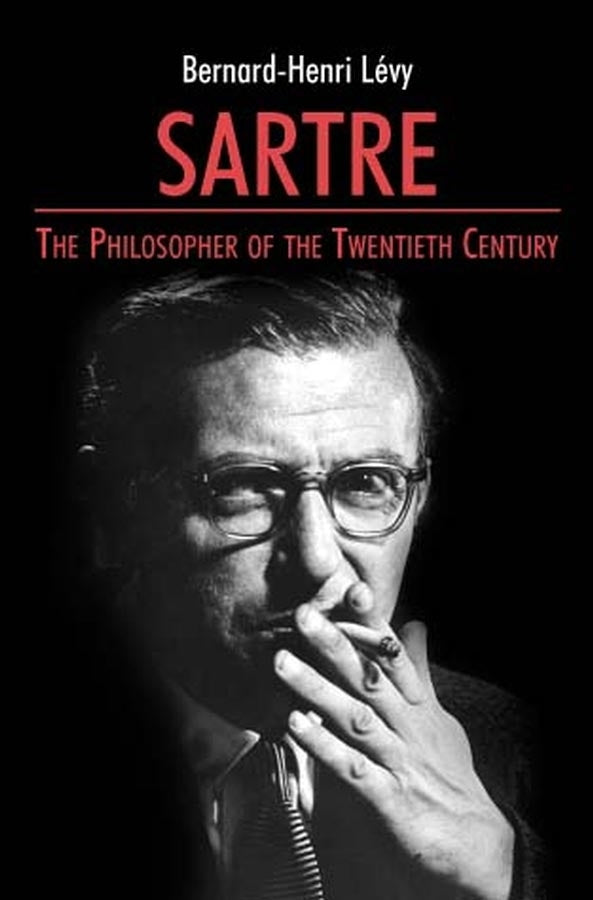
Sartre
The Philosopher of the Twentieth Century
Bernard-Henri Levy (Author)
9780745630090, Polity Press
Hardback, published 24 July 2003
544 pages
23.6 x 15.8 x 4.5 cm, 0.93 kg
"The book's enthusiasm is infectious. It delves sympathetically into Sartre's ideas and makes a strong case for their importance." The Economist "This biography of the French guru is brilliant." George Walden, The Sunday Telegraph "Enthralling, absolutely enthralling." Christian Sauvage, Le Journal du Dimanche "Bernard-Henri Lévy wonderfully resurrects Jean-Paul as a colossus bestriding the age...It would be hard to imagine a better translation of BHL oracular French. Andrew Brown succeeds in bringing Lévy so flamingly to life as a passionately engaged and combative speaker that you can hear him holding forth on the other side of the table in the Flore or the Deux Magots" Andy Martin, Daily Telegraph "Sartre, who had refused all kinds of introspection, is here thoroughly revisited in both his life and work. In this journey through the century in which Sartre lived, one learns as much about the twentieth century as one does about Sartre. This is Bernard Henri Lévy at his very best." Marcel Neusch, La Croix "Levy is seldom a less than engaging guide to the drama of the rise and fall of one of the last century's most prominent writers and thinkers" Aengus Collins, Irish Times
"A whole man, made of all men, worth all of them, and any one of them worth him." This was how Jean-Paul Sartre characterized himself at the end of his autobiographical study, Words. And Bernard-Henri Levy shows how Sartre cannot be understood without taking into account his relations with the intellectual forebears and contemporaries, the lovers and friends, with whom he conducted a lifelong debate. His thinking was essentially a tumultuous dialogue with his whole age and himself. He learned from Gide the art of freedom, and how to experiment with inherited fictional forms. He was a fellow-traveller of communism, and yet his relations with the Party were deeply ambiguous. He was fascinated by Freud but trenchantly critical of psychoanalysis. Beneath Sartre's complex and ever-mutating political commitments, Levy detects a polarity between anarchic individualism on the one hand, and a longing for absolute community that brought him close to totalitarianism on the other. Levy depicts Sartre as a man who could succumb to the twentieth century's catastrophic attraction to violence and the false messianism of its total political solutions, while also being one of the fiercest critics of its illusions and shortcomings.
Prologue 1 2 Stendhal and Spinoza 42 3 Taking Leave of Gide 74 4 A "German" Philosopher 102 5 Note on the Heidegger Question 134 2 What is a Monster? (biographical fragments) 202 3 Anti-fascist from Beginning to End 238 4 Note on the Vichy Question: Sartre in the Resistance 269 5 Sartre, Now 295 2 On the Workings of Error in the Life of an Intellectual 355 3 The Confession 381 4 Sartre's Failure 412 5 Requiem for literature 445
Part I "The Man, a Century" 7
1 Sartre's Fame 9
Part II Justice for Jean-Paul Sartre 163
1 Existentialism is an Anti-humanism 165
Part III The Madness of the Age 321
1 Another Sartre (snapshots) 323
Epilogue (The Blind Philosopher) 476
Notes 503
Index 527
Subject Areas: Philosophy [HP]