Freshly Printed - allow 7 days lead
Couldn't load pickup availability
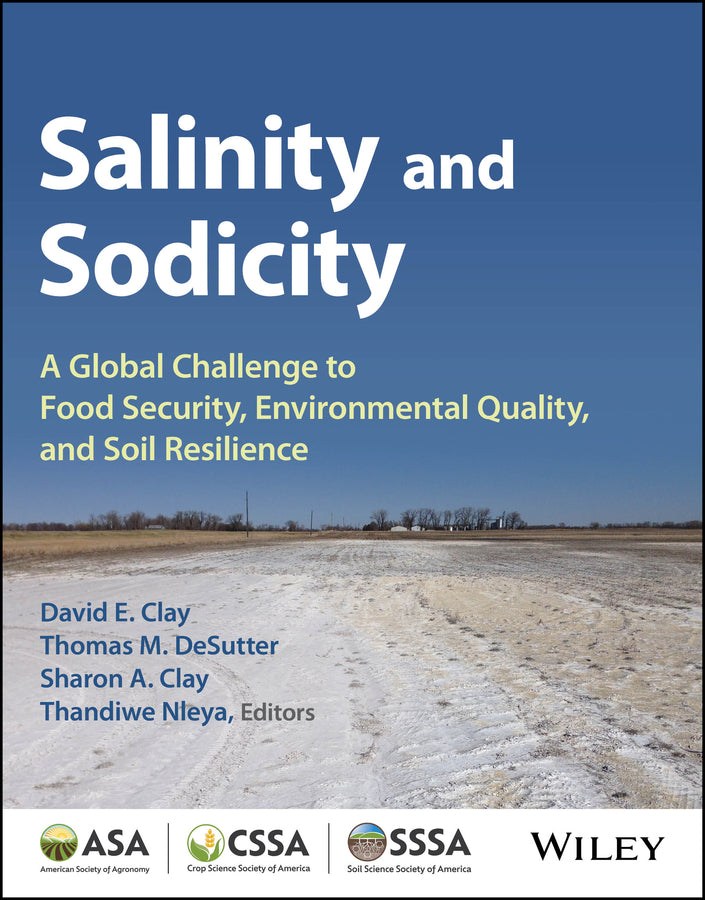
Salinity and Sodicity
A Growing Global Challenge to Food Security, Environmental Quality and Soil Resilience
David E. Clay (Edited by), Thomas M. DeSutter (Edited by), Sharon A. Clay (Edited by), Thandiwe Nleya (Edited by)
9780891183983, Wiley
Paperback / softback, published 22 August 2024
192 pages
27.4 x 21.5 x 1.4 cm, 0.567 kg
Explore the growing problem of soil salinity and sodicity and its impact on the environment, profitability, the human population, and soil resilience In Salinity and Sodicity: A Global Challenge to Food Security, Environmental Quality, and Soil Resilience, a team of distinguished educators delivers an expert discussion of salinity and sodicity management. This book is designed to improve the problem-solving capabilities of students, soil health professionals, certified crop advisors, and other practicing professionals in this area. In addition to an introduction to the causes of a rapidly growing problem, Salinity and Sodicity explores different measurement techniques, provides answers to common questions, provides potential solutions in a way that’s appropriate for introductory classes on soil salinity and sodicity management. It’s an ideal reference manual for professionals, as well as an effective tool for classrooms and crop advisor workshops. Readers will also find: Perfect for undergraduate, graduate, and doctoral students and certified and practicing soil professionals and advisors, Salinity and Sodicity will also benefit industry and academic researchers with an interest in soil salinity and sodicity in dryland regions.
Scope xv 1 An Introduction to Salinity and Sodicity 1 2 Salinity, the Silent Profit Killer 7 3 Formation and Classification of Salt-Affected Soils 1 4 Laboratory Methods for Determining Salinity and Sodicity 31 5 Monitoring Soil Salinity and Water Content with Electromagnetic Sensors 41 6 Using Soil Sensors to Assess Soil Salinity 51 7 Use of Models to Assess Salinity and Water Stress for Irrigated Corn (Zea mays) Production 57 8 How to Use Remote Sensing to Identify Salt-affected Soil 63 9 Plant Reponses to Salt Stress 73 10 Native Plant Restoration of Salt-impacted Soils 85 11 Benefits of Phytoremediation when Repairing Salt-affected Soils 93 12 Water Management and Chemical Amendments in the Remediation of Saline and Sodic Soils 99 13 An Introduction to Coastal Flooding Impact on Salinity and Sodicity in Agricultural Fields 113 14 Greenhouse Gas Emissions from Salt-Affected Soils 121 15 Case Studies on Salt-Affected Soil Remediation 129 16 Critical Questions About the Origins and Plant Responses to Soil Salinity and Sodicity 143 Answer Key 157
Shaina Westhoff, David E. Clay, Kristopher Osterloh, Sharon A. Clay, Thomas M. DeSutter, Thandiwe Nleya, Jorge F. S. Ferreira, Donald L. Suarez, and Devinder Sandhu
Kyle P. Jore and Joleen C. Hadrich
Shaina Westhoff, Kristopher Osterloh, and Doug Malo
Thomas M. DeSutter, David E. Clay, J.D. Oster, Shanna Westhoff, and Beverly Alvarez-Torres
Thijs J. Kelleners
Shailesh Pandit and David E. Clay
J. D. Oster and Aaron L. M. Daigh
Jiyul Chang and Jose P. Castro
Thandiwe Nleya, Sharon A. Clay, Lora Perkins, and Chantel Mertz
Lora Perkins, Abigail Blanchard, Krista Ehlert, and A. Joshua Leffler
Sharon A. Clay
Shaina Westhoff, Thomas M. DeSutter, J. D. Oster, and David E. Clay
Jarrod Miller
David E. Clay, Brennan Lewis, Sharon A. Clay, Shailesh Pandit, and Graig Reicks
David E. Clay, Shailesh Pandit, and Dwarika Bhattarai
Jorge F. S. Ferreira, Donald L. Suarez, and Devinder Sandhu
Subject Areas: Earth sciences [RB]