Freshly Printed - allow 10 days lead
Couldn't load pickup availability
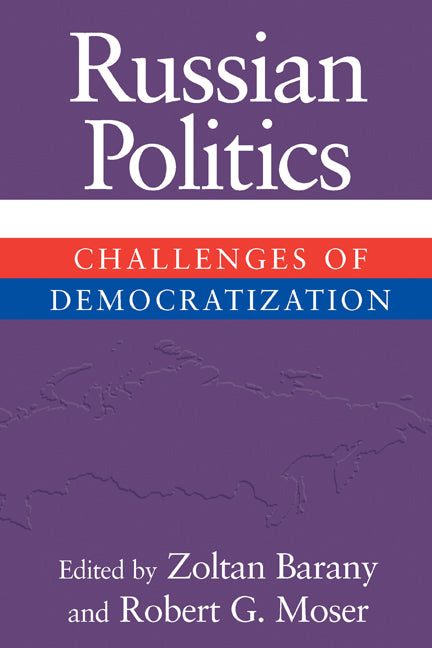
Russian Politics
Challenges of Democratization
First published in 2001, this book assesses five crucial political arenas during the Yeltsin era.
Zoltan Barany (Edited by), Robert G. Moser (Edited by)
9780521805124, Cambridge University Press
Paperback / softback, published 27 August 2001
276 pages, 9 tables
22.9 x 15.3 x 1.7 cm, 0.38 kg
'Michael McFaul's chapter on Russian elections is one of the best and most useful for students of Russia … The well-written conclusion is among many other merits of the book. It skilfully assesses whether overall Russia has been successful in building a true democracy.' Choice
What went wrong in Russia's decade-old post-communist transition? A group of leading young scholars answer this question by offering assessments of five crucial political arenas during the Yeltsin era: elections, executive-legislative relations, interactions between the central state and the regions, economic reforms, and civil-military relations. All of the contributors recognize that adverse historical legacies have complicated Russian democratization. They challenge structural explanations that emphasize constraints of the pre-existing system, however, and concentrate instead on the importance of elite decisions and institution-building. The authors agree that elites' failure to develop robust political institutions has been a central problem of Russia's post-communist transition. The weakness of the state and its institutions has contributed to a number of serious problems threatening democratic consolidation. These include the tensions between the executive and the legislature, the frail infrastructure for successful market reform, and the absence of proper civilian control over the armed forces.
Introduction: challenges of Russian democratization Robert G. Moser
1. Russian electoral trends Michael McFaul
2. Executive-legislative relations in Russia, 1991–9 Robert G. Moser
3. The Russian Central State in crisis: center and periphery in the post-Soviet era Kathryn Stoner-Weiss
4. Russian economic reform, 1991–9 Yoshiko M. Herrera
5. Politics and the Russian Armed Forces Zoltan Barany
6. Conclusion: democracy and Russian politics M. Steven Fish
Notes.
Subject Areas: Politics & government [JP], Regional studies [GTB]