Freshly Printed - allow 10 days lead
Couldn't load pickup availability
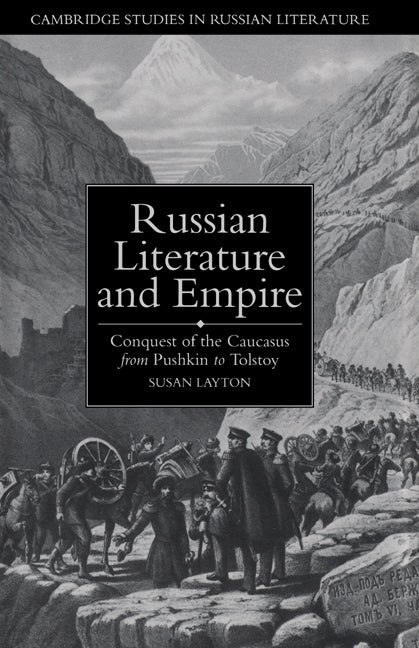
Russian Literature and Empire
Conquest of the Caucasus from Pushkin to Tolstoy
The first book to provide a synthesising study of Russian writing about the Caucasus during the nineteenth-century age of empire-building.
Susan Layton (Author)
9780521444439, Cambridge University Press
Hardback, published 26 January 1995
372 pages, 1 map
22.4 x 14.5 x 2.8 cm, 0.62 kg
"In laying bare the ambivalent and often contradictory expectations of this market, Layton is acute and perceptive...there is much to be learnt from this investigation of an imperial relationship which contained elements of both the creative and the destructive." Goeffrey Hosking, Russian Literature
This is the first book to provide a synthesising study of Russian writing about the Caucasus during the nineteenth-century age of empire-building. From Pushkin's ambivalent portrayal of an alpine Circassia to Tolstoy's condemnation of tsarist aggression against Muslim tribes in Hadji Murat, the literary analysis is firmly set in its historical context, and the responses of the Russian readership too receive extensive attention. As well as exploring literature as such, this study introduces material from travelogues, oriental studies, ethnography, memoirs, and the utterances of tsarist officials and military commanders. While showing how literature often underwrote imperialism, the book carefully explores the tensions between the Russian state's ideology of a European mission to civilise the Muslim mountaineers, and romantic perceptions of those tribes as noble primitives whose extermination was no cause for celebration. By dealing with imperialism in Georgia as well, the study shows how the varied treatment of the Caucasus in literature helped Russians construct a satisfying identity for themselves as a semi-European, semi-Asian people.
Acknowledgements
Map
1. Introduction
2. The poet and terra incognita
3. Imaginative geography
4. Sentimental pilgrims
5. The national stake in Asia
6. The Pushkinian mountaineer
7. Bestuzhev-Marlinsky's interchange with the tribesman
8. Early Lermontov and oriental machismo
9. Little orientalizers
10. Feminizing the Caucasus
11. Georgia as an oriental woman
12. The anguished poet in uniform
13. Tolstoy's revolt against romanticism
14. Post-war appropriation of romanticism
15. Tolstoy's confessional indictment
16. Concluding observations
Notes
Bibliography
Index.
Subject Areas: Literary studies: c 1800 to c 1900 [DSBF]