Freshly Printed - allow 10 days lead
Couldn't load pickup availability
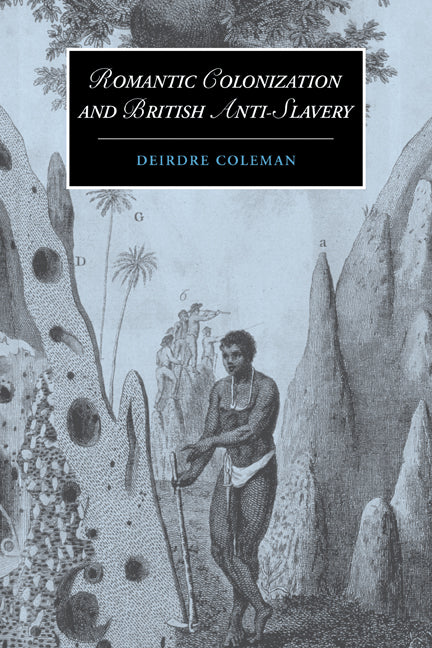
Romantic Colonization and British Anti-Slavery
Deirdre Coleman shows how the growing popularity of the anti-slavery movement gave a utopian cast to the debate about colonization.
Deirdre Coleman (Author)
9780521102711, Cambridge University Press
Paperback / softback, published 12 March 2009
296 pages, 14 b/w illus.
22.9 x 15.2 x 1.7 cm, 0.44 kg
"A great strength of the book is its historical depth. Coleman is a literary scholar who is also an extremely good historian. She uncovers compelling evidence about the people who produced the texts she examines; the study of the 'flycatcher' Smeathman is done particularly well. Coleman has an eye for contradiction and ambiguity. She allows her subjects to breathe, as it were, and doesn't try to smooth over human complexity.... The vivid detail and deft nuance of each study makes every section not only illuminating but also very readable. - The International Journal of African Historical Studies
The loss of Britain's North American colonies sparked an intense debate about the nature of colonization in the period 1770–1800. Drawing on archival research into colonies in Africa and Australia, including Sierra Leone and Botany Bay, Deirdre Coleman shows how the growing popularity of the anti-slavery movement gave a utopian cast to the debate about colonization. This utopianism can be seen most clearly in Romantic attempts to found an empire without slaves, a new world which would also encompass revolutionary sexual, racial and labour arrangements. From Henry Smeathman and John Clarkson in Sierra Leone to Arthur Phillip and William Dawes in Botany Bay, Coleman analyses the impact of the discourses and ideals underlying Romantic colonization. She argues that these paved the way for racial strife in West Africa and the eventual dispossession of Australia's native people.
List of illustrations
Acknowledgements
Introduction: the Cowpastures
1. Henry Smeathman, imperial flycatcher and aeronaut
2. The 'microscope of enthusiasm': Swedenborgian ideas about Africa
3. Rallying under the flag of Empire: the Nova Scotians in Sierra Leone
4. 'New Albion': the camp at Port Jackson
5. Etiquettes of colonisation and dispossession
Epilogue
Notes
Bibliography
Index.
Subject Areas: Literary studies: c 1800 to c 1900 [DSBF]