Freshly Printed - allow 7 days lead
Couldn't load pickup availability
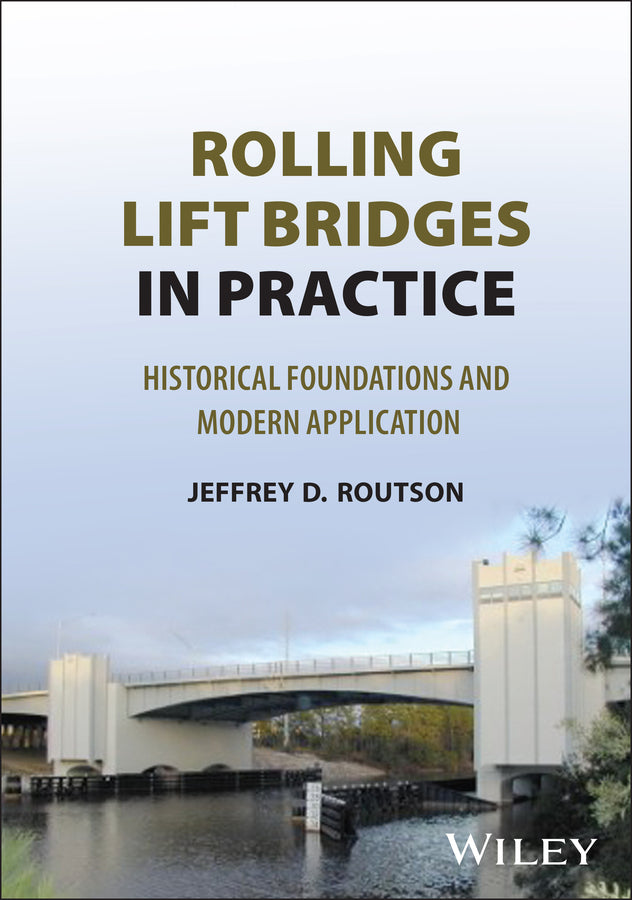
Rolling Lift Bridges in Practice
Historical Foundations and Modern Application
Jeffrey D. Routson (Author)
9781394347469, Wiley
Hardback, published 13 January 2026
240 pages
25.4 x 18.3 x 2 cm, 0.635 kg
PROVIDES A DEFINITIVE GUIDE TO THE DESIGN, EVOLUTION, AND PRACTICAL APPLICATION OF SCHERZER ROLLING LIFT BRIDGES Rolling Lift Bridges in Practice: Historical Foundations and Modern Application addresses a critical gap in contemporary bridge engineering literature by offering both a historical framework and a modern technical guide to Scherzer rolling lift bridges. For engineers tasked with designing resilient, movable structures that accommodate growing transportation demands, this authoritative book delivers the essential understanding to integrate proven mechanisms with today’s performance expectations. Author Jeffrey Routson traces the lineage of the Scherzer rolling lift bridge from its origins, through its technological evolution, and up to its current role in infrastructure development. Routson’s analysis details how these bridges have adapted to advancements in materials, mechanical systems, and aesthetics while maintaining the integrity of Scherzer’s original concept. In-depth chapters discuss the integration of rolling lift systems with modern technologies, clarify design codes and standards relevant to movable bridge construction and rehabilitation, provide clear technical guidance on optimizing components and assessing and retrofitting aging bridges, and much more. Empowering bridge and structural engineers to apply time-tested principles with confidence in a present-day context, Rolling Lift Bridges in Practice: Supplying original engineering insights from the author’s experience with award-winning bascule bridge projects, Rolling Lift Bridges in Practice: Historical Foundations and Modern Application is ideal for graduate and upper-level undergraduate courses in structural engineering, bridge design, or transportation infrastructure, particularly within civil engineering degree programs. It is also an invaluable reference for professional bridge engineers, infrastructure planners, historians, and consulting firms involved in movable bridge projects.
About the Author xi Preface xiii Acknowledgments xvii Abbreviations and Symbols xix Part I Historical Considerations 1 1 Heaven and Earth, Water and Fire 3 Note 5 2 Seas, Lakes, Rivers, Canals 7 Notes 10 3 Chicago, Illinois 11 Note 13 4 Peru, Illinois 15 5 The Mid-nineteenth-Century Generation 17 Notes 21 6 The Hazelet and Meals Families 23 Notes 26 7 The Sanitary District of Chicago 29 8 William D. Scherzer, Engineer and Inventor 31 Note 34 9 Scherzer Rolling Lift Bridge Co. − The Early Years 35 Notes 40 10 Chicago’s Bridge Department 41 Notes 47 11 Albert Scherzer’s Death 49 Notes 55 12 Keller & Harrington 57 Notes 58 13 The Scherzer Rolling Lift Bridge Co. 1922–1936 59 Note 60 14 Hazelet & Erdal 61 Notes 65 Part II Technical Considerations 67 15 Early Movable Bridge Types 69 Notes 74 16 Modern Bascule Bridges 75 Note 81 17 Myths, Misunderstandings, and Factual Errors 83 Notes 95 18 Loads and Leaf Balance 97 Notes 104 19 Structural Forms for Bascule Spans 105 20 Foundations 111 Notes 116 21 Treads, Tracks, and Their Girders 117 Segmental Girders and Track Girders 141 Notes 145 22 Bascule Structure 147 Notes 161 23 Mid-span Shear Locks 163 Notes 169 24 Operating Systems 171 Notes 179 25 Safety Features 181 Notes 186 Appendix A List of Rolling Lift Bridges 187 Appendix B List of US Patents 201 Bibliography 205 Index 213
Subject Areas: Civil engineering, surveying & building [TN]