Freshly Printed - allow 7 days lead
Couldn't load pickup availability
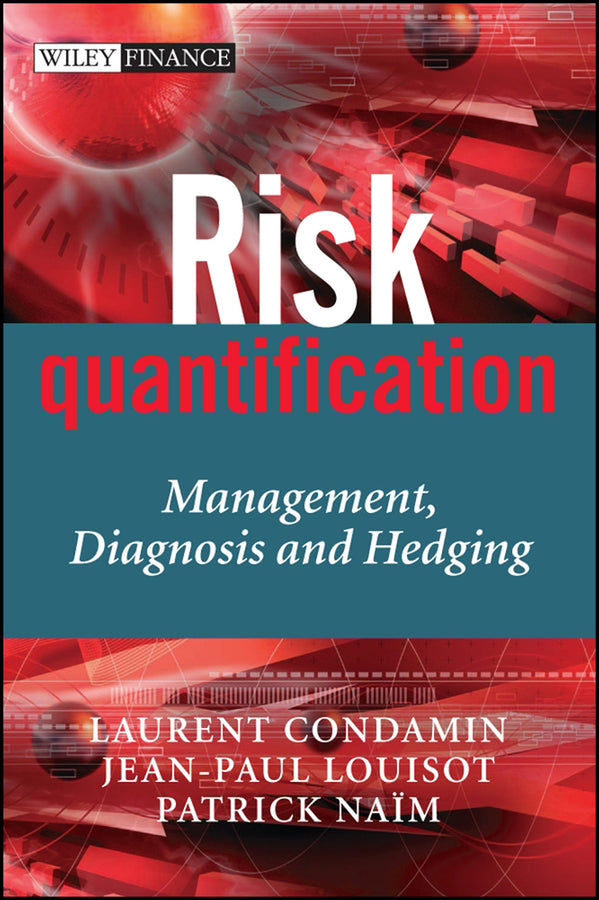
Risk Quantification
Management, Diagnosis and Hedging
Laurent Condamin (Author), Jean-Paul Louisot (Author), Patrick Na¿m (Author)
9780470019078, Wiley
Hardback, published 8 December 2006
288 pages
25.2 x 17.5 x 2.3 cm, 0.694 kg
"Risk Quantification" ist das bislang einzige Buch auf dem Markt, das eine aktuelle und umfassende Betrachtung des Bereiches Risikomanagement bietet, wobei der Schwerpunkt klar auf der Quantifizierung von Risiken und weniger auf dem reinen Management liegt. Es vermittelt ein fundiertes Verständnis der zur Ermittlung des Risikopotenzials einsetzbaren Tools. Dabei geht es sowohl um die Quantifizierung des Risikos als auch um die Wahrscheinlichkeit des Risikoereignisses, seine Häufigkeit und Eintrittswahrscheinlichkeit. Der Band gliedert sich in drei Teile. Teil 1 beschreibt die Grundlagen des Risikomanagement als einen dreistufigen Prozess - Diagnose, Verminderung und Finanzierung des Risikos - und demonstriert, warum die Quantifizierung (Messung, Bewertung und Analyse) von Risiken in allen Phasen des Prozesses so wichtig ist. Der Schwerpunkt liegt klar auf der praktischen Herangehensweise an das Problem und weniger auf statistischen Analyseverfahren.
Teil 2 stellt ein bewährtes Toolset zur Risikoquantifizierung vor, erläutert sog. Score Cards zur Bewertung wichtiger Risikoindikatoren sowie Monte Carlo Simulation und Bayesianische Netze als Quantifizierungsansatz für die Risikomodellierung.
Teil 3 demonstriert dann anschaulich anhand von Fallstudien, wie das Toolset auf die drei Stufen des Risikomanagement in der Praxis angewendet wird.
Foreword xi Introduction xiii 1 Foundations 1 Risk management: principles and practice 1 Definitions 3 Systematic and unsystematic risk 4 Insurable risks 4 Exposure 7 Management 7 Risk management 7 Risk management objectives 8 Organizational objectives 8 Other significant objectives 10 Risk management decision process 11 Step 1–Diagnosis of exposures 11 Step 2–Risk treatment 16 Step 3–Audit and corrective actions 19 State of the art and the trends in risk management 20 Risk profile, risk map or risk matrix 20 Frequency × Severity 20 Risk financing and strategic financing 23 From risk management to strategic risk management 23 From managing physical assets to managing reputation 25 From risk manager to chief risk officer 26 Why is risk quantification needed? 27 Risk quantification – a knowledge-based approach 28 Introduction 28 Causal structure of risk 28 Building a quantitative causal model of risk 31 Exposure, frequency, and probability 33 Exposure, occurrence, and impact drivers 34 Controlling exposure, occurrence, and impact 35 Controllable, predictable, observable, and hidden drivers 35 Cost of decisions 36 Risk financing 37 Risk management programme as an influence diagram 38 Modelling an individual risk or the risk management programme 39 Summary 41 2 Tool Box 43 Probability basics 43 Introduction to probability theory 43 Conditional probabilities 45 Independence 49 Bayes’ theorem 50 Random variables 54 Moments of a random variable 57 Continuous random variables 58 Main probability distributions 62 Introduction–the binomial distribution 62 Overview of usual distributions 64 Fundamental theorems of probability theory 67 Empirical estimation 68 Estimating probabilities from data 68 Fitting a distribution from data 69 Expert estimation 71 From data to knowledge 71 Estimating probabilities from expert knowledge 73 Estimating a distribution from expert knowledge 74 Identifying the causal structure of a domain 74 Conclusion 75 Bayesian networks and influence diagrams 76 Introduction to the case 77 Introduction to Bayesian networks 78 Nodes and variables 79 Probabilities 79 Dependencies 81 Inference 83 Learning 85 Extension to influence diagrams 87 Introduction to Monte Carlo simulation 90 Introduction 90 Introductory example: structured funds 90 Risk management example 1 – hedging weather risk 96 Description 96 Collecting information 98 Model 99 Manual scenario 101 Monte Carlo simulation 101 Summary 104 Risk management example 2– potential earthquake in cement industry 104 Analysis 104 Model 106 Monte Carlo simulation 107 Conclusion 109 A bit of theory 109 Introduction 109 Definition 110 Estimation according to Monte Carlo simulation 111 Random variable generation 112 Variance reduction 113 Software tools 117 3 Quantitative Risk Assessment: A Knowledge Modelling Process 119 Introduction 119 Increasing awareness of exposures and stakes 119 Objectives of risk assessment 120 Issues in risk quantification 121 Risk quantification: a knowledge management process 122 The basel II framework for operational risk 122 Introduction 123 The three pillars 123 Operational risk 124 The basic indicator approach 124 The sound practices paper 125 The standardized approach 125 The alternative standardized approach 127 The advanced measurement approaches (AMA) 127 Risk mitigation 130 Partial use 130 Conclusion 131 Identification and mapping of loss exposures 131 Quantification of loss exposures 134 The candidate scenarios for quantitative risk assessment 134 The exposure, occurrence, impact (XOI) model 135 Modelling and conditioning exposure at peril 135 Summary 136 Modelling and conditioning occurrence 137 Consistency of exposure and occurrence 137 Evaluating the probability of occurrence 140 Conditioning the probability of occurrence 143 Summary 144 Modelling and conditioning impact 145 Defining the impact equation 145 Defining the distributions of variables involved 146 Identifying drivers 147 Summary 148 Quantifying a single scenario 148 An example – “fat fingers” scenario 150 Modelling the exposure 150 Modelling the occurrence 151 Modelling the impact 152 Quantitative simulation 154 Merging scenarios 157 Modelling the global distribution of losses 158 Conclusion 159 4 Identifying Risk Control Drivers 161 Introduction 161 Loss control – a qualitative view 163 Loss prevention (action on the causes) 164 Eliminating the exposure 164 Reducing the probability of occurrence 166 Loss reduction (action on the consequences) 166 Pre-event or passive reduction 166 Post-event or active reduction 167 An introduction to cindynics 169 Basic concepts 170 Dysfunctions 172 General principles and axioms 174 Perspectives 174 Quantitative example 1 – pandemic influenza 176 Introduction 176 The influenza pandemic risk model 177 Exposure 177 Occurrence 177 Impact 178 The Bayesian network 180 Risk control 181 Pre-exposition treatment (vaccination) 182 Post-exposition treatment (antiviral drug) 182 Implementation within a Bayesian network 183 Strategy comparison 185 Cumulated point of view 185 Discussion 188 Quantitative example 2 – basel II operational risk 189 The individual loss model 189 Analysing the potential severe losses 189 Identifying the loss control actions 189 Analysing the cumulated impact of loss control actions 191 Discussion 192 Quantitative example 3 – enterprise-wide risk management 194 Context and objectives 195 Risk analysis and complex systems 195 An alternative definition of risk 196 Representation using Bayesian networks 196 Selection of a time horizon 197 Identification of objectives 197 Identification of risks (events) and risk factors (context) 198 Structuring the network 199 Identification of relationships (causal links or influences) 200 Quantification of the network 200 Example of global enterprise risk representation 200 Usage of the model for loss control 201 Risk mapping 201 Importance factors 202 Scenario analysis 202 Application to the risk management of an industrial plant 203 Description of the system 203 Assessment of the external risks 204 Integration of external risks in the global risk assessment 207 Usage of the model for risk management 210 Summary – using quantitative models for risk control 210 5 Risk Financing: The Right Cost of Risks 211 Introduction 211 Risk financing instruments 212 Retention techniques 214 Current treatment 214 Reserves 215 Captives (insurance or reinsurance) 215 Transfer techniques 219 Contractual transfer (for risk financing – to a noninsurer) 219 Purchase of insurance cover 219 Hybrid techniques 220 Pools and closed mutual 220 Claims history-based premiums 222 Choice of retention levels 222 Financial reinsurance and finite risks 223 Prospective aggregate cover 225 Capital markets products for risk financing 225 Securitization 226 Insurance derivatives 227 Contingent capital arrangements 228 Risk financing and risk quantifying 230 Using quantitative models 231 Example 1: Satellite launcher 231 Example 2: Defining a property insurance programme 243 A tentative general representation of financing methods 252 Introduction 252 Risk financing building blocks 254 Usual financing tools revisited 257 Combining a risk model and a financing model 261 Conclusion 263 Index 267
Subject Areas: Finance & accounting [KF]