Freshly Printed - allow 7 days lead
Couldn't load pickup availability
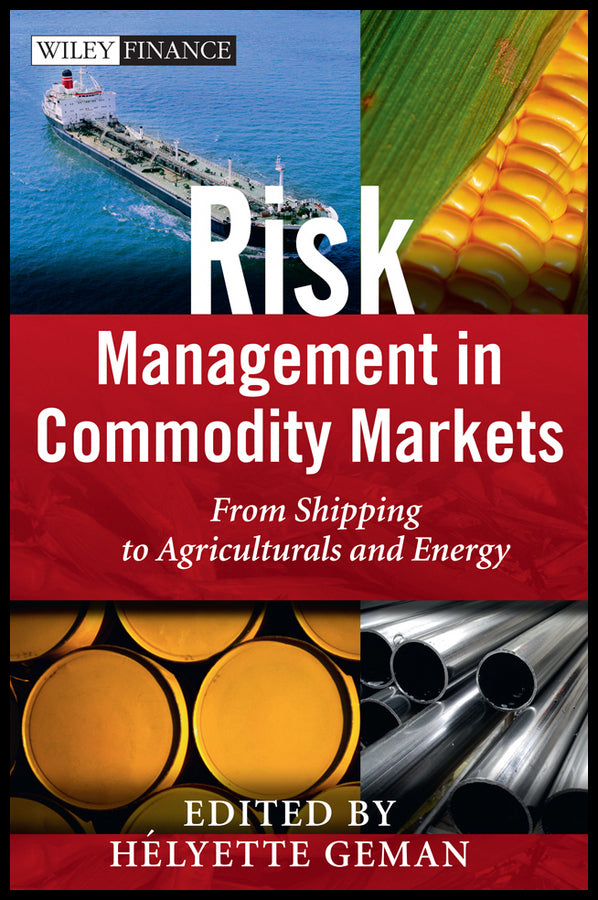
Risk Management in Commodity Markets
From Shipping to Agriculturals and Energy
Helyette Geman (Edited by)
9780470694251, Wiley
Hardback, published 14 November 2008
320 pages
24.9 x 17.8 x 2.5 cm, 0.737 kg
"... the wide range of issues covered in different ways should mean there is something for everyone." (Supply Management, February 5th 2009)
Commodities represent today the fastest growing markets worldwide. Historically misunderstood, generally under- studied and under- valued, certainly under- represented in the literature, commodities are suddenly receiving the attention they deserve. Bringing together some of the best authors in the field, this book focuses on the risk management issues associated with both soft and hard commodities: energy, weather, agriculturals, metals and shipping. Taking the reader through every part of the commodities markets, the authors discuss the intricacies of modelling spot and forward prices, as well as the design of new Futures markets. The book also looks at the use of options and other derivative contract forms for hedging purposes, as well as supply management in commodity markets. It looks at the implications for climate policy and climate research and analyzes the various freight derivatives markets and products used to manage shipping and freight risk in a global commodity world. It is required reading for energy and mining companies, utilities’ practitioners, commodity and cash derivatives traders in investment banks, CTA’s and hedge funds
Preface xi About the Editor xv About the Contributors xvii 1 Structural Models of Commodity Prices 1 1.1 Introduction 1 1.2 A Commodity Taxonomy 1 1.3 Fundamental Models for Storable Commodities 2 1.4 Non-Storable Commodities 6 1.5 Summary 7 1.6 References 7 2 Forward Curve Modelling in Commodity Markets 9 2.1 Introduction 9 2.2 Forward Curve Models for Non-Seasonal Commodities 14 2.3 The Seasonal Forward Curve Model and its Extensions 17 2.4 Principal Component Analysis of a Forward Curve 24 2.5 Forward Curve Indicators 26 2.6 Conclusions 31 2.7 References 31 3 Integrating Physical and Financial Risk Management in Supply Management 33 3.1 Introduction 33 3.2 A Primer On Previous Supply Management Contracting Literature 35 3.3 A Modelling Framework and a Simple Illustrative Case 37 3.4 Recent Contributions to the Optimal Contracting Literature 44 3.5 Some Open Research Questions and Implications for Practice 46 3.6 References 49 4 The Design of New Derivative Markets 51 4.1 Introduction 51 4.2 Determinants of Success of New Derivative Markets 52 4.3 Price Discovery 53 4.4 Trading, Clearing, and Margining 54 4.5 Market Integrity 55 4.6 Market Recovery 56 4.7 Market Oversight 56 4.8 Case Studies 57 4.9 Conclusion 58 4.10 References 58 5 Risk Premia of Electricity Futures: A Dynamic Equilibrium Model 61 5.1 Introduction 61 5.2 The Dynamic Equilibrium Model 62 5.3 Comparative Statics 64 5.4 Empirical Study 73 5.5 Conclusion 77 5.6 References 80 6 Measuring Correlation Risk for Energy Derivatives 81 6.1 Introduction 81 6.2 Correlation 81 6.3 Perturbing the Correlation Matrix 82 6.4 Correlation VaR 85 6.5 Some Examples 85 6.6 Discussion and Conclusions 88 6.7 References 89 7 Precaution and a Dismal Theorem: Implications for Climate Policy and Climate Research 91 7.1 Introduction 91 7.2 A New Source of Concern: Weitzman’s Dismal Theorem 93 7.3 Implications of the “Dismal Theorem” 94 7.4 Some Concluding Remarks 96 7.5 References 97 8 Incentives for Investing in Renewables 101 8.1 Introduction and Background 101 8.2 Subsidies for Energy 103 8.3 The Model 104 8.4 Statistical Estimations 107 8.5 Risk Analysis 109 8.6 Conclusions 114 8.7 References 115 9 Hedging the Risk of an Energy Futures Portfolio 117 9.1 Mapping Portfolios to Constant Maturity Futures 117 9.2 The Portfolio and its Key Risk Factors 120 9.3 Identifying the Key Risk Factors 123 9.4 Hedging the Portfolio Risk 124 9.5 Conclusions 127 9.6 References 127 10 Spark Spread Options when Commodity Prices are Represented as Time Changed Processes 129 10.1 Spark Spread Options 130 10.2 Time Change in a Nutshell 132 10.3 Time Change and Commodity Prices 134 10.4 An Application to PJM Electricity and NYMEX Natural Gas 137 10.5 Conclusions and Further Research 144 10.6 Appendix A: Modelling Specification in the Multivariate Case 145 10.7 Appendix B: Alternative Modelling Specifications in the Univariate Case 147 10.8 References 150 11 Freight Derivatives and Risk Management: A Review 153 11.1 Introduction 153 11.2 Forward Freight Agreements 154 11.3 Freight Futures 157 11.4 “Hybrid” (Cleared) FFAs 161 11.5 Freight Options 162 11.6 Empirical Research on Freight Derivatives 164 11.7 Conclusion 178 11.8 References 179 12 Mean-Reversion and Structural Breaks in Crude Oil, Copper, and Shipping 183 12.1 Introduction 183 12.2 Fundamentals of Copper, Crude Oil, and Shipping 186 12.3 Defining Mean-Reversion 191 12.4 Dataset and Unit Root Tests 193 12.5 Conclusion 203 12.6 References 204 13 Managing Agricultural Price Risk in Developing Countries 207 13.1 The Liberalization Context 207 13.2 Incidence of Risk Exposure 209 13.3 Instruments and Problems 215 13.4 Price Risk Management in the Developing Country Supply Chain 221 13.5 Concluding Comments 234 13.6 References 236 14 Gaining Exposure to Emerging Markets in Institutional Portfolios: The Role of Commodities 239 14.1 Introduction 239 14.2 Asset Markets and Economic Growth 239 14.3 Are Emerging Markets Equity Markets and Commodity Markets Integrated? 244 14.4 Implications for the Investment Policy of Institutional Investors 247 14.5 Conclusion 254 14.6 References 254 15 Case Studies and Risk Management in Commodity Derivatives Trading 255 15.1 Introduction 255 15.2 Institutional Risk Management 258 15.3 Proprietary-Trading Risk Management 265 15.4 Hedge Fund Risk Management 266 15.5 Fund-of-Hedge-Funds Diversification 266 15.6 Market Risk Management 267 15.7 Conclusion 288 15.8 References 288 Index 293
Craig Pirrong, University of Houston
Svetlana Borovkova, Universiteit Amsterdam, and Hélyette Geman, University of London and ESSEC
Paul R. Kleindorfer, University of Pennsylvania and INSEAD
Giovanni Barone-Adesi, The Swiss Finance Institute and The University of Lugano
Wolfgang Bühler, University of Mannheim, and Jens Müller-Merbach, BHF-Bank Aktiengesellschaft
Roza Galeeva, Jiri Hoogland, and Alexander Eydeland, CMG, Morgan Stanley
Gary W. Yohe, Wesleyan University and Richard S. J. Tol, Economic and Social Research Institute, Dublin
Falbo Paolo, University of Brescia, Felletti Daniele and Stefani Silvana, University of Milano Bicocca
Carol Alexander, ICMA Centre, University of Reading
Elisa Luciano, University of Turin
Manolis G. Kavussanos, Athens University of Economics and Business, and Ilias D. Visvikis, ALBA Graduate Business School, Athens
Hélyette Geman, University of London and ESSEC Business School, and Steve Ohana, University of London
Julie Dana, The World Bank, and Christopher L. Gilbert, University of Trento and University of London
George A. Martin, Alternative Investment Analytics LLC and University of Massachusetts at Amherst, and Richard Spurgin, Clark University and Alternative Investment Analytics LLC
Hilary Till, Premia Capital Management LLC
Subject Areas: Finance & accounting [KF]