Freshly Printed - allow 7 days lead
Couldn't load pickup availability
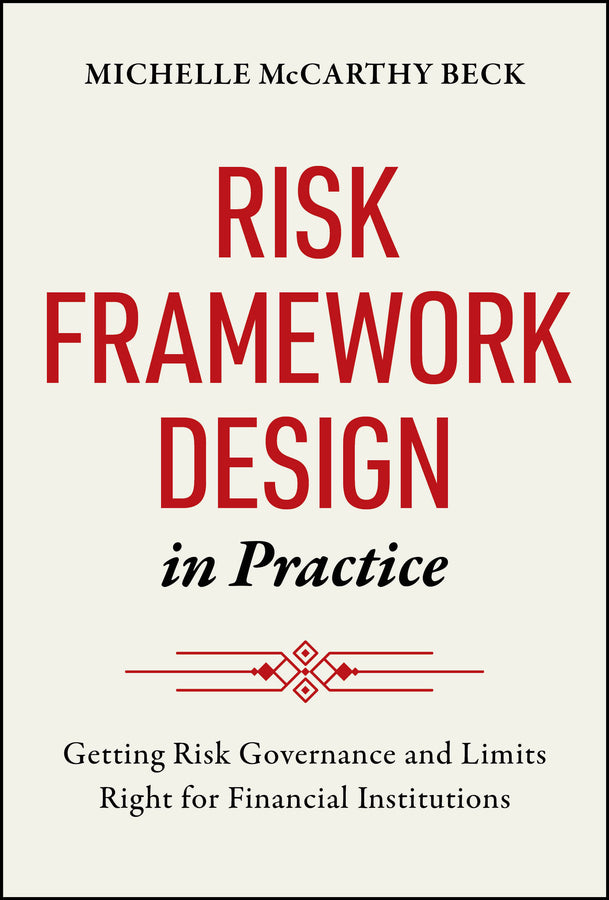
Risk Framework Design in Practice
Getting Risk Governance and Limits Right for Financial Institutions
Michelle McCarthy Beck (Author)
9781394378654, Wiley
Hardback, published 13 April 2026
448 pages
23.1 x 16.3 x 4.1 cm, 0.658 kg
A comprehensive and practical collection of tools and frameworks for risk governance at banks, insurance firms, asset managers, and other financial organizations In Risk Framework Design in Practice: Getting Risk Governance and Limits Right for Financial Institutions, veteran portfolio and risk manager, Michelle Beck, delivers a robust and functional approach to risk governance that’s perfect for financial institution managers and executives. Beck skips the high-level bromides, avoids narrowly considering only one type of asset class or financial institution, and instead offers practical guidance for leaders across the full scope of the industry seeking to answer critical risk management questions: What types of risk limits are necessary? How many of them does my organization need? How should they be set? Are minimum regulatory standards sufficient to safeguard my company’s interests? Risk Framework Design in Practice provides an effective structure for enterprise risk limits in different types of firms, including banks, asset managers, insurers, and corporate pensions. It explains how these types of firms should establish risk appetites, the essential pieces of their governance structures, and how to ensure the right information is in the right hands at the right times. It also includes: Risk Framework Design in Practice is an effective resource for chief risk officers and professionals working in enterprise risk departments at banks, broker dealers, insurance companies, asset managers, and hedge funds. Also perfect for board members at banks and insurance companies, in-house counsel at financial firms, and bank and securities regulators.
Foreword xi A Note On Language In This Book xx About the Author xxiii Chapter One Overview of Enterprise Risk Frameworks 1 Purpose and Philosophy of Risk Limits 3 Setting a Total Risk Limit at the Top of the Enterprise: Interaction with Return on Equity, Cost of Equity, and Other Corporate Objectives 14 Lessons from Risk Governance Gone Wrong 18 What Does Effective Challenge Look Like? 31 Profitable Strategies and Event Risk 33 Distinctions Between Risk Controls and Financial Controls 35 Differences and Establishing Limits/Tolerances by Type of Financial Institution 40 Where Is Governance Needed? 48 Exercises for Chapter One 53 Answer Key 54 Chapter Two Risks of Degree: An Overview 55 Market Risks for Public Markets 57 Exercises for Chapter Two 72 Answer Key 72 Chapter Three Risks of Degree: the “big Six” for Market Risk, Part I 73 Notional and Principal Limits 74 Exposure Limits 89 Value at Risk 151 Exercises for Chapter Three 188 Answer Key 190 Chapter Four Risks of Degree: the “big Six” for Market Risk, Part II 191 Stress Tests and Scenario Analysis 191 Liquidity: Concentration and Market Participation Limits 199 Stop- Loss and Drawdown Limits 241 Summary of Chapters Three and Four: How the “Big Six” Work Together to Maximize Strengths and Minimize Weaknesses 244 Exercises for Chapter Four 248 Answer Key 249 Chapter Five Risks of Degree: Credit Exposure and Potential Loss Limits 251 Limiting Commitments 252 Credit Default and Ratings Change Risk Limits 258 Interplay of Market Risk and Counterparty Credit 263 Collateral Considerations 272 Credit Default Derivatives as a Hedge 273 Exercises for Chapter Five 275 Answer Key 276 Chapter Six Binary Risks 277 Understanding Binary, One- Tailed Risks 280 Operational Risk Program Design 285 Key Risk Indicators 297 Specialized Operational Risk Programs 298 Compliance Program Design 302 Exercises for Chapter Six 314 Answer Key 315 Chapter Seven Model Risk Controls 317 How and Why Did Model Risk Controls Develop? 317 How Do We Define a “Financial Model?” 319 What Makes a Model High- Risk? 321 What Controls Can Be Applied to Manage Financial Model Risk? 339 Additional Words for the Wise 362 Exercises for Chapter Seven 366 Answer Key 368 Chapter Eight Risk Governance for Private Assets 369 Risk Management Frameworks for Stand- Alone Private Asset Investment Funds 372 Incorporating Private Assets into Multiasset Portfolios 380 Exercises for Chapter Eight 386 Answer Key 387 Notes 389 Index 401
Subject Areas: Finance & accounting [KF]