Freshly Printed - allow 10 days lead
Couldn't load pickup availability
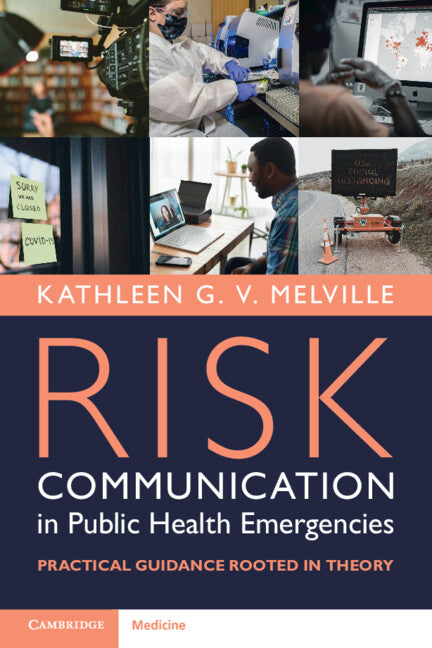
Risk Communication in Public Health Emergencies
Practical Guidance Rooted in Theory
All you need to plan, create, deliver and evaluate crisis and emergency risk communication before, during and after health emergencies.
Kathleen G. V. Melville (Author)
9781009449038, Cambridge University Press
Paperback / softback, published 19 June 2025
342 pages
23.3 x 15.5 x 1.8 cm, 0.52 kg
'Dr. Melville offers a timely and very thought-provoking book. Reflecting on the COVID-19 pandemic, it is easy to acknowledge the important role of crisis and emergency risk communication. The book is well written, and the case studies portray easily relatable examples for most professionals responsible for communications or who are positioned on the periphery of the communications functions. The skills to be gained in these pages will strengthen our collective ability to respond efficiently, effectively, and cohesively to health security challenges during the next pandemic or during the next disaster in your area of responsibility.' Stephen Murphy, Ph.D., MPH, MBA, Program Director - MS in Health Security, and Director of the Region 6 Center for Health Security and Response Readiness at Tulane University C. S. Weatherhead School of Public Health and Tropical Medicine
This book clearly explains how public health officials plan, deliver, and evaluate crisis and emergency risk communication before, during, and after health emergencies. Organized into four parts - precrisis planning, communicating during a health emergency, communicating and evaluating after a health emergency, and crisis leadership - it offers practical information as well as the opportunity to reflect on emergency risk communication best practices and theories. Including information on precrisis planning, implications of public health law, developing communication plans, writing messages, evaluating emergency risk communication, and crisis leadership, this book brings together theory and practical application to provide working professionals with evidence-based research and practical knowledge to effectively communicate during health emergencies. Case studies of emergencies such as COVID-19, Zika, Ebola, Mpox, and water crises all use the US Centers for Disease Control and Prevention's Crisis and Emergency Risk Communication framework to analyze how health officials provided accurate and actionable health information to the public.
1. Why you need to care about emergency risk communication
Part I. Precrisis Planning
2. Precrisis planning is necessary for public information and emergency communications: Leveraging what you've got
3. Identifying who needs to know what and when: It's not a surprise what your audiences need to know
4. Addressing the information needs of the public and medical community during a public health emergency
5. How to get the message out: Understanding all of your communication channels and when to use them
Part II. Communicating during a Health Emergency
6. Initial messages during a health emergency: addressing uncertainty and creating trust with the public
7 Maintenance messages during a health emergency: How to protect the public's health and debunking misinformation
8. Communicating during long public health emergencies: Creating health communication campaigns
Part III. Communicating and Planning after a Health Emergency
9. Pivoting from crisis management to recovery: Communicating the end of a health emergency
10. Evaluating emergency risk communication and engaging in public education for the next emergency
Part IV. Crisis Leadership
11. Effective communication during a health emergency: The role of the spokesperson and working with the media
12. Crisis leadership: Staying steady on unsteady ground
Index.
Subject Areas: Epidemiology & medical statistics [MBNS]