Freshly Printed - allow 10 days lead
Couldn't load pickup availability
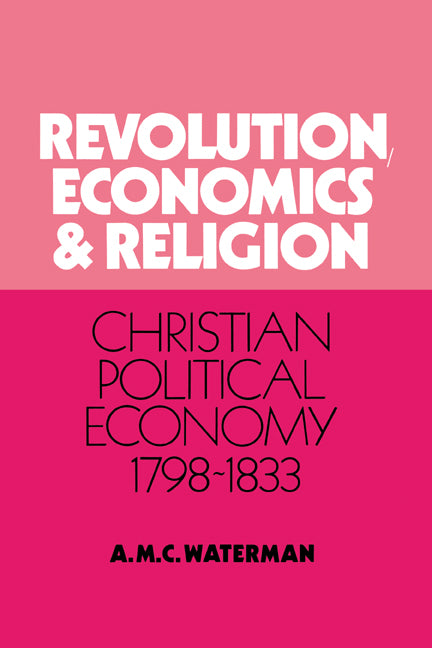
Revolution, Economics and Religion
Christian Political Economy, 1798–1833
Professor Waterman analyses the story of the 'intellectual repulse of revolution', and describes the ideological alliance of political economy and Christian theology after 1798.
A. M. C. Waterman (Author)
9780521394475, Cambridge University Press
Hardback, published 30 August 1991
328 pages
23.7 x 15.8 x 2.3 cm, 0.602 kg
"This is a clearly structured and well-written book on the sort of interdisciplinary issue that we all pay homage to but seldom engage in....There is a great deal of very valuable material here: the delineation of the common ground between Godwin and Malthus; the extent to which Godwin adumbrates Marxian thought; the connection between Abraham Tucker and Malthus; the emphasis on theology and the importance of doctrine to those intended for the Church; and the importance of Paley at Cambridge. Much can be learned by paying attention to what Waterman has to say on these issues." Salim Rashid, History of Political Economy
Malthus's Essay on Population was seen in 1798 as a complete refutation of Godwin and all 'Jacobin' ideology. It proved that a state of equality and justice for all was unfeasible; and it demonstrated the inevitability and beneficence of private property and political institutions. But its central theme, the dominance of scarcity in human affairs, presented the theological 'problem of evil' in novel and threatening form. For thirty-five years both the economics and the theology of the Essay were modified and refined: first by Paley, Sumner and Malthus himself, and later by Copleston, Whately and Chalmers. The result was 'Christian Political Economy': an ideological alliance of political economy and Christian theology, congenial to a new 'liberal-conservatism' in the early nineteenth century, which found middle ground between the ultra-tory defence of the ancien régime and a 'radical' repudiation of existing institutions. Professor Waterman analyses this story of the 'intellectual repulse of revolution', and describes the ideological alliance of political economy and Christian theology after 1798.
List of figures
Acknowledgements
Abbreviations
1. Polemic, ideology and 'christian political economy'
2. The first Essay on Population: political economy
3. The first Essay on Population: theology
4. The reconstruction of Malthusian theodicy: Paley and Sumner
5. Oxford contributions: Copleston and Whately
6. Chalmers and the establishment
7. The end of christian political economy
Appendices
Bibliography
Index.
Subject Areas: History of ideas [JFCX]