Freshly Printed - allow 7 days lead
Couldn't load pickup availability
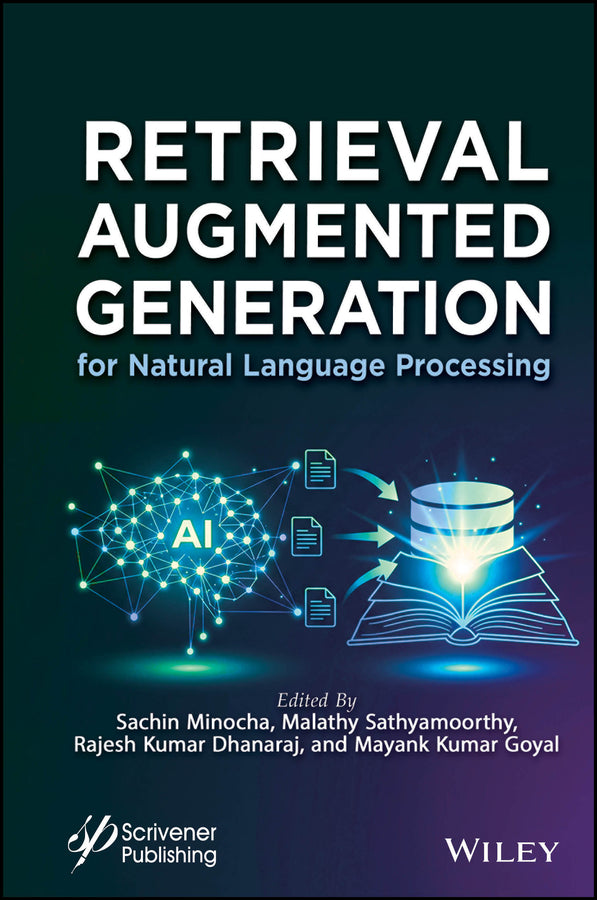
Retrieval Augmented Generation for Natural Language Processing
Sachin Minocha (Edited by), Malathy Sathyamoorthy (Edited by), Rajesh Kumar Dhanaraj (Edited by), Mayank Kumar Goyal (Edited by)
9781394336098, Wiley
Hardback, published 10 July 2026
480 pages
25 x 15 x 1.5 cm, 0.666 kg
Master the cutting-edge technology bridging the gap between massive AI capabilities and precise corporate reality with this essential guide to overcoming LLM limitations and deploying secure, domain-specific Retrieval-Augmented Generation solutions across real-world industries. The natural language processing domain has witnessed remarkable growth due to the availability of diverse, high-volume data and advanced machine-learning techniques, particularly large language models. Large language models trained on massive datasets can perform diverse tasks ranging from machine translation to text generation. However, these models face challenges such as factual inaccuracy, biases in data, and a lack of domain-specific knowledge. This book explores the Retrieval-Augmented Generation (RAG) spectrum, focusing on current trends, challenges, and applications. It introduces large language models and their capabilities, followed by the issues they face, particularly the lack of domain-specific knowledge. It also covers the fundamentals of retrieval-augmented generation and the process of integrating information retrieval with text generation, explaining how RAG bridges the gap between statistical learning and real-world information repositories. Different information retrieval techniques, generation models, and evaluation metrics such as BLEU score, ROUGE score, and task-specific metrics used to assess model effectiveness are discussed. The book also addresses critical security and privacy concerns, as well as ethical considerations and policies surrounding retrieval-augmented generation. Case studies covering knowledge management through summarization techniques, personalized learning in education, and customized customer-service chatbots demonstrate the broad potential of RAG systems. This essential guide provides a deep understanding of this transformative technology and how it is revolutionizing human-machine interaction.
Preface xxi 1 Overview of Large Language Models in Natural Language: Potential Issues and Challenges 1 1.1 Introduction 2 2 Impact of Retrieval-Augmented Generation Framework for Natural Language Processing 23 2.1 Introduction 24 3 Advances in Information Retrieval for Natural Language Processing: From Classical Models to Transformer-Based Architectures 59 3.1 Introduction 60 4 Traditional Approaches of Generation Techniques vs. Neural Language Models: A Comparative Study 95 4.1 Introduction to Text Generation Paradigms 96 5 Security and Privacy Concerns in Retrieval-Augmented Generation: Practical Challenges and Solutions 129 5.1 Introduction 130 6 Sparse Retrieval Techniques vs. Dense Retrieval Techniques: Pros and Cons 171 6.1 Introduction 172 7 Fine-Tuned LLM-Powered AI Assistant for Real-Time Speech Transcription and Intelligent Task Automation 203 7.1 Introduction 204 8 Role of Transfer Learning and Machine Translation Techniques in Retrieval-Augmented Generation: Past, Present, and Future 231 8.1 Introduction 232 9 Performance Analysis and Metrics for RAG Models: Traditional Natural Language Processing Metrics vs. Task-Specific Metrics 255 9.1 Introduction to Retrieval-Augmented Generation (RAG) Models 256 10 Ethical Deliberations, Values, and Strategies in RAG About Article Finding and Investigation: An Interpretative Overview 287 10.1 Introduction 288 11 Framework for Evaluating Multilingual Information Retrieval Systems 319 11.1 Introduction 320 12 A Case Study on Retrieval-Augmented Generation and Large Language Model–Based Personalized Chatbots and Dialogue Systems in Customer Service–Based Applications 347 12.1 Introduction 348 13 A RAG-Enhanced Personalized Course Recommendation Framework Using Sem-Gram and Ontology-Based Modeling 377 13.1 Introduction 378 14 Harnessing Retrieval-Augmented Generation for Legal Document Analysis and Case Law Prediction: A Case Study on Enhancing Transparency and Efficiency in Legal NLP 407 14.1 Introduction: Convergence of Law and Advanced Language Models 408 References 431
Amit Chaudhary, Ashish Jain and Jyoti Pruthi
1.2 Background and Development of Large Language Models 5
1.3 Milestones in LLM Development 6
1.4 Capabilities and Applications of Large Language Models 12
1.5 Potential Issues in Large Language Models (LLMs) 14
1.6 Future Prospects of LLMs and Their Societal Impact 18
Ashish Jain and Amit Chaudhary
2.2 The RAG Framework: A Technical Overview 25
2.3 Impact on NLP Tasks 30
2.4 Technical Aspects of RAG 39
2.5 Challenges and Limitations in Retrieval-Augmented Generation (RAG)—Heatmap Analysis 42
2.6 Future Research Directions 49
2.7 Conclusion 53
Subhajit Ghosh
3.2 Historical Evolution of Information Retrieval (IR) 61
3.3 Classical IR Techniques in NLP 63
3.4 Probabilistic and Topic Models 67
3.5 Neural and Transformer-Based IR Models 70
3.6 Core Functions and Methodologies 74
3.7 Evaluation Metrics in IR 78
3.8 Application Areas 82
3.9 Comparative Analysis of IR Techniques 84
3.10 Emerging Trends in IR 84
3.11 Future Research 91
M. Devendran, R.S. Ramya, Akshya. J., M. Sundarrajan and Rajesh Kumar Dhanaraj
4.2 Classical Rule-Based and Statistical Methods for Text Generation 97
4.3 Neural Language Models and Deep Learning Approaches 101
4.4 Comparative Analysis of Performance and Efficiency 110
4.5 Case Studies and Real-World Implementations 113
4.6 Challenges and Limitations of Traditional and Neural Methods 119
4.7 Future Directions in Text Generation Technologies 121
4.8 Summary 125
Retinderdeep Singh, Chander Prabha, Balamurugan Balusamy and M. A. Al-Khasawneh
5.2 Fundamentals of RAG and Its Architecture 136
5.3 Security Concerns in RAG Systems 140
5.4 Privacy Challenges in RAG Systems 145
5.5 Practical Case Studies 148
5.6 Current Solutions and Mitigation Strategies 153
5.7 Open Research Challenges 157
5.8 Future Directions and Conclusion 161
Gurjot Kaur, Chander Prabha, Balamurugan Balusamy and M. A. Al-Khasawneh
6.2 Fundamentals of Information Retrieval Systems 174
6.3 Sparse Retrieval Techniques 185
6.4 Dense Retrieval Techniques 191
6.5 Difference between Sparse and Dense Retrieval Techniques 198
6.6 Conclusion 200
Vidivelli S., Sundarrajan P. S., Manikandan Ramachandran, S. Magesh and R. Gopal
7.2 Related Work 206
7.3 Dataset 209
7.4 Methodology 211
7.5 Experimental Analysis 218
7.6 Conclusion 227
Gagandeep Kaur, Satish Saini, Monika Mehra and Ranjeev Kumar Chopra
8.2 Foundations of Retrieval-Augmented Generation (RAG) 234
8.3 Key Components: Retrieval Models and Generative Models 235
8.4 Applications of RAG in AI and NLP Explain the Above Content in Human Language 236
8.5 Challenges and Limitations 238
8.6 Case Studies and Real-World Applications 243
8.7 Future Directions 248
8.8 Conclusion 252
R. Vijayakumar, C.M. Sowntharya, Akshya. J., M. Sundarrajan and Sachin Minocha
9.2 Evaluation Metrics in Traditional Natural Language Processing 259
9.3 Task-Specific Metrics for RAG Model Performance 263
9.4 Comparative Assessment of Metric Suitability 268
9.5 Benchmarking RAG Models Across Diverse Applications 269
9.6 Challenges in Standardizing RAG Evaluation 274
9.7 Future Perspectives in RAG Model Optimization 278
9.8 Conclusion 283
Shantanu Siuli
10.2 Literature Review 295
10.3 Methodology 296
10.4 Theoretical Framework 297
10.5 Deontological Ethics 298
10.6 Discussion in Brief 301
10.7 Ethical Consideration 312
10.8 Conclusion 314
Jothi Prabha Appadurai, P.C. Karthik, K.S. Jayareka, S. Abijah Roseline, Balasubramanian Prabhu Kavin and Priyan Malarvizhi Kumar
11.2 Related Works 322
11.3 Problem Formulation and Motivation of the Research 323
11.4 Experimentation Methodology—Required for MLIR-Specific Measurement Technique 325
11.5 Outcome Evaluation 335
11.6 Conclusion 342
Anil Sharma, Renu, Gunank Kaushal, Teena Achan Kunju and Suresh Kumar
12.2 Literature Survey 352
12.3 Discussions 365
12.4 Issues and Challenges in Applying RAG in Customer Support Service 370
12.5 Conclusion and Future Work 371
S. Abijah Roseline, P.C. Karthik, Abhishek Chakraborty, S.K. Fathima, Balasubramanian Prabhu Kavin and Priyan Malarvizhi Kumar
13.2 Related Works 380
13.3 Proposed System Model 382
13.4 Outcome Evaluation 394
13.5 Conclusion 403
Malini A., Subhash Thippa and Tarun Vinod Pai
14.2 The Architectural Design: Unpacking a Legal RAG System 411
14.3 Case Study Part I: RAG for In-Depth Legal Document Analysis 417
14.4 Case Study II: RAG for Predictive Analytics in Case Law 418
14.5 Evaluating Model Performance and Effectiveness: A Holistic Approach 424
14.6 Working through Ethical and Regulatory Obstruction 427
14.7 Conclusion and Future Directions 429
Index 433
Subject Areas: Computer science [UY]