Freshly Printed - allow 10 days lead
Couldn't load pickup availability
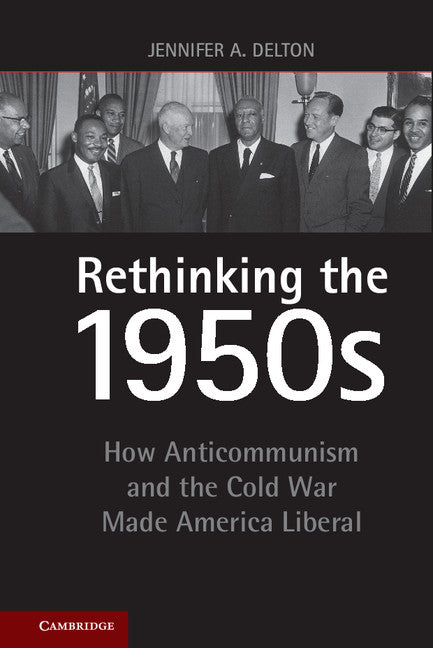
Rethinking the 1950s
How Anticommunism and the Cold War Made America Liberal
This book argues that far from subverting the New Deal state, anticommunism and the Cold War enabled, fulfilled, and even surpassed the New Deal's reform agenda.
Jennifer A. Delton (Author)
9781107011809, Cambridge University Press
Hardback, published 7 October 2013
203 pages
23.5 x 15.7 x 1.7 cm, 0.47 kg
'Jennifer Delton advances a bold new interpretation of postwar American politics. She pushes back against historians skeptical of the achievements of the New Deal or convinced that American politics has been dominated by conservative rather than liberal ideas. As she shows, even pro-market Republicans supported the liberal vision of the good society in the 1950s because there was an alternative to capitalism abroad during the Cold War. In fighting the menace of communism, they advanced the American welfare state and accommodated themselves to the call for civil rights. She has a message that those interested in American politics both past and present should hear.' Kenneth Lipartito, Florida International University, and co-author of Corporate Responsibility: The American Experience
Historians generally portray the 1950s as a conservative era when anticommunism and the Cold War subverted domestic reform, crushed political dissent, and ended liberal dreams of social democracy. These years, historians tell us, represented a turn to the right, a negation of New Deal liberalism, an end to reform. Jennifer A. Delton argues that, far from subverting the New Deal state, anticommunism and the Cold War enabled, fulfilled, and even surpassed the New Deal's reform agenda. Anticommunism solidified liberal political power and the Cold War justified liberal goals such as jobs creation, corporate regulation, economic redevelopment, and civil rights. She shows how despite President Eisenhower's professed conservativism, he maintained the highest tax rates in US history, expanded New Deal programs, and supported major civil rights reforms.
Introduction: the liberal fifties
1. Anticommunist liberals
2. Moderate Republicans
3. Corporate liberals
4. Conservatives
5. Civil rights
6. Eisenhower's liberal legacy.
Subject Areas: Political ideologies [JPF], Political science & theory [JPA], History of the Americas [HBJK], History [HB]