Freshly Printed - allow 7 days lead
Couldn't load pickup availability
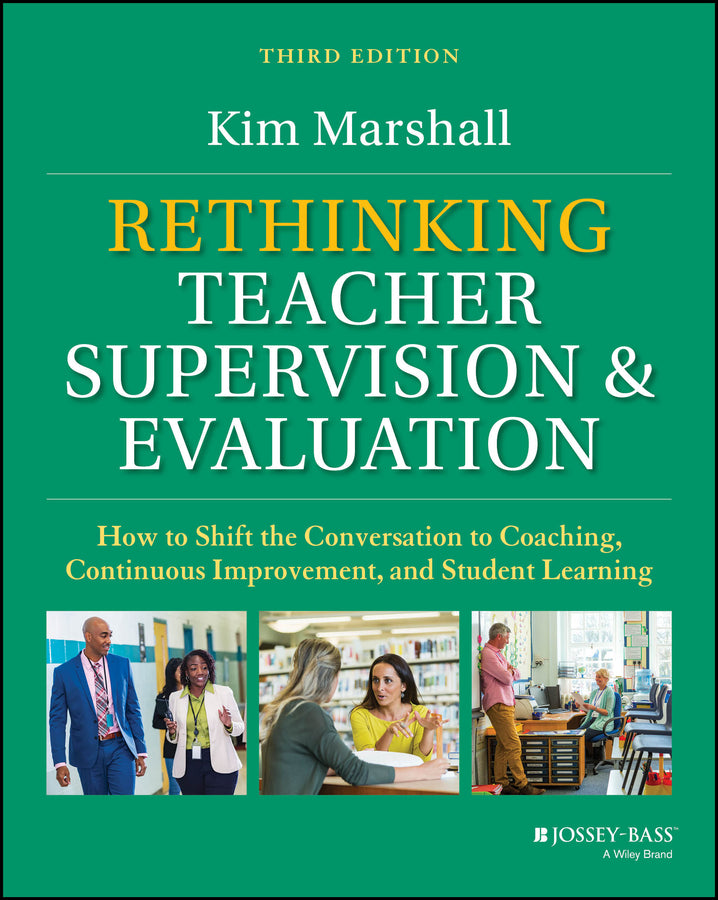
Rethinking Teacher Supervision and Evaluation
How to Shift the Conversation to Coaching, Continuous Improvement, and Student Learning
“A concise collection of practical ideas on how principals can improve teaching and learning, Kim Marshall is a former administrator who knows from experience how to ensure that teachers receive the support and guidance they need to be effective in meeting the needs of students. An invaluable resource for instructional leaders.” "Ample research now tells us that principals can be crucial to student learning, especially so for disadvantaged students. This book helps us understand how principals can matter, embedding a discussion of high-impact strategies for improving instruction into an insightful overview of the most relevant research, information that should be part of every principal’s training." "This book serves as a manual for everyday supervisors looking to help teachers improve their practices. The micro-observation strategies will help us build the muscles to coach teachers towards closing the knowing-doing gaps of planning and implementing effective lessons." "Kim Marshall’s new book is a master class in teacher supervision and evaluation. All current and prospective supervisors stand to l benefit from its deep insights, clear explanations, and spot-on guidance." "Kim Marshall’s Rethinking Teacher Supervision and Evaluation is the most practical, compelling source you’ll find on this topic. If we heed his irrefutable case for frequent classroom visits and specific, targeted feedback, then instructional quality--and student outcomes--will absolutely improve." —Mike Schmoker, Ed.D., Author, Speaker, and Consultant "Kim Marshall, an award-winning principal, author, consultant, and mentor to school leaders, leverages his extensive career experience into this compendium of practical wisdom on the important topic of teacher observation and evaluation. Marshall begins by debunking many current supervision and evaluation practices, then builds a case for more demonstrably efficient and effective ways of offering feedback that actually improves teaching and learning. This updated version of his classic book includes new insights, including the potential of Artificial Intelligence to support the teacher observation/feedback process. I consider this 3rd edition of Rethinking Teacher Evaluation and Supervision an indispensable guide to any current or aspiring school leader or instructional coach." In Rethinking Teacher Supervision and Evaluation, Dr. Marshall challenges the conventional perspective on teacher evaluation, urging us to perceive it not merely as a set of obligatory transactions but as a system capable of transformative leadership moves. This paradigm shift, according to Marshall, holds the potential to cultivate true collaboration, strategic actions grounded in research, and ultimately, improved learning for teachers, effective leadership decisions, and tangible progress in student achievement. Dr. Marshall introduces a novel approach, emphasizing mini observations and reflective post-visit conversations as key components. These elements, he argues, enable school leaders to construct a comprehensive understanding of teachers' strengths and areas for improvement. Notably, this method relies on multiple data points rather than a single observation, providing a more nuanced and accurate evaluation. What sets this text apart is its practicality. Dr. Marshall offers actionable suggestions that render it an invaluable resource for both emerging and experienced school leaders. The proposed strategies empower leaders to navigate the complexities of teacher evaluation with finesse, making informed decisions based on a holistic understanding of each teacher's performance. Moreover, the text advocates for transformative changes in the existing evaluation system, positioning it not as a mandatory exercise but as a catalyst for positive outcomes. Dr. Marshall's innovative ideas, outlined in this book, present a compelling argument for reshaping our approach to teacher evaluation. It is, undeniably, the resource needed to usher in a new era of evaluation that prioritizes the growth and success of students, teachers, and school leaders alike.
—Pedro A. Noguera, Ph.D., Dean of Rossier School of Education and Distinguished Professor of Education, University of Southern California
—Charles M. Payne, Henry Rutgers Professor of Africana Studies and Director of Joseph C. Cornwall Center for Metropolitan Studies at Rutgers, The State University of New Jersey-Newark
—Dr. Hoa Tu, Superintendent, New York City Public Schools
—Dr. Susan Moore Johnson, Jerome T. Murphy Research Professor, Harvard Graduate School of Education, Massachusetts
—Jay McTighe, Education author and consultant, and Coauthor of the Understanding by Design® series
—Gloria McDaniel-Hall, Ed.D, Associate Professor, Educational Leadership, National Louis University, Chicago, IL
Kim Marshall (Author)
9781394265251, Wiley
Paperback / softback, published 24 July 2024
320 pages
23.1 x 18.5 x 2 cm, 0.454 kg
A proven, practical approach to teacher supervision, coaching, and evaluation that emphasize fairness, equity, and achievement In the third edition of this longtime bestseller, nationally recognized education leader Kim Marshall offers a framework for supervisors who want to motivate and inspire their colleagues and bring more good teaching to more classrooms more of the time. Rethinking Teacher Supervision and Evaluation shows you how to break away from outdated evaluation approaches, describing an innovative approach that enlists teachers and teacher teams in improving the performance of all students. This thoroughly revised and updated third edition brings Marshall's widely used framework up to date, with even more practical guidelines for implementing effective classroom visits, teacher teamwork around data and curriculum unit planning, professional development, and more. You'll also discover high-tech and low-tech tools that can boost a supervisor's impact and efficiency. Since the publication of the first and second editions, Rethinking Teacher Supervision and Evaluation has been an invaluable resource for K-12 supervisors, instructional coaches, and teacher leaders, as well as trainers and policymakers. The third edition builds on a decade of additional research and work in schools around the world, bringing the ideas into alignment with the rapidly changing world of education, for a timely and beneficial approach to leading today's teachers.
The Author xi Acknowledgments xiii Introduction 1 Chapter 1 A Rookie Principal Learns the Hard Way 17 Chapter 2 Finding Our Way to a Better System 31 Chapter 3 Design Flaws in the Traditional Teacher Evaluation Process 51 Chapter 4 Mini-Observations 1: Sampling Daily Reality 73 Chapter 5 Mini-Observations 2: Observing Perceptively 85 Chapter 6 Mini-Observations 3: Affirming and Coaching 103 Chapter 7 Mini-Observations 4: End-of-Year Rubric Evaluation 127 Chapter 8 Mini-Observations 5: Making Student Learning Central 159 Chapter 9 Coaching Results-Focused Teacher Teams 179 Chapter 10 Coaching Differentiation 195 Chapter 11 Coaching Curriculum Unit Planning 207 Chapter 12 Should Supervisors Get Involved During Mini-Observations? 227 Chapter 13 Time Management: Fitting It All In 237 Chapter 14 The Role of the Superintendent 257 Chapter 15 A Short Summary, Frequently Asked Questions, and a Wrap-Up 277 Bibliography 289 Index 299
Subject Areas: Education [JN]