Freshly Printed - allow 10 days lead
Couldn't load pickup availability
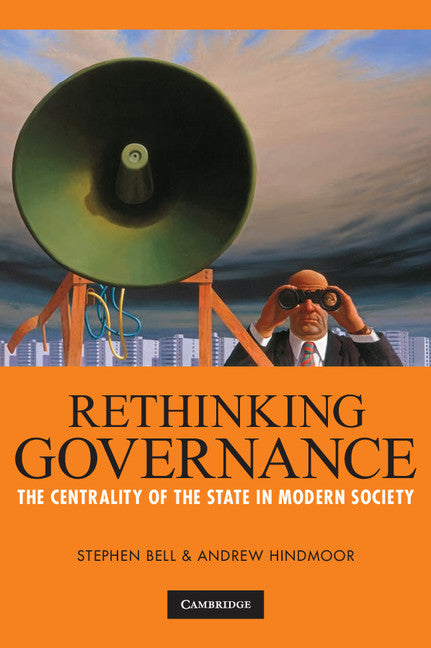
Rethinking Governance
The Centrality of the State in Modern Society
This book seeks to make key developments in political science relevant to discussions about governance.
Stephen Bell (Author), Andrew Hindmoor (Author)
9780521712835, Cambridge University Press
Paperback / softback, published 29 June 2009
252 pages
22.9 x 15.2 x 1.3 cm, 0.34 kg
'Stephen Bell and Andrew Hindmoor have produced an exemplary scholarly study, which is meticulous, spirited and lucid … This excellent work deserves wide attention and influence. In future debates concerning the formal apparatus of the state, it should be the basic reference.' Ian Marsh, The Australian Journal of Political Science
Several problems plague contemporary thinking about governance. From the multiple definitions that are often vague and confusing, to the assumption that governance strategies, networks and markets represent attempts by weakening states to maintain control. Rethinking Governance questions this view and seeks to clarify how we understand governance. Arguing that it is best understood as 'the strategies used by governments to help govern', the authors counter the view that governments have been decentred. They show that far from receding, states are in fact enhancing their capacity to govern by developing closer ties with non-government sectors. Identifying five 'modes' of government (governance through hierarchy, persuasion, markets and contracts, community engagement, and network associations), Stephen Bell and Andrew Hindmoor use practical examples to explore the strengths and limitations of each. In so doing, they demonstrate how modern states are using a mixture of governance modes to address specific policy problems. This book demonstrates why the argument that states are being 'hollowed out' is overblown.
Preface
1. Introduction: a state-centric relational approach to governance
2. The resilient state
3. Metagovernance and state capacity
4. Hierarchy and top-down governance
5. Governance through persuasion
6. Governance through markets and contracts
7. Governance through community engagement
8. Governance through associations
9. Conclusion.
Subject Areas: Laws of Specific jurisdictions [LN]