Freshly Printed - allow 8 days lead
Couldn't load pickup availability
Resurrecting Democracy
Faith, Citizenship, and the Politics of a Common Life
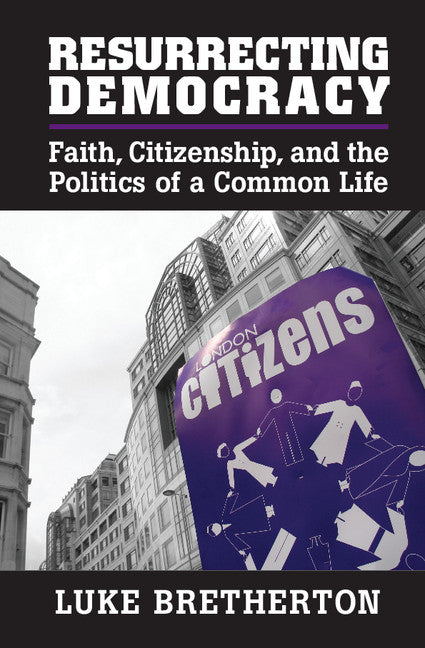
This book assesses the construction of citizenship as an identity, a performance, and a shared rationality.
Luke Bretherton (Author)
9781107641969, Cambridge University Press
Paperback / softback, published 22 December 2014
492 pages, 22 b/w illus. 1 map
22.6 x 15 x 3 cm, 0.7 kg
'This engaging, insightful book weaves together theology, political philosophy, and ethnography in order to illuminate the ways in which community organizing can help build a common life in a pluralistic world. … This book will appeal to all those interested not only in political theology, but also community organizers seeking to be reflective about the goals and methods of their work.' A. W. Klink, Religious Studies Review
Through a case study of community organizing in the global city of London and an examination of the legacy of Saul Alinsky around the world, this book develops a constructive account of the relationship between religious diversity, democratic citizenship, and economic and political accountability. Based on an in-depth, ethnographic study, Part I identifies and depicts a consociational, populist and post-secular vision of democratic citizenship by reflecting on the different strands of thought and practice that feed into and help constitute community organizing. Particular attention is given to how organizing mediates the relationship between Christianity, Islam and Judaism and those without a religious commitment in order to forge a common life. Part II then unpacks the implications of this vision for how we respond to the spheres in which citizenship is enacted, namely, civil society, the sovereign nation-state, and the globalized economy. Overall, the book outlines a way of re-imagining democracy, developing innovative public policy, and addressing poverty in the contemporary context.
Introduction
Part I: 1. The origins of organizing: an intellectual history
2. Faith and citizenship in a world city
3. Reimagining the secular: interfaith relations as a civic practice
4. An anatomy of organizing I: listening, analysis, and building power
5. An anatomy of organizing II: capacity, action, and representation
Part II: 6. Civil society as the body politic
7. Sovereignty and consociational democracy
8. Economy, debt, and citizenship
Conclusion.
Subject Areas: Comparative politics [JPB], Politics & government [JP]