Freshly Printed - allow 7 days lead
Couldn't load pickup availability
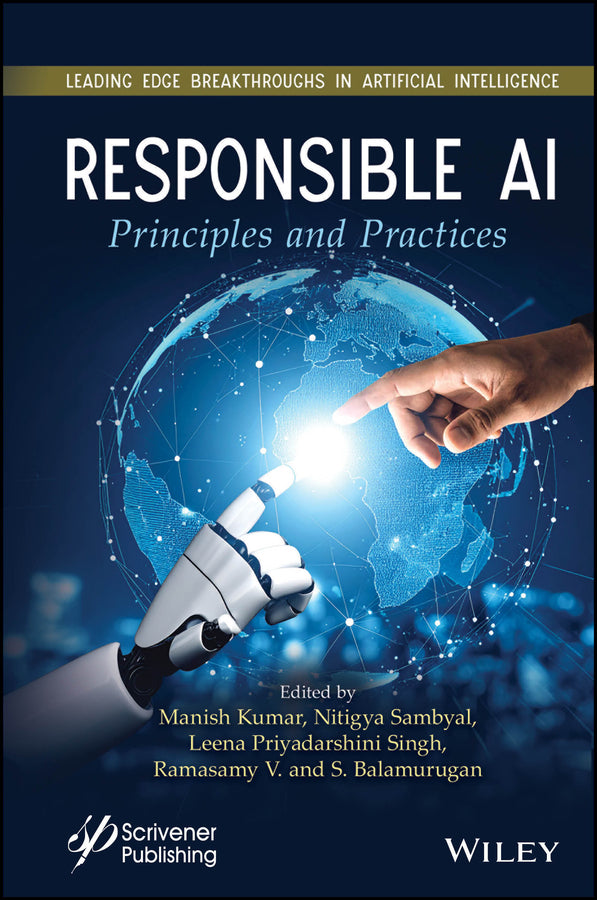
Responsible AI
Principles and Practices
Manish Kumar (Edited by), Nitigya Sambyal (Edited by), Leena P. Singh (Edited by), V. Ramasamy (Edited by), S. Balamurugan (Edited by)
9781394355440, Wiley
Hardback, published 25 March 2026
448 pages
22.9 x 15.2 x 2.7 cm, 0.812 kg
Bridge the gap between groundbreaking AI innovation and ethical responsibility with this comprehensive guide to the expert-led frameworks needed to navigate the complex legal, social, and moral landscapes of our digital future. Artificial Intelligence (AI) has emerged as a transformative force with the ability to bring new innovations to reshape economies, industries, and our daily lives. From advanced medical diagnostics to autonomous vehicles, AI systems are driving incomparable innovations in every sector. These advancements promise unmatched benefits and provide the potential to solve some of humanity’s most pressing challenges. However, there are many potential challenges and significant risks that come alongside the benefits provided by AI. This book offers a multidisciplinary viewpoint on how to develop and use AI systems responsibly by offering a deep dive into the ethical, legal, and societal ramifications of artificial intelligence. It explores important subjects such as algorithmic fairness, transparency, accountability, and governance through contributions from notable academics, engineers, and policy specialists. It highlights how crucial it is to match AI development with democratic norms and human values, offering both theoretical frameworks and workable implementation solutions for a range of industries. This comprehensive guide is an essential resource for scholars, professionals, and legislators dedicated to making sure that AI technology is created and applied in ways that are moral, inclusive, and advantageous to society. The reader will find the volume: Audience AI practitioners, data scientists, developers, business leaders, and executives actively engaged in the development and implementation of AI systems.
Series Preface xxi 1 AI for Social Good 1 1.1 Introduction to AI for Social Good 2 2 Balancing Innovation and Patient Safety: Ethical AI Deployment in Healthcare 29 2.1 Introduction 29 3 Responsible AI in Practice: Case Studies from Industry and Government 69 3.1 Introduction 69 4 An Efficient System for Skin Disease Detection and Localization Using Faster Region Based Convolutional Neural Networks with Inception Architecture 81 4.1 Introduction 82 5 Detection of Machining Error Using Intelligent Hybrid Machine Learning Technique 105 5.1 Introduction 106 6 Ground Water Level Classification Using Machine Learning 119 6.1 Introduction 120 7 Sustainability in AI Development 143 7.1 Introduction 144 8 Integrating AutoML and Explainability: A Unified Approach for Decision-Making in Engineering and Social Sciences 175 8.1 Introduction 176 9 Trust Dynamics and Ethical Transparency in AI-Powered Mobile Apps: A Data‑Driven Exploration of User Perceptions 199 9.1 Introduction 200 10 AI-Powered Advancements in Autonomous Vehicle Technologies 221 10.1 Introduction 222 11 Data Security and Privacy Frameworks for AI Technologies 247 11.1 Introduction 248 12 AI in Autonomous Systems 269 12.1 Introduction to AI in Autonomous Systems 270 13 Responsible Use of AI in Healthcare: Addressing Bias, Transparency, and Patient Trust 297 13.1 Introduction 298 14 Advancing Healthcare with AI: Balancing Efficiency, Security, and Compliance 323 14.1 Introduction 324 15 AI Beyond the Veil: Techniques for Privacy Preservation 363 15.1 Introduction 364 16 VetAce – A Deep Learning Inspired Framework for Classification and Prediction of Pet Diseases 379 16.1 Introduction 380 Bibliography 397
Preface xxiii
Acknowledgement xxvii
R. Srivats, Kalyanasundaram V., Abhiram Sharma, Deepika Roselind J. and Logeswari G.
1.2 AI in Healthcare 6
1.3 AI in Education 10
1.4 AI for Disaster Management and Response 14
1.5 AI in Culture 17
1.6 Conclusion and Future Work 24
Prajakta R. Patil, Sachin S. Mali, Riya R. Patil and Dhanashree R. Davare
2.2 The Promise of AI in Healthcare 34
2.3 Ethical Challenges in AI 36
2.4 Responsible AI Development and Deployment 39
2.5 Case Studies: Real-World Examples of Ethical AI in Healthcare 46
2.6 Strategies for Ensuring Ethical and Responsible Use of AI 52
2.7 The Future of Ethical AI in Healthcare 56
2.8 Conclusion 58
Nabanita Roy, Sangita Roy and Shalini Kumari
3.2 Framework for Analyzing Responsible AI Implementation 71
3.3 Literature Review 72
3.4 Case Studies 72
3.5 Cross-Sector Analysis: Patterns in Responsible AI Implementation 74
3.6 Emerging Regulatory Landscape 75
3.7 Recommendations for Organizations 75
3.8 Discussion 78
3.9 Conclusion 79
Nitin Singh, Ankita Nanda, Keshav Garg, Varun Gupta, Nitigya Sambyal and Deepika Vikas Agrawal
4.2 Related Work 84
4.3 Proposed System 86
4.4 Results 96
4.5 Conclusion 100
Ritu Maity
5.2 Literature Review 106
5.3 Models Used 108
5.4 Methodology 109
5.5 Results and Discussion 113
5.6 Conclusion 116
Charu Chaudhary, Khushi Passi, Taruna Saini, Ritika Dhaneshwar and Varun Gupta
6.2 Related Work 121
6.3 Data Description and Data Processing 124
6.4 Results and Discussion 130
6.5 Conclusion 139
Riya R. Patil, Sandip A. Bandgar, Sachin S. Mali, Prajakta R. Patil and Dhanashree R. Davare
7.2 Environmental Sustainability in AI 148
7.3 Social Sustainability in AI 152
7.4 Economic Sustainability in AI 157
7.5 Governance and Policy for Sustainable AI 159
7.6 Challenges and Future Directions 164
7.7 Conclusion and Call to Action 167
Ayush Dalmia and Chandramohan Dhasarathan
8.2 Literature Study 178
8.3 Proposed Model 183
8.4 Evaluation of the Proposed System (Comparative Analysis/Justification with Acceptable Measures/Metrics) 186
8.5 Observations 195
8.6 Conclusion 196
Rachita Sambyal
9.2 Review of Literature 201
9.3 Research Methodology 204
9.4 Results and Discussion 204
9.5 Results and Recommendations 212
9.6 Limitations and Future Scope 212
9.7 Conclusion 212
Sachi Choudhary and Prashant Shukla
10.2 Core AI Technologies for AVs 224
10.3 Machine Learning and Deep Learning Techniques for AVs 226
10.4 Computer Vision and Image Processing in AVs 228
10.5 Sensor Fusion and Environmental Perception in AVs 231
10.6 Object Detection and Classification in Autonomous Vehicles (AVs) 233
10.7 Decision-Making and Path Planning in AVs 235
10.8 AI's Role in Route Optimization, Path Planning, and Obstacle Avoidance 239
10.9 Challenges of AI in Autonomous Vehicles 240
10.10 Conclusion 241
Sangita Roy and Nabanita Roy
11.2 Foundations of Data Security and Privacy in AI 249
11.3 Challenges in AI-Specific Privacy and Security 251
11.4 Privacy-Preserving AI Technologies 251
11.5 Regulatory and Legal Frameworks 255
11.6 Organizational Privacy and Security Frameworks 258
11.7 Case Studies 259
11.8 Designing Privacy-Centric AI Systems 261
11.9 Future Directions 264
11.10 Conclusion 266
Kalyanasundaram V., G. Prethija, Keerthi A.J., Yuvan Shankar Baabu and R. Srivats
12.2 AI Technologies in Autonomous Systems 274
12.3 Autonomous Vehicles and Real-Time Decision Making 279
12.4 AI Innovations in Space and Healthcare Systems 284
12.5 Safety, Ethical Considerations, and Challenges 288
12.6 Future Directions and Conclusion 291
Shubham Gupta
13.2 Ethical Challenges in AI-Driven Healthcare 300
13.3 Transparency in AI Systems 306
13.4 Building and Maintaining Patient Trust 311
13.5 Governance and Regulatory Oversight 314
13.6 The Future of Ethical AI in Healthcare 318
Sivakumar Ramakrishnan
14.2 Literature Review 329
14.3 Identified Gaps in Literature and Future Directions 332
14.4 Methodology 333
14.5 Result and Discussion 345
14.6 Case Studies and Real-World Examples 351
14.7 Ethical Considerations in AI-Based Healthcare Fraud Detection 353
14.8 Blockchain and Federated Learning: Securing AI-Based Healthcare Transactions Blockchain in Healthcare Transactions 357
14.9 AI's Limitations and the Evolution of Fraud Strategies 357
14.10 Conclusion 359
D. Kalpanadevi
15.2 Scope of Research 364
15.3 Background 365
15.4 Techniques for Privacy Preservation 365
15.5 Implementation and Discussion 373
15.6 Current Challenges 375
15.7 Industry Adoption 376
15.8 Future Directions 377
15.9 Conclusion 377
References 378
Munish Saini, Vaibhav Arora and Harpreet Singh
16.2 Related Work 381
16.3 Analysis Methodology 383
16.4 Results and Analysis 391
16.5 Discussion 395
16.6 Conclusion 396
Index 401
Subject Areas: Computer science [UY]