Freshly Printed - allow 10 days lead
Couldn't load pickup availability
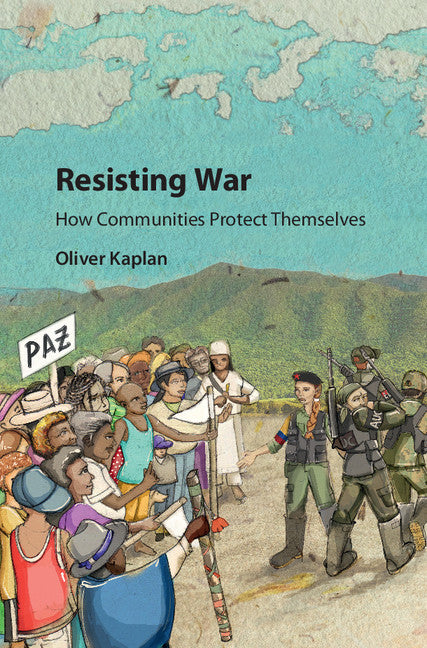
Resisting War
How Communities Protect Themselves
This book explores how local social organization and cohesion enable covert and overt nonviolent strategies.
Oliver Kaplan (Author)
9781107159808, Cambridge University Press
Hardback, published 20 July 2017
396 pages, 34 b/w illus. 12 maps 21 tables
23.5 x 15.8 x 3 cm, 0.73 kg
'Kaplan's book will be a cornerstone from which to tackle these questions in the future for a broader and deeper understanding of civilians' lives during civil wars. He should be applauded for asking big, important research questions that resist clean answers. Delving into civil war settings in a thoughtful way to provide rich description of how civilians experience and influence civil wars will form a lasting contribution to our knowledge about civil wars.' Abbey Steele, International Studies Review
In civil conflicts around the world, unarmed civilians take enormous risks to protect themselves and confront heavily armed combatants. This is not just counterintuitive - it is extraordinary. In this book, Oliver Kaplan explores cases from Colombia, with extensions to Afghanistan, Pakistan, Syria, and the Philippines, to show how and why civilians influence armed actors and limit violence. Based on fieldwork and statistical analysis, the book explains how local social organization and cohesion enable both covert and overt nonviolent strategies, including avoidance, cultures of peace, dispute resolution, deception, protest, and negotiation. These 'autonomy' strategies help civilians retain their agency and avoid becoming helpless victims by limiting the inroads of armed groups.
1. Introduction: civilian autonomy in civil war
2. A theory of civilian decision-making in civil war
3. The history of conflict and local autonomy in Colombia
4. Living to tell about it: research in conflict settings
5. How civilian organizations affect civil war violence
6. Why some communities are more organized than others
7. The institution of the ATCC: protection through conciliation
8. Discovering civilian autonomy in Cundinamarca
9. Civilian autonomy around the world
10. Conclusions and policy implications.
Subject Areas: International relations [JPS], Political structure & processes [JPH], Politics & government [JP], Society & social sciences [J]