Freshly Printed - allow 6 days lead
Couldn't load pickup availability
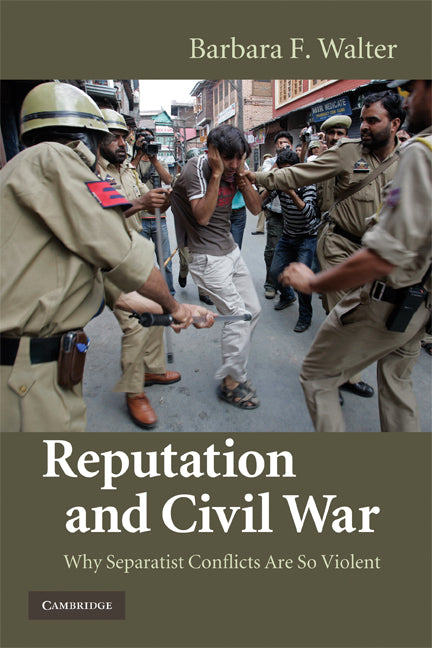
Reputation and Civil War
Why Separatist Conflicts Are So Violent
Attempts to resolve why self-determination disputes between governments and ethnic minorities so often result in civil war.
Barbara F. Walter (Author)
9780521747295, Cambridge University Press
Paperback, published 27 August 2009
272 pages, 2 maps 13 tables
22.8 x 15.2 x 1.5 cm, 0.49 kg
'… the value of this book is the recognition of the importance of including future parties and future stakes in the models of bargaining and civil war. … [It] … provides an excellent study showing that when governments are facing movements seeking autonomy, they make strategic decision and invest in reputation-building.' International Affairs
Of all the different types of civil war, disputes over self-determination are the most likely to escalate into war and resist compromise settlement. Reputation and Civil War argues that this low rate of negotiation is the result of reputation building, in which governments refuse to negotiate with early challengers in order to discourage others from making more costly demands in the future. Jakarta's wars against East Timor and Aceh, for example, were not designed to maintain sovereignty but to signal to Indonesia's other minorities that secession would be costly. Employing data from three different sources - laboratory experiments on undergraduates, statistical analysis of data on self-determination movements, and qualitative analyses of recent history in Indonesia and the Philippines - Barbara F. Walter provides some of the first systematic evidence that reputation strongly influences behavior, particularly between governments and ethnic minorities fighting over territory.
Figures
Tables
Maps
Part I. Theory: 1. Introduction
2. Reputation building and self-determination movements
Part II. Empirical tests: 3. An experimental study of reputation building and deterrence
4. Government responses to self-determination movements
5. Ethnic groups and the decision to seek self-determination
Part III. Case studies: 6. Indonesia: many ethnic groups, few demands
7. The Philippines: few ethnic groups, many demands
Part IV. Conclusions: 8. Reputation building and deterrence in civil wars.
Subject Areas: International relations [JPS], Comparative politics [JPB]