Special Order - allow 2+ weeks lead
Couldn't load pickup availability
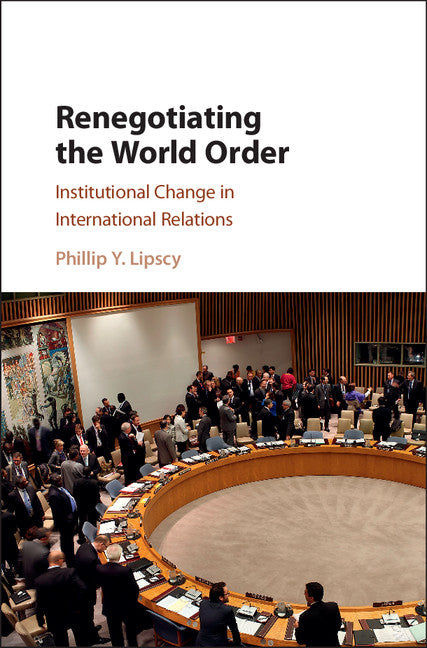
Renegotiating the World Order
Institutional Change in International Relations
This book explains how countries renegotiate international institutions when rising powers such as Japan and China challenge the existing order.
Phillip Y. Lipscy (Author)
9781107149762, Cambridge University Press
Hardback, published 9 June 2017
338 pages, 32 b/w illus.
23.5 x 15.8 x 2.2 cm, 0.61 kg
'Lipscy's book provides well-written historical accounts with a compelling theory that provides both an academic case as well as fruitful insight for policy-makers.' Felicity Vabulas, Review of International Organizations
Rising powers often seek to reshape the world order, triggering confrontations with those who seek to defend the status quo. In recent years, as international institutions have grown in prevalence and influence, they have increasingly become central arenas for international contestation. Phillip Y. Lipscy examines how international institutions evolve as countries seek to renegotiate the international order. He offers a new theory of institutional change and explains why some institutions change flexibly while others successfully resist or fall to the wayside. The book uses a wealth of empirical evidence - quantitative and qualitative - to evaluate the theory from international organizations such as the International Monetary Fund, World Bank, European Union, League of Nations, United Nations, the International Telecommunications Satellite Organization, and the Internet Corporation for Assigned Names and Numbers. The book will be of particular interest to scholars interested in the historical and contemporary diplomacy of the United States, Japan, and China.
1. Introduction
2. A theory of institutional change
3. The International Monetary Fund and the World Bank
4. Japan in the International Monetary Fund and the World Bank
5. INTELSAT
6. ICANN
7. The League of Nations and the United Nations Security Council
8. Policy area discipline: development institutions and regional integration projects
9. China-Taiwan competition over international organizations: a placebo test
10. Conclusion.
Subject Areas: International relations [JPS], Comparative politics [JPB]