Freshly Printed - allow 8 days lead
Couldn't load pickup availability
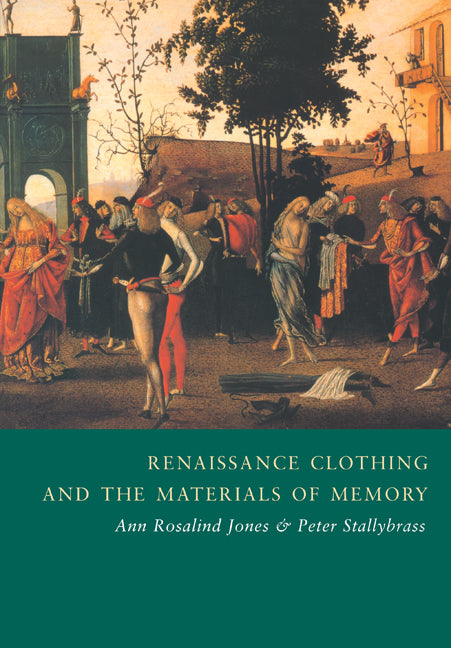
Renaissance Clothing and the Materials of Memory
This 2001 interpretation of literature and arts reveals how clothing and costume were critical to Renaissance culture.
Ann Rosalind Jones (Author), Peter Stallybrass (Author)
9780521786638, Cambridge University Press
Paperback, published 25 January 2001
386 pages, 58 b/w illus.
25.1 x 16.7 x 2 cm, 0.64 kg
'Jones and Stallybrass argue cogently and clearly, switching genre and medium easily but stitching the raw materials into a coherent and impressive whole … this work should become both key in its own right and influential in suggesting a new approach to the study of the period overall.' Early Modern Literary Studies
During the late sixteenth century 'fashion' first took on the sense of restless change in contrast to the older sense of fashioning or making. As fashionings, clothes were perceived as material forms of personal and social identity which made the man or woman. In Renaissance Clothing and the Materials of Memory Jones and Stallybrass argue that the making and transmission of fabrics and clothing were central to the making of Renaissance culture. Their examination explores the role of clothes as forms of memory transmitted from master to servant, from friend to friend, from lover to lover. This 2001 book offers a close reading of literary texts, paintings, textiles, theatrical documents, and ephemera to reveal how clothing and textiles were crucial to the making and unmaking of concepts of status, gender, sexuality, and religion in the Renaissance. The book is illustrated with a wide range of images from portraits to embroidery.
Acknowledgements
List of illustrations
Introduction: fashion, fetishism and memory in early modern England and Europe
Part I. Material Subjects: 1. The currency of clothing
2. Composing the subject: making portraits
3. Yellow starch: fabrications of the Jacobean court
Part II. Gendered Habits: 4. Arachne's web: Velazquez's Las Hilanderas
5. The fate of spinning: Penelope and the Three Fates
6. The needle and the pen: needlework and the appropriation of printed texts
Part III. Staging Clothes: 7. The circulation of clothes and the making of the English theater
8. Transvestism and the 'body beneath': speculating on the boy actor
9. (In)alienable possessions: Griselda, clothing and the exchange of women
10. Of ghosts and garments: the materiality of memory on the Renaissance stage
Conclusion: the end(s) of livery
Notes
Index.
Subject Areas: Literary studies: general [DSB]