Freshly Printed - allow 10 days lead
Couldn't load pickup availability
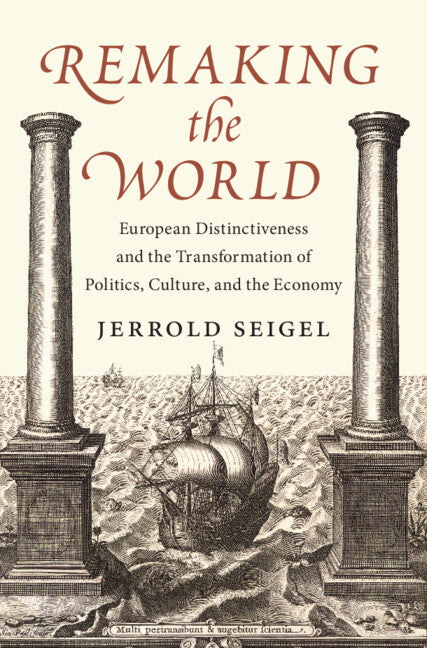
Remaking the World
European Distinctiveness and the Transformation of Politics, Culture, and the Economy
Examines what was distinctive about Europe's role in world history, both for good and ill.
Jerrold Seigel (Author)
9781009541664, Cambridge University Press
Hardback, published 19 December 2024
378 pages
23.5 x 16.1 x 3.4 cm, 0.69 kg
'… tells the story of the West's outsize role across the last five centuries as the chief agent in unifying the globe, fostering complex networks of connection, and making originally European ways of interaction into points of reference for the rest of the world. This European impact was multidimensional: in economics, it brought the Industrial Revolution; in politics, it produced a distinctive preoccupation with the sources and meaning of freedom and equality; and in society and culture, it led to a reconceptualization of the cosmos and the modern imagination. In explaining why this grand transformation happened in Europe and not in the other great civilizations, Seigel points to the West's distinctive trajectory within the larger global system: after the fall of Rome, no aspiring hegemon succeeded in remaking Europe into a continent-sized empire, whereas its civilizational peers - China, Mughal India, and the Islamic dynasties - remained imperial in form. This fragmented and competitive early modern European landscape, Seigel argues, generated unique incentives for a dynamic process of “creative destruction,” laying the foundation of the great nineteenth-century explosion in wealth, power, and global imperial domination.' G. John Ikenberry, Foreign Affairs
How should we understand Europe's special role in world history, and the enduring impact it made on the rest of the globe? Jerrold Seigel traces both the positive and negative sides of the continent's special role to its absence of effective central authority, the division and competition between its states and peoples, and its propensity for developing autonomous spheres of activity. Remaking the World analyzes how these features fostered Europe's characteristic preoccupation with a politics of liberty, its evolution of an aesthetic sphere animated by values specific to itself, its singular capacity to revolutionize scientific understanding, and its ability to prepare and carry out the first transition to a modern industrial economy. Extended and substantive comparisons with Africa, India, China, and the lands that came under the rule of the Ottomans demonstrate the absence of similar phenomena elsewhere, whereas in Europe they also helped generate the malign force of imperial expansion.
1. Introduction
Part I. Liberty and Liberties: 2. A preoccupation with liberty
3. From liberties to liberty
4. Liberties elsewhere
Part II. Autonomy and Teleocracy: 5. Spheres of autonomy: the church, universities, and the bounds of reason
6. Classical humanism and aesthetics
7. Science as a sphere of autonomy
8. Teleocratic sciences
Part III. Openness and Domination: 9. Other peoples, other places
10. Empire: material expansion, moral contraction, and internal criticism
11. Courage and weakness: anti-imperialism and its limits in the nineteenth century
Part IV. Transformations: 12. Autonomy and transformation: Britain
13. Transformation and autonomy: France and Germany
14. Ready or not? China and India
15. Conclusion.
Subject Areas: European history [HBJD]