Freshly Printed - allow 8 days lead
Couldn't load pickup availability
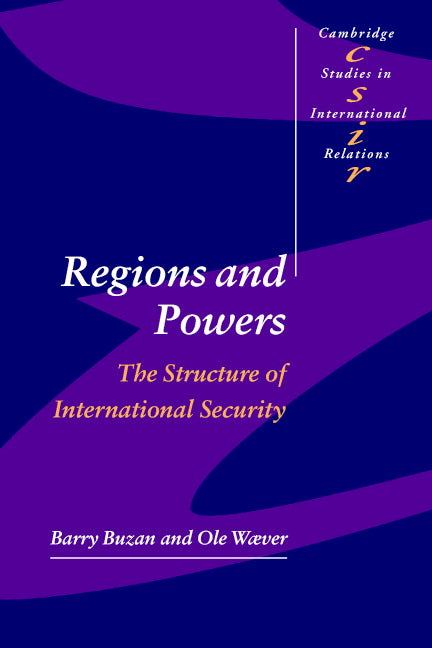
Regions and Powers
The Structure of International Security
An analysis and application of security complex theory in security regions in the post-Cold War order.
Barry Buzan (Author), Ole Wæver (Author)
9780521891110, Cambridge University Press
Paperback, published 4 December 2003
598 pages, 12 maps
22.9 x 15.2 x 3.3 cm, 0.93 kg
'... A sophisticated analytical toolbox equipped with a plethora of useful concepts and categories, heuristic models and methods, checklists of comparative criteria, etc. ... this is a valuable study and it should be read by both security/IR scholars and policy practicioners. As a macro-study with a global sweep, the book opens the door up to research programming to students of security, above all in terms of the more detailed micro-studies of and within various RSCs.' Journal of International Relations and Development
This book develops the idea that since decolonisation, regional patterns of security have become more prominent in international politics. The authors combine an operational theory of regional security with an empirical application across the whole of the international system. Individual chapters cover Africa, the Balkans, CIS Europe, East Asia, EU Europe, the Middle East, North America, South America, and South Asia. The main focus is on the post-Cold War period, but the history of each regional security complex is traced back to its beginnings. By relating the regional dynamics of security to current debates about the global power structure, the authors unfold a distinctive interpretation of post-Cold War international security, avoiding both the extreme oversimplifications of the unipolar view, and the extreme deterritorialisations of many globalist visions of a new world disorder. Their framework brings out the radical diversity of security dynamics in different parts of the world.
Part I. Introduction: Developing a Regional Approach to Global Security: 1. Theories and histories about the structure of contemporary international security
2. Levels: distinguishing the regional from the global
3. Security complexes: a theory of regional security
Part II. Asia: 4. South Asia: inching towards internal and external transformation
5. Northeast and southeast Asian security complexes during the Cold War
6. The 1990s and beyond: an emergent east Asian complex
Conclusion
Part III. The Middle East and Africa: Introduction
7. The Middle East: a perennial conflict formation
8. Sub-saharan Africa: security dynamics in a setting of weak and failed states
Conclusions
Part IV. The Americas: 9. North America: the sole superpower and its surroundings
10. South America: an under-conflictual anomaly?
Conclusion: scenarios for the RSCs of the Americas
Part V. The Europes: Introduction: 11. EU-Europe: the European Union and its 'near abroad'
12. The Balkans and Turkey
13. The post-Soviet space: a regional security complex around Russia
Conclusion: scenarios for the European supercomplex
Part VI. Conclusions: 14. Regions and powers: summing up and looking ahead
15. Reflections on conceptualising international security.
Subject Areas: International relations [JPS]