Freshly Printed - allow 10 days lead
Couldn't load pickup availability
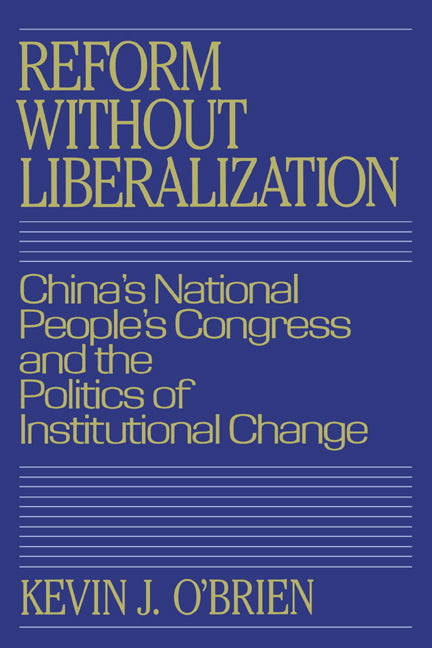
Reform without Liberalization
China's National People's Congress and the Politics of Institutional Change
This detailed study of the NPC examines how it has changed from its founding under Mao through the regime of Deng Xiaoping.
Kevin J. O'Brien (Author)
9780521380867, Cambridge University Press
Hardback, published 30 November 1990
280 pages
23.8 x 16 x 2 cm, 0.548 kg
"O'Brien has written a fine work on a subject that is sure to receive much more attention in the future." The Journal of Politics
Since its founding in 1954, the National People's Congress of China (NPC) has followed a difficult course of development, a course which has been characterized by periods of limited progress intermingled with periods of stagnation and regression. Political campaigns from the Anti-Rightist Movement (1957–1958) to the Great Leap Forward (1958–1960) to the Cultural Revolution (1966–1976) frustrated the establishment of any consistent policy concerning the appropriate role of the legislature within the one-party, Maoist regime. Mao's death in 1976, however, ushered in a new era of political reform which has included the strengthening of the NPC. In this detailed study of the NPC, Kevin O'Brien examines how the NPC has changed from its founding under Mao through the regime of Deng Xiaoping. He describes the various functions it has served, from the management of intra-elite relations; to the incorporation, and co-optation, of criticisms of regime policies into regime debates; to legislation and supervision of government agencies.
Acknowledgements
Part I. Introduction: 1. Chinese legislatures and political change
2. Origins of the NPC
Part II. The NPC Under Mao: 3. Development, doubts and decline
4. Structural features
5. The NPC in the political system
Part III. The NPC Under Deng: 6. Plenary sessions and policy discussions
7. Structural reforms
8. The NPC and systemic change
Abbreviations
Notes
Bibliography
Index.
Subject Areas: Politics & government [JP]