Freshly Printed - allow 10 days lead
Couldn't load pickup availability
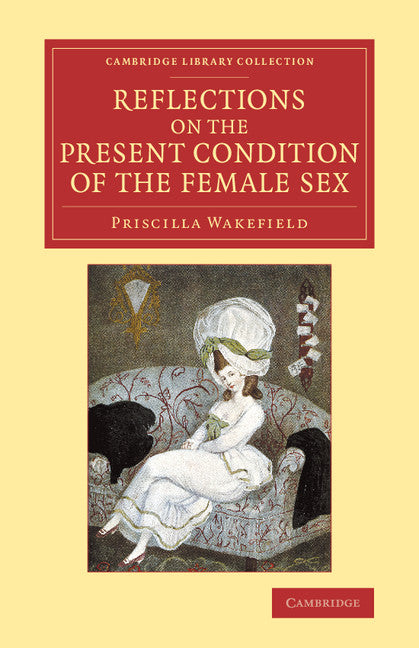
Reflections on the Present Condition of the Female Sex
With Suggestions for its Improvement
In this 1798 work, Wakefield suggests ways for women without the support of husband or family to earn a living.
Priscilla Wakefield (Author)
9781108084710, Cambridge University Press
Paperback / softback, published 27 April 2015
208 pages
21.6 x 14 x 1.3 cm, 0.4 kg
Coming from a prosperous London Quaker family, the author Priscilla Wakefield (1751–1832) wrote educational books for children, including an introduction to botany (also reissued in this series), and this 1798 work for adults, a fascinating piece of social and feminist history. Wakefield argues for better education for women, and suggests ways for those without the support of a husband or family to earn a living. Her ideas are not radical: she divides women into four social classes, with recommendations on appropriate work for each, and she believes that marriage rather than independence is the best outcome for any woman. Her concern for social norms is illustrated by her belief that field labour and any manufacturing job 'where both sexes are promiscuously assembled' are detrimental to female virtue. There are, however, many occupations which do not destroy 'the peculiar characteristic of their sex', or exceed 'the most exact limits of modesty and decorum'.
1. Introductory observations, shewing the claim which society has on women to employ their time usefully
2. From the connexion between the mind and the body is deduced the necessity of a more hardy mode of rearing female children
3. Remarks on the duties of a married and a single life
4. On the duties, studies, and amusements of women of the first class in society
5. On the duties, studies, and amusements of women of the second class in society
6. Lucrative employments for the first and second classes suggested
7. On the duties, attainments, and employments of women of the third class
8. Observations on the condition of the fourth class of women, suggesting a discrimination in distributing charity and an encouragement of marriage.
Subject Areas: Literary studies: general [DSB]