Freshly Printed - allow 10 days lead
Couldn't load pickup availability
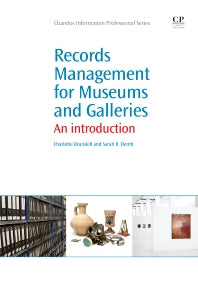
Records Management for Museums and Galleries
An Introduction
Charlotte Brunskill (Author), Sarah Demb (Author)
9781843346371, Elsevier Science
Paperback / softback, published 27 April 2012
278 pages
23.3 x 15.6 x 1.8 cm, 0.5 kg
"This book will doubtless prove to be a useful guide for those responsible for records management in the museum and gallery sector." --Australian Library Journal
The systematic management of records is an important activity for ‘information businesses’ such as museums and galleries, but is not always recognized as a core function. Record keeping activities are often concentrated on small groups of records, and staff charged with managing them may have limited experience in the field.
Records Management for Museums and Galleries offers a comprehensive overview of records management work within the heritage sector and draws on over a decade of experience in applying fundamental principles and practices to the specific circumstances of museums. It introduces readers to the institutional culture, functions, and records common to museums, and examines the legislative and regulatory environments affecting record-keeping practices. The book is comprised of eight chapters, including: a history of records keeping in the UK museum and gallery sector; the basics of records management; making a business case for records management; requirements of legislation for records management; how to conduct a records survey; strategy and action planning; how to develop a file plan, retention schedule and records management programme; and a guide to useful additional resources.
List of figures Acronyms Acknowledgements Preface About the authors Chapter 1: The history of record keeping in the UK museum and gallery sector Abstract: History Record keeping in museums: roles Record keeping in museums: record types Chapter 2: Records management basics Abstract: Introduction What is a record? What is records management? The ‘difference’ between archives and records management Basic records management concepts Chapter 3: Making a business case for records management Abstract: Introduction Compile a business case The importance of communication Chapter 4: Legislation and records management requirements Abstract: Introduction Public Records Acts 1958 and 1967 Local government legislation Data Protection Act 1998 Freedom of Information Act 2000 Environmental Information Regulations 2004 Other relevant legislation Chapter 5: The records survey Abstract Why conduct a survey? Pre-survey: the importance of planning The survey: issues and tips Post-survey: analyse, summarise and report Chapter 6: Strategy and action planning Abstract: Introduction Why to plan How to plan How to make the plan into a strategy Planning for required resources Chapter 7: Developing a file plan, retention schedule and records management programme Abstract: Introduction The file plan The records retention schedule Implementing a records management programme A final word Chapter 8: Resources UK legislation and regulations Spoliation and repatriation Professional bodies Discussion lists Useful guidance and training Standards Appendices: policies, forms and checklists Appendix 1: Risk assessment template and scoring framework Appendix 2: Business case example Appendix 3: Sample data protection survey form Appendix 4: Museum record series commonly containing personal data Appendix 5: Sample data protection policies Appendix 6: Sample data protection statements Appendix 7: Data subject access request form Appendix 8: Sample records management policy Appendix 9: Museum record series commonly containing environmental information Appendix 10: Records survey questionnaire forms Appendix 11: Supplies checklist template Appendix 12: Sample records transfer instruction and forms for staff References Index
Subject Areas: Library, archive & information management [GLC], Library & information sciences [GL]