Freshly Printed - allow 10 days lead
Couldn't load pickup availability
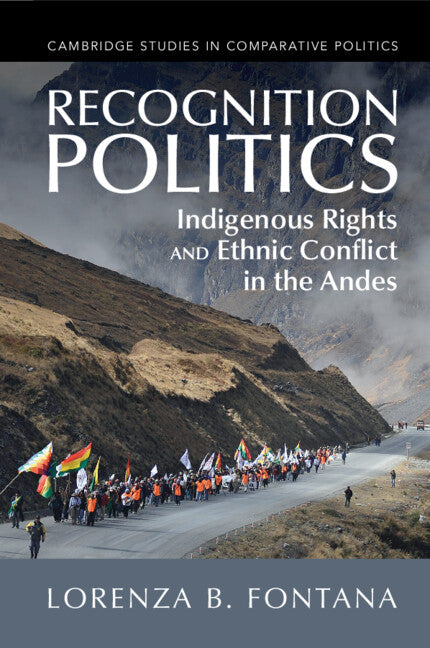
Recognition Politics
Indigenous Rights and Ethnic Conflict in the Andes
A critical analysis of influential theories on identity politics and recognition in the Global South which proposes new policy solutions.
Lorenza B. Fontana (Author)
9781009265508, Cambridge University Press
Paperback / softback, published 11 April 2024
272 pages
22.8 x 15 x 1.7 cm, 0.42 kg
'The book is a valuable addition to the literature and a must-read for students of Indigenous politics in Latin America. The book is characterised by rigorous research, compelling arguments and original theoretical contributions. It challenges us to re-think recognition politics and the policies that flow from these generally lauded reforms. These themes should be of interest to scholars well beyond the Andean region.' Pascal Lupien, Journal of Latin American Studies
This pioneering work explores a new wave of widely overlooked conflicts that have emerged across the Andean region, coinciding with the implementation of internationally acclaimed indigenous rights. Why are groups that have peacefully cohabited for decades suddenly engaging in hostile and, at times, violent behaviours? What is the link between these conflicts and changes in collective self-identification, claim-making, and rent-seeking dynamics? And how, in turn, are these changes driven by broader institutional, legal and policy reforms? By shifting the focus to the 'post-recognition,' this unique study sets the agenda for a new generation of research on the practical consequences of the employment of ethnic-based rights. To develop the core argument on the links between recognition reforms and 'recognition conflicts', Lorenza Fontana draws on extensive empirical material and case studies from three Andean countries – Bolivia, Colombia and Peru – which have been global forerunners in the implementation of recognition politics.
Introduction
1. Recognition Conflicts
2. Citizenship and Development in the Andes
3. Class and Ethnic Shifts
4. Recognition for Whom?
5. The Physical Boundaries of Identity
6. Unsettled Demographies
7. Struggles for Inclusion and Exclusion
8. Rethinking Recognition: What are the Implications for Identity Governance?.
Subject Areas: Politics & government [JP], Sociology & anthropology [JH], Ethnic studies [JFSL]