Freshly Printed - allow 10 days lead
Couldn't load pickup availability
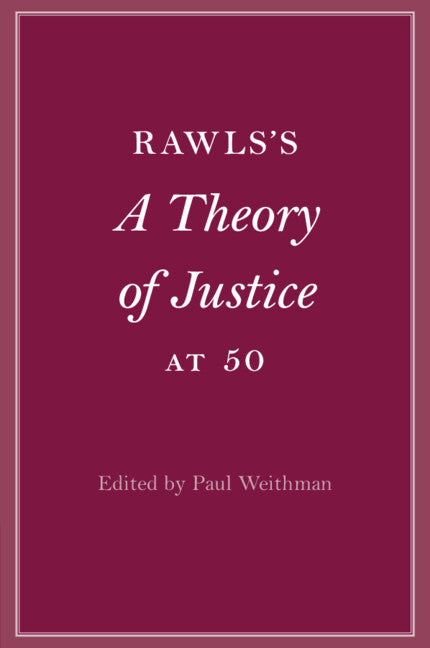
Rawls’s A Theory of Justice at 50
Marking the 50th anniversary of Rawls's A Theory of Justice, this volume offers a multifaceted exploration of this important work.
Paul Weithman (Edited by)
9781009214667, Cambridge University Press
Paperback / softback, published 1 May 2025
392 pages
22.9 x 15.2 x 2.1 cm, 0.565 kg
'The generations that have grown up witnessing regular major recessions in 2008 and 2020 have begun rediscovering Rawls's work and putting it to the more radical purposes it was intended for. This makes the new collection Rawls's A Theory of Justice at 50, edited by Paul Weithman, a welcome contribution.' Matt McManus, Jacobin
In 1971 John Rawls's A Theory of Justice transformed twentieth-century political philosophy, and it ranks among the most influential works in the history of the subject. This volume of new essays marks the 50th anniversary of its publication with a multi-faceted exploration of Rawls's most important book. A team of distinguished contributors reflects on Rawls's achievement in essays on his relationship to modern political philosophy and 20th-century economic theory, on his Kantianism, on his transition to political liberalism, on his account of public reason and contemporary challenges to it, on his theory's implications for problems of racial justice, on democracy and its fragility, and on Rawls's enduring legacy. The volume will be valuable for students and scholars working in moral and political philosophy, political theory, legal theory, and religious ethics.
Part I. Rawls and History: 1. 'Taillight illumination: how Rawlsian concepts may improve understanding of Hobbes's political philosophy' S. A. Lloyd
2. 'The theory Rawls, the 1844 Marx, and the market' Daniel Brudney
3. 'Rawls, Lerner, and the tax-and-spend booby trap: what happened to monetary policy?' Aaron James
4. 'Rawls's principles of justice as a transcendence of class warfare' Elizabeth Anderson
5. 'The significance of injustice' Peter de Marneffe
Part II. Developments between A Theory of Justice and Political Liberalism: 6. 'On being a 'self-originating source of valid claims' Stephen Darwall
7. ' Moral independence revisited: a note on the development of Rawls's thought from 1977–1980 and beyond' Samuel Scheffler
8. 'The method of insulation: on the development of Rawls's thought after a theory of justice' Rainer Forst
9. 'The stability or fragility of justice' Japa Pallikkathayil
Part III. Rawls, Ideal Theory and the Persistence of Injustice: 10. 'The circumstances of justice' Erin I. Kelly
11. 'Why Rawls's ideal theory leaves the well-ordered society vulnerable to structural oppression' Henry S. Richardson
12. 'Race, reparations, and justice as fairness' Tommie Shelby
13. ' On the role of the original position in Rawls's theory: reassessing the 'idealization' and 'fact-sensitivity' critiques' Laura Valentini
Part IV. Pluralism, Democracy and the Future of Justice as Fairness: 14. 'Public reason at fifty' Kevin Vallier
15. 'Reasonable political conceptions and the well-ordered liberal society' Samuel Freeman
16. 'Religious pluralism and social unions' Paul Weithman
17. 'One Person, at least one vote? Rawls on political equality…within limits' David Estlund
18. 'Reflections on democracy's fragility' Joshua Cohen
19. 'A society of self-respect' Leif Wenar
Bibliography
Index.
Subject Areas: Social & political philosophy [HPS]