Freshly Printed - allow 7 days lead
Couldn't load pickup availability
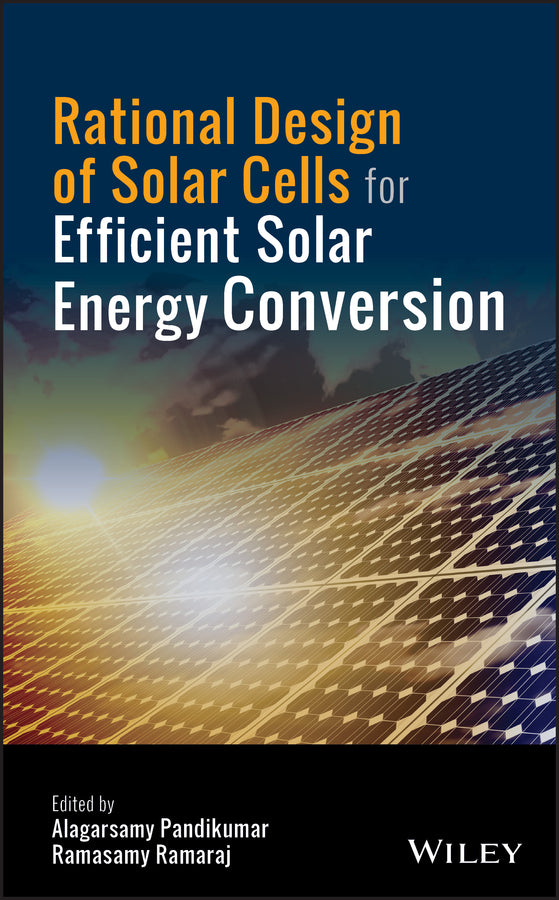
Rational Design of Solar Cells for Efficient Solar Energy Conversion
Alagarsamy Pandikumar (Edited by), Ramasamy Ramaraj (Edited by)
9781119437406, Wiley
Hardback, published 30 November 2018
400 pages
23.1 x 15.8 x 2.8 cm, 0.748 kg
An interdisciplinary guide to the newest solar cell technology for efficient renewable energy Rational Design of Solar Cells for Efficient Solar Energy Conversion explores the development of the most recent solar technology and materials used to manufacture solar cells in order to achieve higher solar energy conversion efficiency. The text offers an interdisciplinary approach and combines information on dye-sensitized solar cells, organic solar cells, polymer solar cells, perovskite solar cells, and quantum dot solar cells. The text contains contributions from noted experts in the fields of chemistry, physics, materials science, and engineering. The authors review the development of components such as photoanodes, sensitizers, electrolytes, and photocathodes for high performance dye-sensitized solar cells. In addition, the text puts the focus on the design of material assemblies to achieve higher solar energy conversion. This important resource: Written for researchers, scientists, and engineers in university and industry laboratories, Rational Design of Solar Cells for Efficient Solar Energy Conversion offers a comprehensive review of the newest developments and applications of solar cells with contributions from a range of experts in various disciplines.
Biographies xiii 1 Metal Nanoparticle Decorated ZnO Nanostructure Based Dye-Sensitized Solar Cells 1 1.1 Introduction 1 2 Cosensitization Strategies for Dye-Sensitized Solar Cells 15 2.1 Introduction 15 3 Natural Dye-Sensitized Solar Cells – Strategies and Measures 61 3.1 Introduction 61 4 Advantages of Polymer Electrolytes for Dye-Sensitized Solar Cells 85 4.1 Why Solar Cells? 85 5 Advantages of Polymer Electrolytes Towards Dye-sensitized Solar Cells 121 5.1 Introduction 121 6 Rational Screening Strategies for Counter Electrode Nanocomposite Materials for Efficient Solar Energy Conversion 169 6.1 Introduction 169 7 Design and Fabrication of Carbon-based Nanostructured Counter Electrode Materials for Dye-sensitized Solar Cells 193 7.1 Photovoltaic Solar Cells – An Overview 193 8 Highly Stable Inverted Organic Solar Cells Based on Novel Interfacial Layers 221 8.1 Introduction 221 9 Fabrication of Metal Top Electrode via Solution-based Printing Technique for Efficient Inverted Organic Solar Cells 255 9.1 Introduction 255 10 Polymer Solar Cells – An Energy Technology for the Future 283 10.1 Introduction 283 11 Rational Strategies for Large-area Perovskite Solar Cells: Laboratory Scale to Industrial Technology 307 11.1 Introduction 307 12 Hot Electrons Role in Biomolecule-based Quantum Dot Hybrid Solar Cells 339 12.1 Introduction 339 References 363
List of Contributors xv
Preface xix
Gregory Thien Soon How, Kandasamy Jothivenkatachalam, Alagarsamy Pandikumar, and Nay Ming Huang
1.2 Metal Dressed ZnO Nanostructures as Photoanodes 3
1.3 Conclusions and Outlook 11
Gachumale Saritha, Sambandam Anandan, and Muthupandian Ashokkumar
2.2 Cosensitization 18
2.3 Conclusions 51
N. Prabavathy, R. Balasundaraprabhu, and Dhayalan Velauthapillai
3.2 Components of Dye-sensitized Solar Cell 63
3.3 Fabrication of Natural DSSCs 65
3.4 Efficiency and Stability Enhancement in Natural Dye-Sensitized Solar Cells 68
3.5 Other Strategies and Measures taken in DSSCs Using Natural Dyes 79
3.6 Conclusions 82
L.P. Teo and A.K. Arof
4.2 Structure and Working Principle of DSSCs with Gel Polymer Electrolytes (GPEs) 86
4.3 Gel Polymer Electrolytes (GPEs) 87
4.4 Summary and Outlook 110
Nagaraj Pavithra, Giovanni Landi, Andrea Sorrentino, and Sambandam Anandan
5.2 Polymer Electrolytes 127
5.3 Dye- sensitized Solar Cells 130
5.4 Quantum Dot Sensitized Solar Cells (QDSSC) 150
5.5 Perovskite- Sensitized Solar Cells (PSSC) 152
5.6 Conclusion 153
Prabhakarn Arunachalam
6.2 Principles of Next Generation Solar Cells 171
6.3 Platinum-free Counterelectrode Materials 175
6.4 Summary and Outlook 185
Jayaraman Theerthagiri, Raja Arumugam Senthil, and Jagannathan Madhavan
7.2 Dye- sensitized Solar Cells 195
7.3 Carbon- based Nanostructured CE Materials for DSSCs 201
7.4 Conclusions 216
Fang Jeng Lim and Ananthanarayanan Krishnamoorthy
8.2 Research Areas in Organic Solar Cells 222
8.3 An Overview of Inverted Organic Solar Cells 224
8.4 Issues in Inverted Organic Solar Cells and Respective Solutions 232
8.5 Overcoming the Wettability Issue and Light-soaking Issue in Inverted Organic Solar Cells 235
8.6 Conclusions and Outlook 245
Navaneethan Duraisamy, Kavitha Kandiah, Kyung-Hyun Choi, Dhanaraj Gopi, Ramesh Rajendran, Pazhanivel Thangavelu, and Maadeswaran Palanisamy
9.2 Organic Photovoltaic Cells 257
9.3 Working Principle 258
9.4 Device Architecture 260
9.5 Fabrication Process 263
9.6 Fabrication of Inverted Organic Solar Cells 267
9.7 Device Morphology 272
9.8 Device Performance 273
9.9 Conclusion 277
Alagar Ramar and Fu-Ming Wang
10.2 Materials Developments for Bulk Heterojunction Solar Cells 284
10.3 Materials Developments for Molecular Heterojunction Solar Cells 291
10.4 Developments in Device Structures 293
10.5 Conclusions 300
Arunachalam Arulraj and Mohan Ramesh
11.2 Perovskite 308
11.3 Perovskite Solar Cells 309
11.4 Device Processing 313
11.5 Enhancing the Stability of Devices 316
11.6 Summary 329
T. Pazhanivel, G. Bharathi, D. Nataraj, R. Ramesh, and D. Navaneethan
12.2 Classifications of Solar Cells 341
12.3 Main Losses in Solar Cells 344
12.4 Hot Electron Concept in Materials 346
12.5 Methodology 347
12.6 Material Synthesis 350
12.7 Identification of Hot Electrons 351
12.8 Quantum Dot Sensitized Solar Cells 360
12.9 Conclusion 363
Index 369
Subject Areas: Mechanical engineering & materials [TG]