Freshly Printed - allow 10 days lead
Couldn't load pickup availability
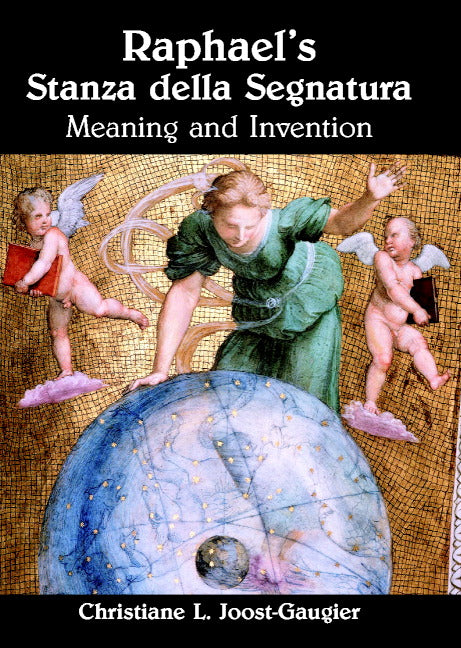
Raphael's Stanza della Segnatura
Meaning and Invention
Examines Raphael's Stanza della Segnatura, exploring the meaning of the frescoes and accompanying decoration.
Christiane L. Joost-Gaugier (Author)
9780521809238, Cambridge University Press
Hardback, published 6 May 2002
284 pages, 33 b/w illus. 12 colour illus.
25.4 x 18 x 2.1 cm, 0.768 kg
"Christiane L. Joost-Gaugier opens her discussion... with the bold asserion that "the Stanza della Segnatura belongs as much to the history of ideas as to the history of art", an assumption she goes on to explore through a painstaking examination of the imagery from Julius II's private library." Sixteenth Century Journal
Raphael was the preeminent painter of Renaissance Rome, whose classical style marks some of the most enduring masterpieces of Italian Renaissance art. Of these, the Stanza della Segnatura in the Vatican Palace has often been considered the most aesthetically perfect. Executed between 1508 and 1511 for the notoriously temperamental, but adventurous, patron of the arts, Pope Julius II, it was the commission that propelled Raphael, then a young man, into international prominence. The work consists of a chamber with a painted ceiling, a pavement of inlaid marble, and four frescoed walls, all orchestrated with a cast of famous historical figures who exemplify the various disciplines of learning. Joost-Gaugier's study is the first to examine the elements of the Stanza della Segnatura as an ensemble. The volume focuses on the meaning of the frescoes and accompanying decoration in light of recent studies into the intellectual world of High Renaissance Rome.
Introduction
1. The Stanza della Segnatura and its painted program: the Library of Julius II
2. The inventor of the program: ambiguities and uncertainties
3. The Pope's Librarian, Tommaso Inghirami: portrait of a Humanist
4. The ceiling: the birth of the disciplines and the triumph of their protector
5. The geography of the Stanza della Segnatura
6. The Disputa: a visionary theology and the exultation of Christianity
7. The School of Athens: the great philosophical inventions
8. The Parnassus: the universal language of Apollo
9. The Jurisprudence: civil law, canon law, and divine law
10. The pavement: the power of the Sacred Hebrew language
11. Conclusion: the Humanism of the Stanza Della Segnatura
12. Epilogue: Harmony is the most beautiful thing. Raphael's pythagoreanism.
Subject Areas: Early modern history: c 1450/1500 to c 1700 [HBLH], European history [HBJD], History of art & design styles: c 1400 to c 1600 [ACN]