Freshly Printed - allow 10 days lead
Couldn't load pickup availability
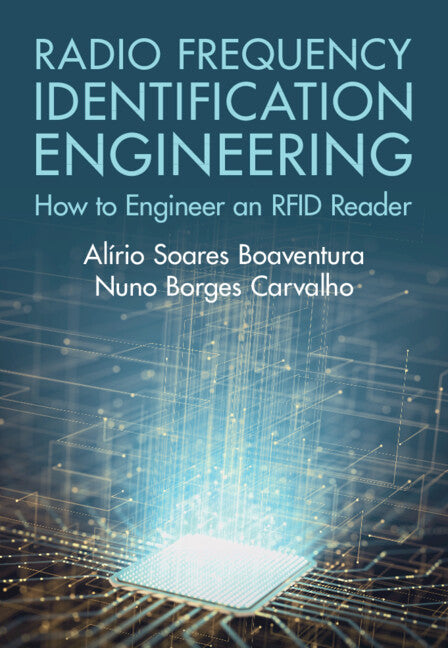
Radio Frequency Identification Engineering
How to Engineer an RFID Reader
The first of its kind, this book provides a unique compilation of technical resources for engineering RFID readers.
Alírio Soares Boaventura (Author), Nuno Borges Carvalho (Author)
9781108489713, Cambridge University Press
Hardback, published 9 January 2025
266 pages
25 x 17.6 x 2 cm, 0.63 kg
'This book is a must-have reference handbook for researchers aspiring to design and build a versatile functional software-defined RFID reader. It is also one of the best resources for anyone looking to learn more about the world of RAIN RFID (RAdio IdentificatioN RFID). This highly recommended book covers a wide range of topics, starting from spectrum, standards, backscatter technology definitions, and all the way to reader architecture choices and RFID signal processing, including encoding, modulation, and filtering. With sections on advanced research concepts, such as multicarrier systems or adaptive self-jamming suppression, as well as many exercises and practical MATLAB code examples, it can be used as a great text-book for students.' James Chu, IEEE Microwave Magazine
Radio Frequency Identification Engineering Radio frequency identification (RFID) has become an undeniable aspect of modern living, being used from logistics, access control, and electronic payment systems to artificial intelligence, and as a key building block of the internet of things. Presenting a unique coverage of RFID reader design and engineering, this is a valuable resource for engineers and researchers, aiding in their mission of fulfilling current and future demands in the RFID space. Providing a cohesive compilation of technical resources for full-stack engineering of RFID readers, the book includes step-by-step techniques, algorithms, and source code that can be incorporated in custom designs. Readers are invited to explore the design of RFID interrogators based on software-defined radio for flexible, upgradeable solutions as well as low-complexity techniques for engineering low-cost RFID readers. Additionally, the authors provide insight into related topics such as waveform design optimization for improved reading range and novel quadrature backscatter modulation techniques.
Foreword Smail Tedjini
Acknowledgments
1. Introduction
2. An introduction to radio frequency identification
3. Backscatter communications: fundamentals and recent advances
4. An overview of the ISO 18000-63 standard
5. Digital signal processing for RFID applications
6. A simple low-cost RFID reader implementation
7. A software-defined RFID reader design
8. Self-jamming in backscatter radio systems
9. Wake-up radios for IoT applications
10. Unconventional wireless power transmission
11. A battery-less backscatter remote control system
Appendix A – Alternative battery-less controller configurations.
Subject Areas: Microwave technology [TJFN]