Freshly Printed - allow 7 days lead
Couldn't load pickup availability
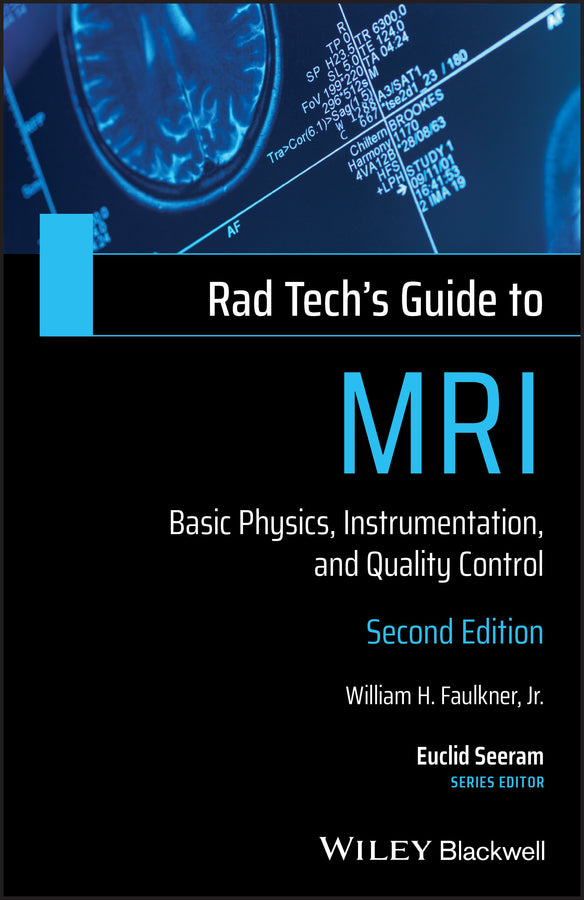
Rad Tech's Guide to MRI
Basic Physics, Instrumentation, and Quality Control
William H. Faulkner, Jr. (Author), Euclid Seeram (Series edited by)
9781119508571, Wiley
Paperback / softback, published 27 February 2020
144 pages
21.3 x 14 x 1.5 cm, 0.204 kg
The second edition of Rad Tech's Guide to MRI provides practicing and training technologists with a succinct overview of magnetic resonance imaging (MRI). Designed for quick reference and examination preparation, this pocket-size guide covers the fundamental principles of electromagnetism, MRI equipment, data acquisition and processing, image quality and artifacts, MR Angiography, Diffusion/Perfusion, and more. Written by an expert practitioner and educator, this handy reference guide: Rad Tech's Guide to MRI is a must-have resource for student radiographers, especially those preparing for the American Registry of Radiation Technologist (ARRT) exams, as well as practicing radiology technologists looking for a quick reference guide.
1. Hardware Overview 1 Instrumentation: Magnets 1 Instrumentation: RF Subsystem 6 Instrumentation: Gradient Subsystem 8 2. Fundamental Principles 11 Electromagnetism: Faraday’s Law of Induction 11 Magnetism 12 Behavior of Hydrogen in a Magnetic Field 14 3. Production of Magnetic Resonance Signal 19 4. Relaxation and Tissue Characteristics 23 T2-Relaxation 23 T1-Relaxation 24 Proton Density 24 T2* (Pronounced “T2 star”) 25 5. Data Acquisition and Image Formation 27 Pulse Sequences 27 Image Contrast Control 30 Image Formation 42 Data Acquisition 43 Scan Time 50 Controlling Image Quality with FSE 57 6. Magnetic Resonance Image Quality 61 Spatial Resolution 61 Signal-to-Noise Ratio (SNR) 63 7. Artifacts 75 Chemical Shift (Water and Fat in Different Voxels) 75 Chemical Shift (Water and Fat in the Same Voxel) 77 Magnetic Susceptibility 79 Motion and Flow 81 Spatial Presaturation 82 Gradient Moment Nulling (Flow Compensation) 84 Compensation for Respiration 84 Cardiac Compensation 86 Aperiodic Motion 88 Aliasing 89 Gibbs and Truncation Artifact 91 Radio-Frequency Artifacts 92 Gradient Malfunctions 93 Image Shading 93 Inadequate System Tuning 94 Reconstruction Artifacts 94 8. Flow Imaging 97 Flow Patterns 97 Magnetic Resonance Angiography (Non Contrast) 98 Reduction of Flow Artifacts 102 Signal Loss in MRA 102 Two-Dimensional and Three-Dimensional Time-of-Flight 103 Signal Loss with Two-Dimensional TOF 104 Three-Dimensional TOF 106 Signal Loss with Three-Dimensional TOF 108 PC Techniques 109 Contrast Enhanced MRA (CE-MRA) 113 9. Diffusion and Perfusion Imaging 117 Diffusion-Weighted Imaging (DWI) 117 10. Gadolinium-Based Contrast Agents 125 Characteristics, Composition and Structure 125 Index 129
Subject Areas: Medicine: general issues [MB]