Freshly Printed - allow 10 days lead
Couldn't load pickup availability
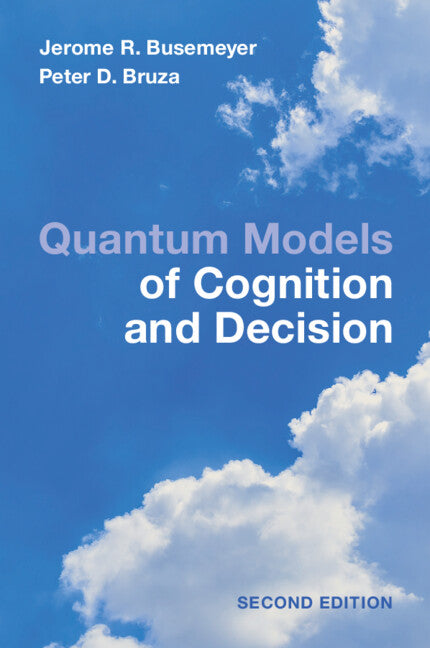
Quantum Models of Cognition and Decision
Principles and Applications
Explains how quantum theory accounts for many empirical findings in cognition and decision making using a common set of principles.
Jerome R. Busemeyer (Author), Peter D. Bruza (Author)
9781009205313, Cambridge University Press
Paperback / softback, published 21 November 2024
456 pages
22.8 x 15.1 x 2.4 cm, 0.63 kg
'Quantum models are a valuable addition to the cognitive scientist's toolbox for understanding human information processing and decision making. This second edition of Busemeyer's and Bruza's ground-breaking introduction to the field is required reading for scientists wanting to learn about these models as well as for experts desiring to update their knowledge.' Thomas S. Wallsten, University of Maryland
Quantum Models of Cognition and Decision, Second Edition presents a fully updated and expanded version of this innovative and path-breaking text. It offers an accessible introduction to the intersection of quantum theory and cognitive science, covering new insights, modelling techniques, and applications for understanding human cognition and decision making. In it, Busemeyer and Bruza delve into such topics as the non-commutative nature of judgments, quantum interference as a general principle governing human decision making, contextuality in modelling human cognition, and thought-provoking speculation about what a quantum approach to cognition might reveal about the ultimate nature of the human mind. Additions include new material on measurement, open systems, and applications to computer science. Requiring no prior background in quantum physics, this book comes complete with a tutorial and fully worked-out applications in important areas of cognition and decision.
1. Introduction
2. Elementary quantum probability
3. Advanced quantum probability
4. Elementary quantum probability applications
5. Advanced quantum probability applications
6. Introductory dynamics
7. Advanced dynamics
8. Information processing
9. Quantum learning
10. Contextuality
11. Quantum language
12. Quantum Bayesian networks and quasi-probability
13. Philosophical aspects
14. Contributions and future directions
Appendix
Programs.
Subject Areas: Cognition & cognitive psychology [JMR]