In Stock - dispatch within 48 hours
Couldn't load pickup availability
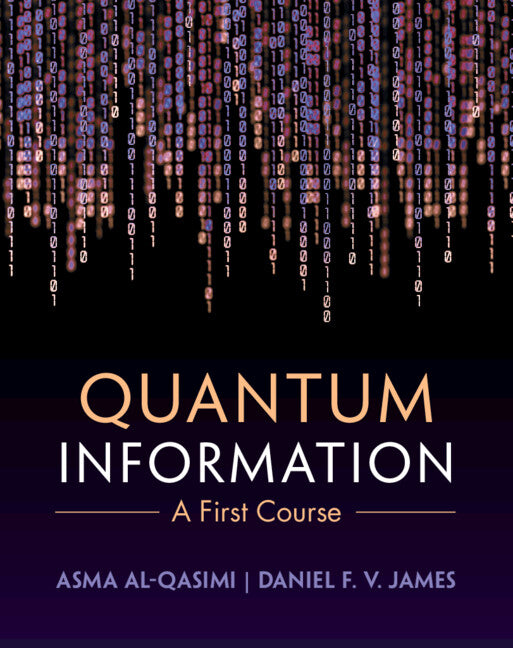
Quantum Information
A First Course
Foundational text on quantum information, aimed at students from various STEM backgrounds and written in an approachable style.
Asma Al-Qasimi (Author), Daniel F. V. James (Author)
9781009514729, Cambridge University Press
Hardback, published 26 June 2025
315 pages
26 x 20.6 x 2 cm, 0.95 kg
'This is a very clear exposition on Quantum Information, a difficult topic and will be a great assistance for students. The authors are to be congratulated of producing such a student 'user friendly' book.' Gerard Edwards, Liverpool John Moores University
Important concepts from the diverse fields of physics, mathematics, engineering and computer science coalesce in this foundational text on the cutting-edge field of quantum information. Designed for undergraduate and graduate students with any STEM background, and written by a highly experienced author team, this textbook draws on quantum mechanics, number theory, computer science technologies, and more, to delve deeply into learning about qubits, the building blocks of quantum information, and how they are used in quantum computing and quantum algorithms. The pedagogical structure of the chapters features exercises after each section as well as focus boxes, giving students the benefit of additional background and applications without losing sight of the big picture. Recommended further reading and answers to select exercises further support learning. Written in approachable and conversational prose, this text offers a comprehensive treatment of the exciting field of quantum information while remaining accessible to students and researchers within all STEM disciplines.
Preface
1. Welcome to quantum computing
2. Quantum mechanics for quantum computers
3. Two qubits and entanglement
4. Quantum algorithms
5. Period finding and Shor's algorithm
6. Realizations of qubits: general discussion
7. Realizations of qubits: examples
8. The physics of two-qubit gates
9. Device characterization
10. Variations on the DiVincenzo criteria
11. Decoherence and how to defeat it
12. Quantum technologies
Afterword
Solutions to select exercises
Appendices
Glossary
Suggestions for further reading
Index.
Subject Areas: Quantum physics [quantum mechanics & quantum field theory PHQ]