Freshly Printed - allow 7 days lead
Couldn't load pickup availability
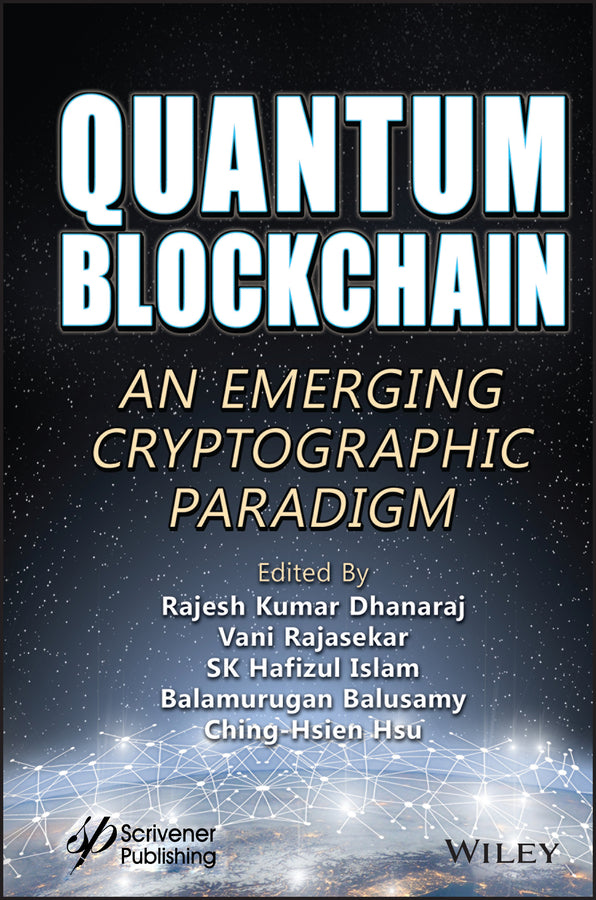
Quantum Blockchain
An Emerging Cryptographic Paradigm
Rajesh Kumar Dhanaraj (Edited by), Vani Rajasekar (Edited by), SK Hafizul Islam (Edited by), Balamurugan Balusamy (Edited by), Ching-Hsien Hsu (Edited by)
9781119836223, Wiley
Hardback, published 13 July 2022
384 pages
1 x 1 x 1 cm, 0.454 kg
QUANTUM BLOCKCHAIN While addressing the security challenges and threats in blockchain, this book is also an introduction to quantum cryptography for engineering researchers and students in the realm of information security. Quantum cryptography is the science of exploiting quantum mechanical properties to perform cryptographic tasks. By utilizing unique quantum features of nature, quantum cryptography methods offer everlasting security. The applicability of quantum cryptography is explored in this book. It describes the state-of-the-art of quantum blockchain techniques and sketches how they can be implemented in standard communication infrastructure. Highlighting a wide range of topics such as quantum cryptography, quantum blockchain, post-quantum blockchain, and quantum blockchain in Industry 4.0, this book also provides the future research directions of quantum blockchain in terms of quantum resilience, data management, privacy issues, sustainability, scalability, and quantum blockchain interoperability. Above all, it explains the mathematical ideas that underpin the methods of post-quantum cryptography security. Readers will find in this book a comprehensiveness of the subject including: Audience The book is for security analysts, data scientists, vulnerability analysts, professionals, academicians, researchers, industrialists, and students working in the fields of (quantum) blockchain, cybersecurity, cryptography, and artificial intelligence with regard to smart cities and Internet of Things.
Preface xix 1 Introduction to Classical Cryptography 1 1.1 Introduction 2 1.2 Substitution Ciphers 2 1.3 Transposition Cipher 8 1.4 Symmetric Encryption Technique 10 1.5 Asymmetric Encryption Technique 17 1.6 Digital Signatures 22 References 28 2 Quantum Cryptographic Techniques 31 2.1 Post-Quantum Cryptography 32 2.2 Strength of Quantum Cryptography 32 2.3 Working Principle of Quantum Cryptography 32 2.4 Example of Quantum Cryptography 33 2.5 Fundamentals of Quantum Cryptography 34 2.6 Problems With the One-Time Pad and Key Distribution 35 2.7 Quantum No-Cloning Property 36 2.8 Heisenberg Uncertainty Principle 37 2.9 Quantum Key Distribution 38 2.10 Cybersecurity Risks Prevailing in Current Cryptographic Techniques 39 2.11 Implementation of Quantum-Safe Cryptography 40 2.12 Practical Usage of Existing QKD Solutions 41 2.13 Attributes of Quantum Key Distribution 41 2.14 Quantum Key Distribution Protocols 44 2.15 Applications of Quantum Cryptography 49 2.16 Conclusion 52 References 52 3 Evolution of Quantum Blockchain 55 3.1 Introduction of Blockchain 55 3.2 Introduction of Quantum Computing 62 3.3 Restrictions of Blockchain Quantum 65 3.4 Post-Quantum Cryptography Features 72 3.5 Quantum Cryptography 73 3.6 Comparison Between Traditional and Quantum-Resistant Cryptosystems 76 3.7 Quantum Blockchain Applications 77 3.8 Blockchain Applications 77 3.9 Limitations of Blockchain 78 3.10 Conclusion 79 References 79 4 Development of the Quantum Bitcoin (BTC) 83 4.1 Introduction of BTC 84 4.2 Extract 87 4.3 Preservation 89 4.4 The Growth of BTC 97 4.5 Quantum Computing (History and Future) 98 4.6 Quantum Computation 99 4.7 The Proposal of Quantum Calculation 101 4.8 What Are Quantum Computers and How They Exertion? 102 4.9 Post-Quantum Cryptography 104 4.10 Difficulties Facing BTC 105 4.11 Conclusion 106 References 107 5 A Conceptual Model for Quantum Blockchain 109 5.1 Introduction 110 5.2 Distributed Ledger Technology 110 5.3 Hardware Composition of the Quantum Computer 115 5.4 Framework Styles of Quantum Blockchain 115 5.5 Fundamental Integrants 122 5.6 Conclusion 124 References 124 6 Challenges and Research Perspective of Post–Quantum Blockchain 127 6.1 Introduction 128 6.2 Post–Quantum Blockchain Cryptosystems 136 6.3 Post–Quantum Blockchain Performance Comparison 154 6.4 Future Scopes of Post–Quantum Blockchain 168 6.5 Conclusion 170 References 170 7 Post-Quantum Cryptosystems for Blockchain 173 7.1 Introduction 174 7.2 Basics of Blockchain 174 7.3 Quantum and Post-Quantum Cryptography 177 7.4 Post-Quantum Cryptosystems for Blockchain 180 7.5 Other Cryptosystems for Post-Quantum Blockchain 195 7.6 Conclusion 196 References 199 8 Post-Quantum Confidential Transaction Protocols 201 8.1 Introduction 201 8.2 Confidential Transactions 202 8.3 Zero-Knowledge Protocol 203 8.4 Zero-Knowledge Protocols 212 8.5 Transformation Methods 216 8.6 Conclusion 217 References 218 9 A Study on Post-Quantum Blockchain: The Next Innovation for Smarter and Safer Cities 221 9.1 Blockchain: The Next Big Thing in Smart City Technology 222 9.2 Application of Blockchain Technology in Smart Cities 226 9.3 Using Blockchain to Secure Smart Cities 228 9.4 Blockchain Public Key Security 231 9.5 Quantum Threats on Blockchain Enabled Smart City 233 9.6 Post-Quantum Blockchain–Based Smart City Solutions 235 9.7 Quantum Computing Fast Evolution 236 9.8 Conclusion 238 References 239 10 Quantum Protocols for Hash-Based Blockchain 241 10.1 Introduction 242 10.2 Consensus Protocols 242 10.3 Quantum Blockchain 246 10.4 Quantum Honest-Success Byzantine Agreement (QHBA) Protocol 255 10.5 MatRiCT Protocol 258 10.6 Conclusion 261 References 261 11 Post-Quantum Blockchain–Enabled Services in Scalable Smart Cities 263 11.1 Introduction 264 11.2 Preliminaries 267 11.3 Related Work 273 11.4 Background of Proposed Work 274 11.5 Proposed Work 278 11.6 Conclusion 287 References 288 12 Security Threats and Privacy Challenges in the Quantum Blockchain: A Contemporary Survey 293 12.1 Introduction 294 12.2 Types of Blockchain 297 12.3 Quantum Blockchain: State of the Art 298 12.4 Voting Protocol 303 12.5 Security and Privacy Issues in Quantum Blockchain 306 12.6 Challenges and Research Perspective in Quantum Blockchain 308 12.7 Security Threats in Quantum Blockchain 310 12.8 Applications of Quantum Blockchain 311 12.9 Characteristics of Post-Quantum Blockchain Schemes 313 12.10 Conclusion 314 References 314 13 Exploration of Quantum Blockchain Techniques Towards Sustainable Future Cybersecurity 317 13.1 Introduction to Blockchain 318 13.2 Insights on Quantum Computing 322 13.3 Quantum Computing Algorithms 332 13.4 Quantum Secured Blockchain 333 13.5 Conclusion 339 References 339 14 Estimation of Bitcoin Price Trends Using Supervised Learning Approaches 341 14.1 Introduction 341 14.2 Related Work 343 14.3 Methodology 344 14.4 Implementation of the Proposed Work 349 14.5 Results Evaluation and Discussion 352 14.6 Conclusion 353 References 353 Index 357
Vani Rajasekar, Premalatha J., Rajesh Kumar Dhanaraj and Oana Geman
Malathy S., Santhiya M. and Rajesh Kumar Dhanaraj
Dinesh Komarasamy and Jenita Hermina J.
Gaurav Dhuriya, Aradhna Saini and Prashant Johari
Vijayalakshmi P., Abraham Dinakaran and Korhan Cengiz
Venu K. and Krishnakumar B.
K. Tamil Selvi and R. Thamilselvan
R. Manjula Devi, P. Keerthika, P. Suresh, R. Venkatesan, M. Sangeetha, C. Sagana and K. Devendran
G.K. Kamalam and R.S. Shudapreyaa
Sathya K., Premalatha J., Balamurugan Balusamy and Sarumathi Murali
Kumar Prateek and Soumyadev Maity
K. Sentamilselvan, Suresh P., Kamalam G. K., Muthukrishnan H., Logeswaran K. and Keerthika P.
H. Muthukrishnan, P. Suresh, K. Logeswaran and K. Sentamilselvan
Prasannavenkatesan Theerthagiri
Subject Areas: Electronics & communications engineering [TJ]