Freshly Printed - allow 10 days lead
Couldn't load pickup availability
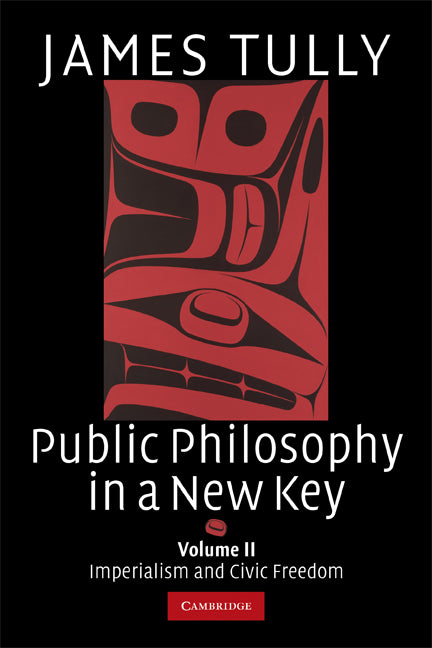
Public Philosophy in a New Key: Volume 2, Imperialism and Civic Freedom
Two ambitious volumes from one of the world's leading political philosophers presenting a new kind of political and legal theory.
James Tully (Author)
9780521728805, Cambridge University Press
Paperback / softback, published 18 December 2008
384 pages
22.8 x 15.1 x 1.8 cm, 0.6 kg
'Tully regards his political philosophy as a public philosophy, engaged in a constant dialogue with political agents. Where and how this dialogue takes place and which political effects it will have are questions beyond its control. The gap between theory and practice thus turns out to be a limit even for a theory that, as far as possible, conceives of itself as practice. Tully's work is exemplary in pushing this limit in ways from which both theory and practice can learn a great deal.' Constellations
These two ambitious volumes from one of the world's most celebrated political philosophers present a new kind of political and legal theory that James Tully calls a public philosophy, and a complementary new way of thinking about active citizenship, called civic freedom. Professor Tully takes the reader step-by-step through the principal debates in political theory and the major types of political struggle today. These volumes represent a genuine landmark in political theory. In this second volume, Professor Tully studies networks and civic struggles over global or imperial relations of inequality, dependency, exploitation and environmental degradation beyond the state. The final chapter brings all of the author's resonant themes together in a new way of thinking about global and local citizenship, and of political theory in relation to it. This forms a powerful conclusion to a major intervention from a vital and distinctive voice in contemporary thought.
Dedication
Acknowledgements
Credits
Introduction
Public philosophy and civic freedom: a guide to the two volumes
Part I. Global Governance and Practices of Freedom: 1. The Kantian idea of Europe: cosmopolitan and critical perspectives
2. Democracy and globalisation: a defeasible sketch
3. An ecological ethics
4. The unfreedom of the moderns in relation to their ideals of constitutionalism and democracy
Part II. On Imperialism
5. On law, democracy and imperialism
6. Communication and imperialism
7. The imperial toles of modern vonstitutional democracy
Conclusion: civic freedom contra imperialism: 8. A new kind of Europe? Democratic integration in the European Union
9. On global and local citizenship
Bibliography
Index.
Subject Areas: Political science & theory [JPA], Social & political philosophy [HPS]