Freshly Printed - allow 7 days lead
Couldn't load pickup availability
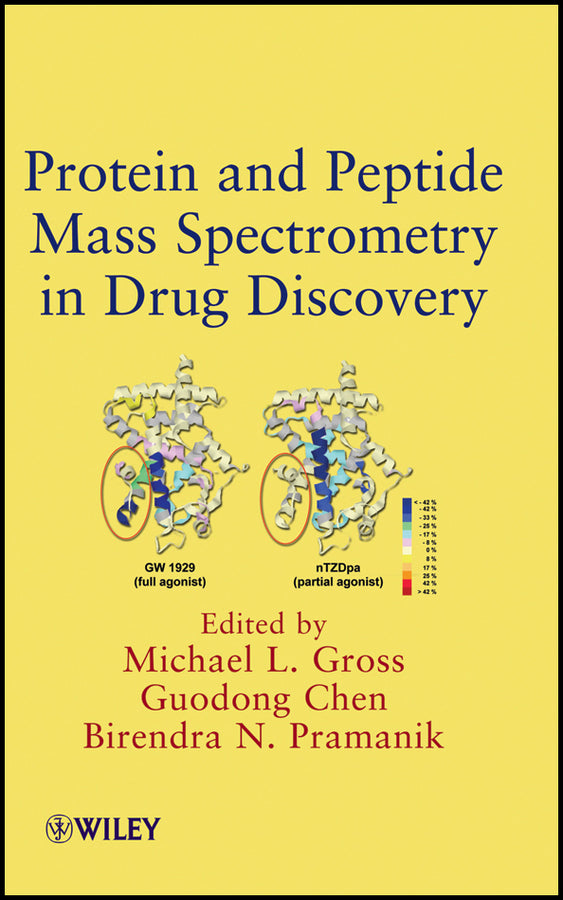
Protein and Peptide Mass Spectrometry in Drug Discovery
Michael L. Gross (Edited by), M.L Gross (Author), Guodong Chen (Edited by), Birendra Pramanik (Edited by)
9780470258170, Wiley
Hardback, published 23 December 2011
492 pages
24.1 x 16.3 x 3 cm, 0.875 kg
"This book will be a valuable reference as it contains plenty of depth and substance to be of interest to experienced practitioners of mass spectrometry and related techniques, but is still accessible to pharmaceutical researchers who want to learn more about MS technologies and its applications." (American Society for Mass Spectrometry, 1 July 2012)
The book that highlights mass spectrometry and its application in characterizing proteins and peptides in drug discovery An instrumental analytical method for quantifying the mass and characterization of various samples from small molecules to large proteins, mass spectrometry (MS) has become one of the most widely used techniques for studying proteins and peptides over the last decade. Bringing together the work of experts in academia and industry, Protein and Peptide Mass Spectrometry in Drug Discovery highlights current analytical approaches, industry practices, and modern strategies for the characterization of both peptides and proteins in drug discovery. Illustrating the critical role MS technology plays in characterizing target proteins and protein products, the methods used, ion mobility, and the use of microwave radiation to speed proteolysis, the book also covers important emerging applications for neuroproteomics and antigenic peptides. Placing an emphasis on the pharmaceutical industry, the book stresses practice and applications, presenting real-world examples covering the most recent advances in mass spectrometry, and providing an invaluable resource for pharmaceutical scientists in industry and academia, analytical and bioanalytical chemists, and researchers in protein science and proteomics.
PREFACE xv CONTRIBUTORS xvii PART I METHODOLOGY 1 1 Ionization Methods in Protein Mass Spectrometry 3 1.1 History of the Development of Protein Mass Spectrometry 4 1.2 Laser-Based Ionization Methods for Proteins 5 1.3 Spray-Based Ionization Methods for Proteins 13 1.4 Ambient Ionization Methods 20 1.5 Conclusions 30 Acknowledgments 30 References 30 2 Ion Activation and Mass Analysis in Protein Mass Spectrometry 43 2.1 Introduction 43 2.2 Ion Activation and Tandem MS Analysis 46 2.3 Mass Analyzers 59 References 81 3 Target Proteins: Bottom-up and Top-down Proteomics 89 3.1 Mass Spectral Approaches to Targeted Protein Identification 89 3.2 Bottom-up Proteomics 90 3.3 Top-down Approaches 96 3.4 Next-Generation Approaches 98 References 99 4 Quantitative Proteomics by Mass Spectrometry 101 4.1 Introduction 101 4.2 In-Cell Labeling 105 4.3 Quantitation via Isotopic Labeling of Proteins 107 4.4 Quantitation via Isotopic Labeling on Peptides 112 4.5 Label-Free Quantitation 116 4.6 Conclusions 119 Acknowledgment 120 References 120 5 Comparative Proteomics by Direct Tissue Analysis Using Imaging Mass Spectrometry 129 5.1 Introduction 129 5.2 Conventional Comparative Proteomics 130 5.3 Comparative Proteomics Using Imaging MS 131 5.4 Conclusions 136 Acknowledgments 137 References 137 6 Peptide and Protein Analysis Using Ion Mobility–Mass Spectrometry 139 6.1 Ion Mobility–Mass Spectrometry: Instrumentation and Separation Selectivity 139 6.2 Characterizing and Interpreting Peptide and Protein Structures 147 6.3 Applications of IM-MS to Peptide and Protein Characterizations 152 6.4 Future Directions 158 Acknowledgments 159 References 160 7 Chemical Footprinting for Determining Protein Properties and Interactions 175 7.1 Introduction to Hydrogen–Deuterium Exchange 175 7.2 Experimental Procedures 178 7.3 Mass Spectrometry-Based HDX in Practice 182 7.4 Protein Footprinting via Free-Radical Oxidation 193 7.5 Chemical Crosslinking 198 7.6 Selective and Irreversible Chemical Modification 201 7.7 Conclusion 205 References 206 8 Microwave Technology to Accelerate Protein Analysis 213 8.1 Introduction 213 8.2 Microwave Technology 215 8.3 Summary 224 Acknowledgments 224 References 224 9 Bioinformatics and Database Searching 231 9.1 Overview 231 9.2 Introduction to Tandem Mass Spectrometry 231 9.3 Overview of Peptide Identification with Database Searching 234 9.4 MyriMatch-IDPicker Protein Identification Pipeline 235 9.5 Results of a Shotgun Proteomics Study 246 9.6 Improvements to MyriMatch Database Search Engine 248 9.7 Applications of MyriMatch-IDPicker Pipeline 250 9.8 Conclusions 251 Acknowledgments 251 References 251 PART II Applications 253 10 Mass Spectrometry-Based Screening and Characterization of Protein–Ligand Complexes in Drug Discovery 255 10.1 Introduction 255 10.2 Affinity Selection Mass Spectrometry (AS-MS) 256 10.3 Solution-Based AS-MS as Screening Technologies 258 10.4 Gas-Phase Interactions 267 10.5 Enzyme Activity Assays Using MS for Screening or Confirming Drug Candidates 271 10.6 Conclusions and Future Directions 276 References 277 11 Utilization of Mass Spectrometry for the Structural Characterization of Biopharmaceutical Protein Products 287 11.1 Introduction 287 11.2 MS-Based Approach for the Characterization of Recombinant Therapeutic Proteins 288 11.3 Cell Culture Development 290 11.4 Purification Development 294 11.5 Formulation Development 300 11.6 Analytical Method Development 304 11.7 Confirmation of Structure/Product Comparability Assessment 311 11.8 Conclusions 313 Acknowledgments 315 References 315 12 Post-translationally Modified Proteins: Glycosylation, Phosphorylation, and Disulfide Bond Formation 321 12.1 Introduction 321 12.2 Glycosylation 322 12.3 Phosphorylation 338 12.4 Disulfide Bond Detection and Mapping 347 12.5 Future Perspectives 350 Acknowledgments 352 Abbreviations 353 References 354 13 Mass Spectrometry of Antigenic Peptides 371 13.1 Introduction 371 13.2 Analysis of Antigenic Peptides 374 13.3 Examples of the Application of Mass Spectrometry to Antigenic Peptide Study 381 13.4 Future Work 385 Acknowledgments 386 Abbreviations 387 References 387 14 Neuropeptidomics 393 14.1 Introduction 393 14.2 Neuropeptidomics: Characterizing Peptides in the Brain 394 14.3 Sample Preparation for Mass Spectrometry 395 14.4 Separations 405 14.5 Peptide Characterization via Mass Spectrometry 407 14.6 Conclusions 419 14.7 Future Perspectives 419 Acknowledgments 420 References 420 15 Mass Spectrometry for the Study of Peptide Drug Metabolism 435 15.1 Introduction 435 15.2 Peptide Drug Metabolism 436 15.3 LC-MS/MS for Metabolite Identification 437 15.4 Quantitative Analysis 439 15.5 Case Study: IL-1b Protease Inhibitors 440 15.6 Future Directions 445 References 445 INDEX 449
Ismael Cotte-Rodriguez, Yun Zhang, Zhixin Miao, and Hao Chen
Cheng Lin and Peter O’Connor
Michael Boyne and Ron Bose
Jacob Galan, Anton Iliuk, and W. Andy Tao
Michelle L. Reyzer and Richard M. Caprioli
Jeffrey R. Enders, Michal Kliman, Sevugarajan Sundarapandian, and John A. McLean
Sandra A. Kerfoot and Michael L. Gross
Urooj A. Mirza, Birendra N. Pramanik, and Ajay K. Bose
Surendra Dasari and David L. Tabb
Christine L. Andrews, Michael R. Ziebell, Elliott Nickbarg, and Xianshu Yang
Amareth Lim and Catherine A. Srebalus Barnes
Anthony Tsarbopoulos and Fotini N. Bazoti
Henry Rohrs
Jonathan V. Sweedler, Fang Xie, and Adriana Bora
Patrick J. Rudewicz
Subject Areas: Chemistry [PN]