Freshly Printed - allow 8 days lead
Couldn't load pickup availability
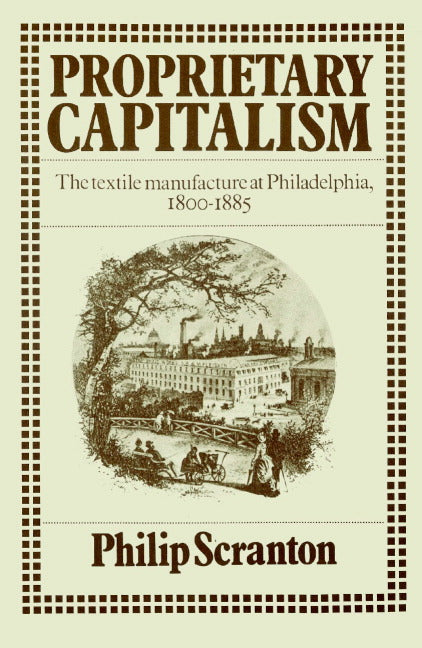
Proprietary Capitalism
The Textile Manufacture at Philadelphia, 1800–1885
A careful reconstruction of the rise of textile capitalism in the Quaker City.
Philip Scranton (Author)
9780521521352, Cambridge University Press
Paperback, published 30 October 2003
448 pages
22.9 x 15.3 x 2.8 cm, 0.705 kg
The greatest textile manufacturing centre in America used to be, not Lowell, Massachusetts, but Philadelphia, where in 1880 over eight hundred textile firms employed over fifty thousand workers producing fabrics, carpets, yarns, and knit-goods of every description. Proprietary Capitalism presents a careful reconstruction of the rise of textile capitalism in the Quaker City, whose distinguishing features were immigrant family firms, flexible strategies for production, and an emphasis on skill, quality, and market responsiveness. The small and middle-sized firms in Philadelphia, far from being displaced by corporate competitors, proved durable, functioning through networks of linked specializations, with spinning, weaving, dyeing, and finishing often performed in separate establishments. Proprietary Capitalism documents the development of a fully realized alternative to the corporate style of mass production that brought fame to New England's mill cities. This book presents a strong challenge for a rethinking of the role of 'small business' in the saga of American industrial development.
List of maps and figures
Preface
Part I. Pathways to Textile Industrialization: 1. Introduction: the matrix of accumulation
2. The textile manufacture in corporate Lowell and rural Rockdale
3. The proprietary alternative at Philadelphia
Part II. 'On Their Own Account': The Proprietary Textile Trades at Philadelphia: 4. The Philadelphia textile manufacture in the early republic
5. Interim decades, 1830–1850
6. Proprietary textiles at midcentury: Kensington
7. Proprietary textiles at midcentury: Germantown and Manayunk
8. The sixties: war and prosperity
9. Flexibility and specialization: Philadelphia as the 'paradise of the skilled workman', 1870–1885
10. Continuity and crisis: the early 1880s
11. Conclusion: separate establishments
Index.
Subject Areas: Modern history to 20th century: c 1700 to c 1900 [HBLL], History of the Americas [HBJK]