Freshly Printed - allow 10 days lead
Couldn't load pickup availability
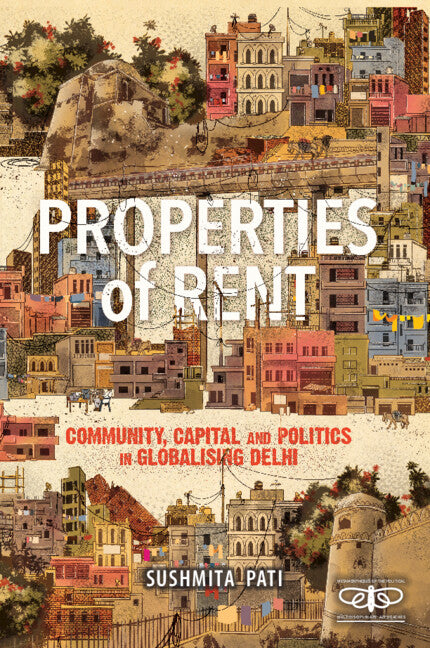
Properties of Rent
Community, Capital and Politics in Globalising Delhi
It is a study of two of Delhi's urban villages and their transition into contemporary urban political economy through rent.
Sushmita Pati (Author)
9781316517277, Cambridge University Press
Hardback, published 25 August 2022
320 pages
23.5 x 15.5 x 2.4 cm, 0.56 kg
'Properties of Rent catalyses new thinking about the entanglements of land, labour and capital in urbanising India, the vital roles urban villages perform in Delhi's urban mosaic, and the neglected social life of rent in shaping cityscapes and caste futures. Desire, loss, alienation, violence and hope all collide in Pati's evocative book. Ethnographically rich and conceptually bold, Properties of Rent makes a range of provocative interventions, in debates spanning geographical political economy, anthropologies of capitalism and urban theory.' Vinay Gidwani, author of Capital, Interrupted: Agrarian Development and the Politics of Work in India
We live in cities whose borders have always been subject to expansion. What does such transformation of rural spaces mean for cities and vice-versa? This book looks at the spatial transformation of villages brought into the Delhi's urban fray in the 1950s. As these villages transform physically; their residents, an agrarian-pastoralist community - the Jats - also transform into dabblers in real estate. A study of two villages - Munirka and Shahpur Jat - both in the heart of bustling urban economies of Delhi, reveal that it is 'rent' that could define this suburbanisation. 'Bhaichara', once a form of land ownership in colonial times, transforms into an affective claim of belonging, and managing urban property in the face of a steady onslaught from the 'city'. Properties of Rent is a study of how vernacular form of capitalism and its various affects shape up in opposition to both state, finance capital and the city in contemporary urban Delhi.
Acknowledgements
List of maps and figures
Abbreviations
Glossary
Units of measurement
Maps
Introduction
1. Creating values of land: Law, records and Kabza
2. From buying land, owning taxis to becoming landlords: The changing economic landscape of villages
3. Villages of the city: Ordering spaces and aspirations in neoliberal times
4. In the shadows of the state: Community as a mode of political and economic organisation
5. Culture, gender and belongingness? City and the violence of rent
6. The fringes of the cartel: How the marginalised become landlords
7. The allure of politics: The candidates, the cadre and the euphoria of elections
Epilogue
Bibliography
Index.
Subject Areas: Urban & municipal planning [RPC], Political economy [KCP], Politics & government [JP], Social & cultural anthropology, ethnography [JHMC], Sociology [JHB], Sociology & anthropology [JH]