Freshly Printed - allow 10 days lead
Couldn't load pickup availability
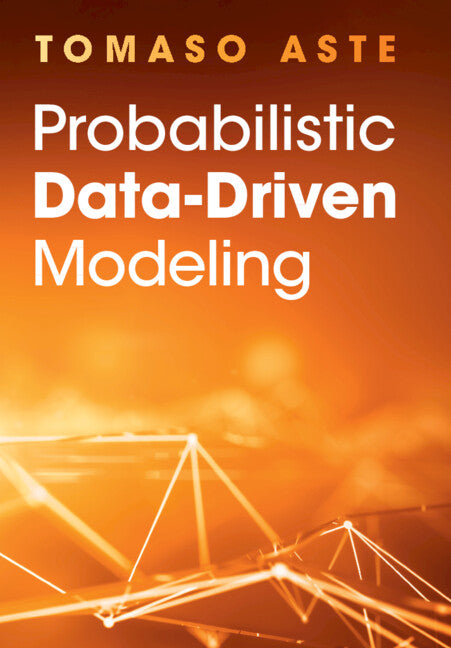
Probabilistic Data-Driven Modeling
A probabilistic data-driven modeling toolbox to help students and researchers characterize, classify and model real complex systems.
Tomaso Aste (Author)
9781009221856, Cambridge University Press
Hardback, published 1 May 2025
452 pages
26 x 18.2 x 3.5 cm, 1 kg
'This is a much-needed book that comprehensively reviews data analysis concepts and methods for complex systems.It starts with probability and statistics and clearly and succinctly connects it to information theory and network analysis. I look forward to having it on my shelf, and I will recommend it to all my students!' J. Doyne Farmer, University of Oxford
This book introduces relevant and established data-driven modeling tools currently in use or in development, which will help readers master the art and science of constructing models from data and dive into different application areas. It presents statistical tools useful to individuate regularities, discover patterns and laws in complex datasets, and demonstrates how to apply them to devise models that help to understand these systems and predict their behaviors. By focusing on the estimation of multivariate probabilities, the book shows that the entire domain, from linear regressions to deep learning neural networks, can be formulated in probabilistic terms. This book provides the right balance between accessibility and mathematical rigor for applied data science or operations research students, graduate students in CSE, and machine learning and uncertainty quantification researchers who use statistics in their field. Background in probability theory and undergraduate mathematics is assumed.
List of symbols
Preface
Part I. Preliminary: 1. Introduction
2. Fundamentals of Probability
3. Fundamentals of machine learning
4. Fundamentals of networks
Part II. Foundations of Probabilistic Modeling: 5. Univariate probabilities
6. Multivariate probabilities
7. Entropies
8. Dependence
9. Stochastic processes and scaling laws
10. Causation
11. Networks as representations of complex systems
12. Probabilistic modeling with network representations
Part III. Model Construction from Data: 13. Nonparametric estimation of univariate probabilities from data
14. Parametric estimation of univariate probabilities from data
15. Estimation of multivariate probabilities from data
16. Time series and probabilistic modeling
17. Construction of network representations from data
18. Assessing the goodness of models
Part IV. Closing: 19. Conclusions
Part V. Appendices: Appendix A. Essentials on probability theory
Appendix B. Finding roots of non-linear equations
Appendix C. Some optimization problems and methods
Appendix D. Principal components analysis
Appendix E. Random forest
Appendix F. Expectation maximization (EM)
Appendix G. Bad modeling
References
Index.
Subject Areas: Numerical analysis [PBKS]